How to Inspect a Bonsai Tree for Pests
A bonsai can look healthy from across the room while pests are already feeding beneath its leaves, hiding in bark crevices, or living around the soil surface. Because bonsai trees have compact canopies and relatively small root systems, catching a problem early can make treatment much easier.
Learning how to inspect a bonsai tree for pests is therefore one of the most useful habits a grower can develop. You do not need expensive equipment or professional training. A few minutes, good light, and a systematic inspection can reveal aphids, scale, spider mites, mealybugs, fungus gnats, and other unwanted visitors before the infestation becomes severe.
This guide explains exactly where to look, what warning signs matter, which simple tools help, and when a suspicious symptom may actually be caused by watering, disease, or general stress instead of pests.
Quick Answer
To inspect a bonsai tree for pests, examine the tops and undersides of leaves, new shoots, branch joints, bark, trunk, and soil surface under bright light. Look for insects, webbing, sticky residue, bumps, cottony material, holes, discoloration, or unusual leaf damage. A hand lens helps reveal very small pests such as spider mites.
Why Regular Pest Inspections Matter for Bonsai
Pest problems are often easiest to manage when populations are still small. Waiting until leaves are dropping or branches are weakening gives the pests more time to reproduce and may make it harder to determine what originally caused the damage.
This matters especially with bonsai because growers care about both tree health and appearance. Even if a pest does not immediately threaten the entire tree, distorted shoots, damaged leaves, and branch dieback can affect years of careful development.
The University of Minnesota Extension guidance on indoor plant insects recommends examining plants closely for common pests and their characteristic damage. Small pests such as spider mites may be easier to detect through symptoms or magnification than by simply looking for obvious insects. (University of Minnesota Extension)
Regular inspection also helps you distinguish pest damage from other bonsai problems such as:
- Too much or too little water
- Root rot
- Poor drainage
- Nutrient deficiencies
- Excessive fertilizer
- Sun scorch
- Cold damage
- Fungal or bacterial disease
- Normal seasonal leaf drop
- Stress after repotting or heavy pruning
Finding damaged leaves does not automatically mean your bonsai has pests. The goal of inspection is to look for evidence before choosing a treatment.
What You Need to Inspect a Bonsai Tree
A basic inspection does not require specialized equipment.
Useful items include:
- Bright natural light or a small flashlight
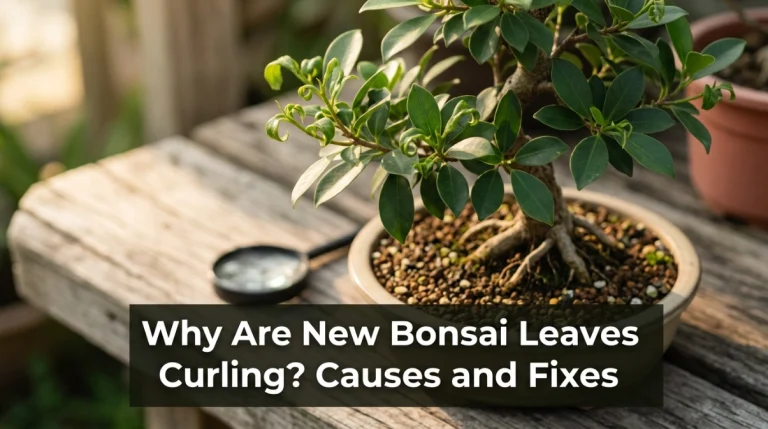
- A 10× hand lens or magnifying glass
- A clean sheet of white paper
- A wooden chopstick or similar blunt tool
- Disposable gloves when handling suspicious material
- Your phone camera for close-up photographs
- Yellow sticky cards when monitoring certain flying pests
A good 10× hand lens is one of the most useful purchases. It is inexpensive, reusable, and durable enough to last for years if kept clean and protected.
For a beginner with only one or two trees, a basic magnifier is usually enough. A grower maintaining a larger collection may benefit from a stronger illuminated hand lens and sticky monitoring traps.
You do not need to buy pesticides before you know what pest you are dealing with.
How to Inspect a Bonsai Tree for Pests Step by Step
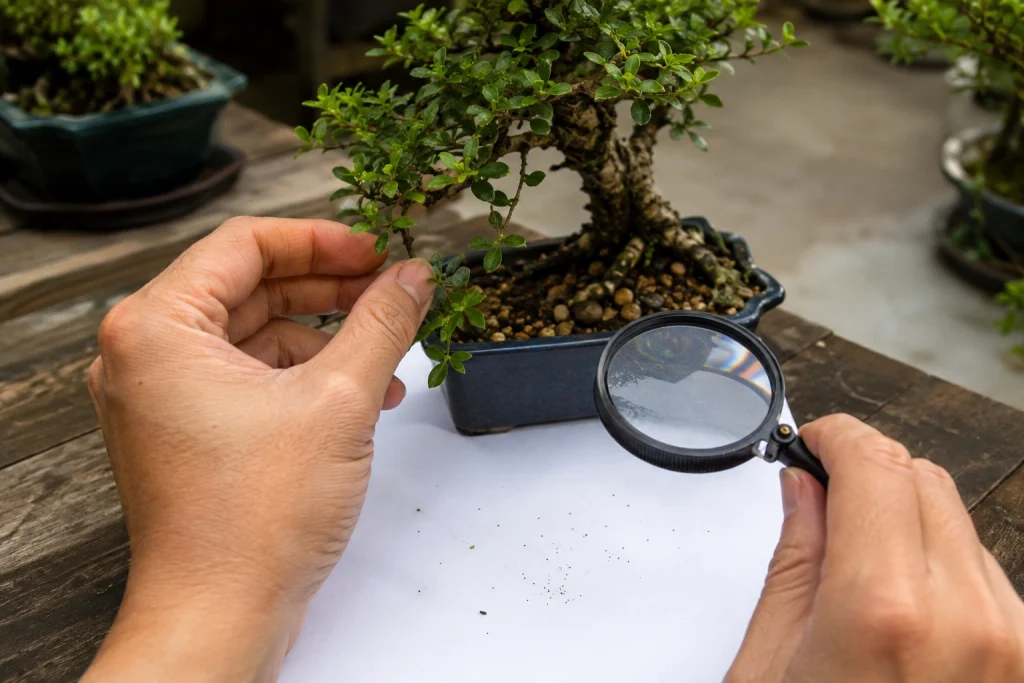
Use the same inspection order every time. A routine makes it less likely that you will overlook hidden areas.
1. Look at the Whole Tree First
Before touching the bonsai, stand back and study its overall appearance.
Ask yourself:
- Is one side of the canopy weaker than the other?
- Are leaves suddenly yellowing?
- Are shoots curling or becoming distorted?
- Is foliage dropping unexpectedly?
- Are certain branches losing vigor?
- Has growth slowed despite otherwise suitable care?
A localized patch of damage can help you decide where to inspect more closely.
Poor vigor throughout the entire tree, however, may point toward a root, watering, soil, temperature, or light problem rather than a localized pest infestation.
2. Check the Tops of the Leaves
Move slowly around the canopy.
Look for:
- Pale dots or speckling
- Yellow areas
- Brown patches
- Holes or chewed edges
- Curled leaves
- Distorted new growth
- Sticky or shiny surfaces
- Black sooty material
Small pale dots across foliage can be associated with sap-feeding pests such as spider mites.
Sticky material may be honeydew, a sugary waste produced by pests including aphids and some scale insects. Sooty mold may subsequently grow on this sticky coating.
3. Turn the Leaves Over
Never inspect only the visible upper leaf surfaces.
Many pests spend much of their time beneath leaves, where they are more protected.
Gently lift several leaves from different areas of the tree. Pay extra attention to leaves near damaged portions of the canopy.
Look for:
- Tiny moving dots
- Eggs
- Fine webbing
- White or cottony material
- Small insects clustered along veins
- Thin, elongated insects
- Cast insect skins
Spider mites are particularly easy to overlook. According to the University of California Statewide Integrated Pest Management Program, mites often occur on leaf undersides, and a hand lens can help reveal them, their eggs, and webbing. (UC IPM)
4. Use the White-Paper Test for Tiny Pests
If leaves show fine speckling but you cannot see an obvious cause, place a clean white sheet of paper beneath a branch.
Tap or gently shake the foliage over the paper.
Then examine the paper carefully.
Tiny moving specks may indicate mites or other very small arthropods. A hand lens makes this test much easier to interpret.
Do not assume every speck is harmful. Soil particles, bark dust, and harmless organisms can also fall from the tree.
5. Examine New Growth Carefully
Tender new shoots are attractive feeding areas for several pests.
Check:
- Shoot tips
- New leaves
- Buds
- Leaf stems
- Branch junctions
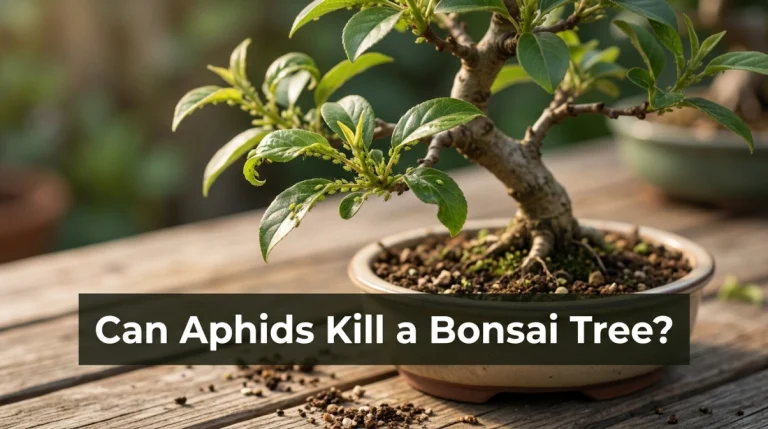
Aphids commonly gather around soft new growth. Heavy feeding may contribute to curled leaves, yellowing, distorted shoots, and reduced growth. (University of Minnesota Extension)
If you see ants repeatedly traveling onto the bonsai, inspect the tree more carefully for honeydew-producing insects. Ant activity alone is not proof of an infestation, but it is worth investigating.
6. Inspect Branch Junctions and Bark
Next, work from the outer branches toward the trunk.
Scale insects and mealybugs can blend surprisingly well with woody surfaces.
Look closely around:
- Branch forks
- Leaf scars
- Pruning scars
- Rough bark
- Cracks and crevices
- The base of branches
- Deadwood features
On some bonsai, jin refers to intentionally exposed dead branch wood, while other carved or naturally dead sections may also provide crevices where debris and insects are difficult to see.
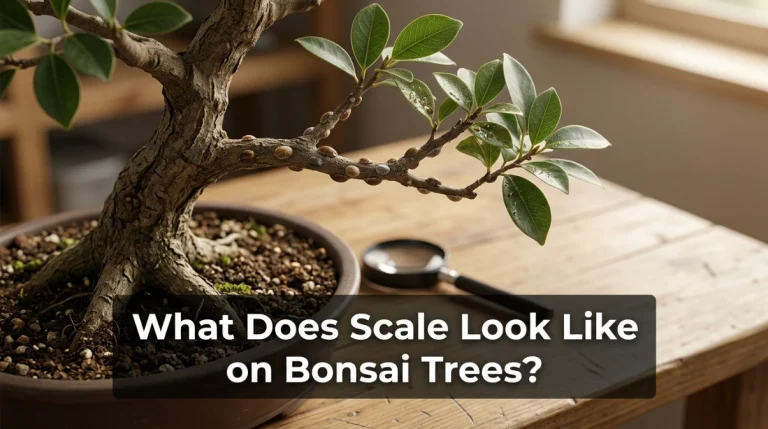
Scale insects may look like small brown, gray, tan, or whitish bumps rather than insects with obvious legs.
Do not scrape every unusual bump immediately. Bark texture, buds, lenticels, and natural scars can be mistaken for pests.
Use magnification first.
7. Check the Trunk and Root Flare
Inspect the trunk from the soil line upward.
The visible roots spreading from the base of a bonsai are commonly called the nebari. Good nebari contributes to the visual impression of stability and maturity, but the area also deserves attention during pest inspections.
Look for:
- Insects hiding against the trunk
- Cottony deposits
- Unusual holes
- Loose or damaged bark
- Sap or sticky material
- Sawdust-like debris
- Sudden localized dieback
Holes combined with fresh sawdust-like material can justify further investigation because some wood-boring insects leave this type of evidence.
Do not insert wire, needles, or other objects into suspected holes. You could damage living tissue without solving the underlying problem.
Inspect the Bonsai Soil and Pot
The tree itself is only part of the inspection.
Look across the soil surface for:
- Small flying insects
- Crawling insects
- Larvae
- Excessively wet soil
- Algae buildup
- Decaying organic material
- Unusual fungal growth
Small dark flies repeatedly moving around wet bonsai soil may be fungus gnats.
A few adult gnats do not necessarily mean the tree is in serious danger. Persistent populations, however, often justify reviewing watering practices and soil moisture.
Do You Need to Remove the Bonsai From Its Pot?
Usually, no.
Do not unpot a healthy bonsai simply because you suspect insects. Unnecessary root disturbance creates stress and can be particularly harmful during the wrong season.
Instead, investigate symptoms first.
Root inspection may become appropriate if the tree also shows serious warning signs such as:
- Persistent decline despite correct watering
- Bad or rotten smells from the soil
- Extremely poor drainage
- Soft or blackened roots visible through drainage holes
- Severe root-pest suspicion
- A soil mass that remains saturated for an unusually long time
Major root work on an already weak tree should be approached carefully.
Bonsai Pest Warning Signs Checklist
| What You Notice | Possible Explanation | Where to Inspect Next |
|---|---|---|
| Fine pale speckles on leaves | Spider mites or other sap feeders | Leaf undersides |
| Fine webbing | Spider mites or spiders | Leaves and branch joints |
| Sticky leaves | Aphids, scale, or other honeydew producers | New shoots and stems |
| Cottony white clusters | Mealybugs or similar pests | Leaf joints and bark crevices |
| Brown or tan bumps | Scale insects or natural bark features | Twigs, stems, trunk |
| Curled new growth | Aphids, pests, environmental stress | Shoot tips |
| Holes in foliage | Chewing insects | Leaves and nearby branches |
| Tiny flies around soil | Fungus gnats or other small flies | Soil surface |
| Yellowing throughout tree | Pests, watering problems, roots, nutrition | Entire tree and root zone |
| Rapid branch decline | Severe pests, disease, root trouble, environmental stress | Branch, trunk, and roots |
Treat this table as a diagnostic starting point rather than a final diagnosis.
The same symptom can have several causes.
How Often Should You Inspect a Bonsai?
A brief inspection once a week is a practical routine for many actively growing bonsai.
You may want to inspect more frequently when:
- Bringing home a new bonsai
- Moving trees indoors for winter
- Moving indoor trees outdoors
- Weather becomes unusually hot and dry
- A nearby plant develops pests
- Your tree begins producing vulnerable new growth
- You have recently treated an infestation
The USDA Animal and Plant Health Inspection Service emphasizes the importance of recognizing plant pests and limiting their spread, particularly because unwanted pests can move with living plants and plant material. Their plant pests and diseases resources can also help growers understand why early identification matters beyond an individual plant collection. (APHIS)
Inspect New Bonsai Before Adding Them to Your Collection
A newly purchased bonsai deserves a particularly careful inspection.
Check it before placing it among established trees.
Examine:
- Leaf tops and undersides.
- New shoots.
- Branch junctions.
- Trunk and bark.
- Soil surface.
- Drainage holes.
- The outside and underside of the pot.
When practical, keep a new plant separated from the rest of your collection while monitoring it for pests.
This is especially useful for indoor bonsai, where pests can move easily between plants placed close together.
Expert Tip: Photograph suspicious leaves or insects through a hand lens before treating the tree. A sharp close-up photo makes identification easier and lets you compare whether the problem is spreading, improving, or remaining unchanged.
What to Do If You Find a Pest
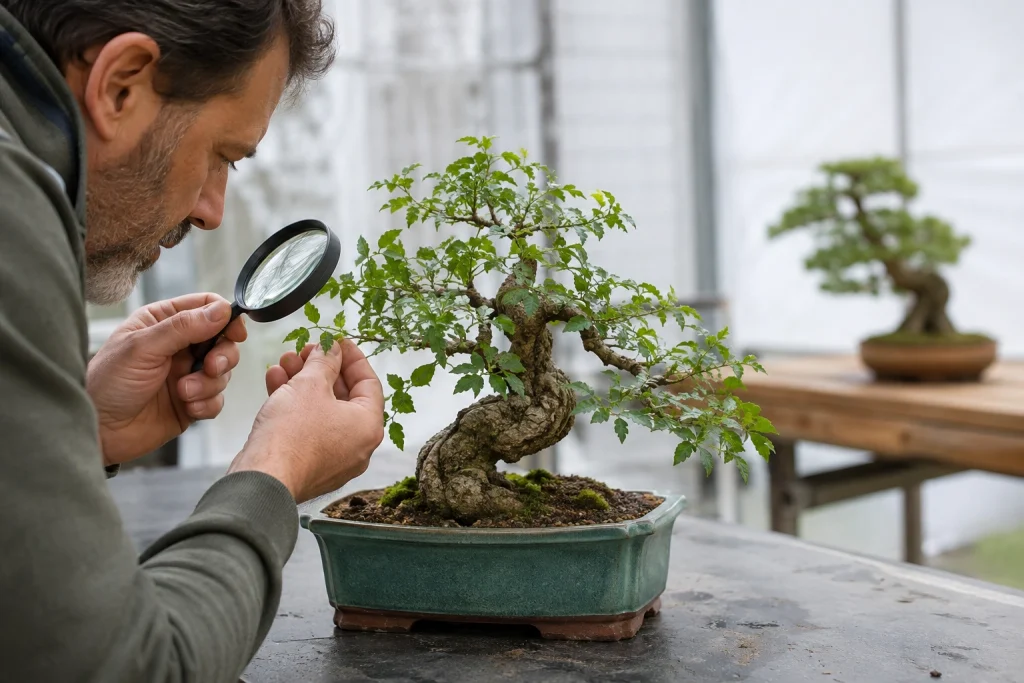
Do not immediately spray the strongest product you can find.
First:
- Separate the affected bonsai from nearby plants when practical.
- Photograph the pest and damage.
- Identify the pest as accurately as possible.
- Assess whether the infestation is minor or widespread.
- Check whether the tree is already stressed.
- Choose the least disruptive effective treatment.
- Reinspect the tree regularly.
Mechanical removal, rinsing, pruning a very small affected area, horticultural soaps, oils, biological controls, or other targeted methods may be appropriate depending on the pest and bonsai species.
Never assume a treatment is safe for every bonsai. Species can differ in their sensitivity to horticultural oils, soaps, pesticides, heat, and treatment timing.
If you use a pesticide in the United States, follow the EPA guidance on pesticide labels. The label contains legally enforceable directions covering where, how, how much, and how often the product can be used. (US EPA)
Keep pesticides away from children and pets, use required protective equipment, and never increase the concentration because you want faster results.
Pest Damage or a Care Problem?
One of the biggest beginner mistakes is blaming pests for every unhealthy leaf.
Suspect pests when you find:
- Living insects or mites
- Eggs
- Webbing
- Honeydew
- Scale-like coverings
- Cottony colonies
- Feeding scars
- Chewed foliage
Suspect a care problem when you find:
- No pest evidence after repeated inspections
- Uniform yellowing throughout the tree
- Constantly saturated soil
- Extremely dry root balls
- Damage starting soon after repotting
- Leaf scorch following sudden sun exposure
- Problems beginning after a large fertilizer dose
More than one issue can occur at the same time. A drought-stressed bonsai, for example, may also become more vulnerable to mite damage; UC IPM notes that water-stressed plants can suffer more severe spider-mite injury. (UC IPM)
Correcting basic care is therefore part of good pest management.
Common Mistakes Bonsai Owners Should Avoid
- Looking only at the top of the leaves. Many pests hide underneath foliage.
- Spraying before identifying the pest. The wrong product may be ineffective or harmful.
- Ignoring nearby plants. An infestation may already have spread.
- Assuming every web means spider mites. Ordinary spiders may also build webs around trees.
- Mistaking bark features for scale insects. Confirm suspicious bumps with magnification.
- Overwatering to control fungus gnats. Persistently wet soil can worsen several root-health problems.
- Repotting immediately after finding a foliage pest. Root disturbance rarely helps with pests living on leaves or stems.
- Using household cleaners on bonsai foliage. Products not intended for plant treatment can burn leaves.
- Applying pesticides in strong heat or direct sun without checking instructions. Some treatments can damage foliage under unsuitable conditions.
- Forgetting to inspect new trees. One infested purchase can introduce pests to an entire collection.
When to Ask an Experienced Bonsai Grower or Arborist
Many minor pest problems can be managed by hobbyists, but professional or experienced help is sensible when diagnosis is uncertain.
Ask an experienced bonsai grower, horticulturist, extension service, or qualified arborist when:
- A valuable or old bonsai is declining rapidly.
- Large branches are dying without an obvious reason.
- You suspect borers inside the trunk or major branches.
- The root system appears badly damaged.
- Pest symptoms resemble a serious plant disease.
- The infestation repeatedly returns despite treatment.
- You cannot confidently identify the pest.
- Treatment would require major pruning or root work.
- A potentially invasive or regulated pest may be present.
For a mature bonsai with years of development invested in it, the cost of professional advice can be small compared with losing important branches—or the entire tree—to an incorrect diagnosis.
FAQs
What is the easiest way to check a bonsai for pests?
Start under the leaves. Use bright light and a 10× hand lens, then examine new shoots, branch joints, bark, trunk, and soil. A white-paper tap test is useful when you suspect very small mites.
What are the most common signs of pests on a bonsai tree?
Common warning signs include sticky leaves, pale speckling, webbing, curled growth, cottony deposits, unusual bumps on stems, holes in leaves, and visible insects. Sudden loss of vigor may also justify a closer inspection.
Can I see spider mites without a magnifying glass?
You may see them as tiny moving dots, but identification is much easier with magnification. Their feeding damage, fine webbing, and activity on leaf undersides may be more noticeable than individual mites.
Should I inspect bonsai soil for pests?
Yes. Look for small flying or crawling insects, larvae, persistent moisture, decaying material, and unusual activity around drainage holes. Soil inspection is especially useful when fungus gnats or root-zone problems are suspected.
Should I repot a bonsai if I find pests?
Not automatically. Most foliage pests do not require repotting. Unnecessary root disturbance can stress the tree. Repot only when the root zone itself has a confirmed problem or when repotting is otherwise appropriate for the tree and season.
How often should I inspect my bonsai for pests?
A quick weekly check during active growth is a useful habit. Inspect more often after buying a new tree, when nearby plants have pests, or when you notice unexplained leaf damage or declining vigor.
Should I spray my bonsai as a precaution even if I cannot find pests?
Usually, preventive spraying without identifying a problem is unnecessary and can sometimes cause plant injury or disrupt beneficial organisms. Monitor first, identify the likely pest, and use a treatment specifically suitable for the pest and tree species.
Conclusion
Knowing how to inspect a bonsai tree for pests is less about memorizing every insect and more about developing a consistent routine. Start with the whole tree, inspect both sides of the leaves, check new growth and branch junctions, study the bark and trunk, and finish at the soil and pot.
A hand lens, good lighting, and a sheet of white paper are often all you need to discover a problem early.
Most importantly, identify before you treat. Yellow leaves, weak growth, or damaged foliage can come from pests, but they can also signal watering, root, soil, disease, or environmental problems.
Make a short pest inspection part of your weekly bonsai-care routine. Catching a few unwanted visitors today is far easier than rescuing a heavily infested tree later.