Best Place for a Bonsai Tree: Indoor and Outdoor Placement Guide


Quick answer: the best place for a bonsai tree depends on the species. Indoor (tropical) bonsai such as ficus, jade and Chinese elm belong in the brightest spot you have, usually close to a south- or west-facing window, away from heaters, air-conditioning and drafts. Outdoor (hardy) bonsai such as juniper, pine and maple belong outside on a sunny bench with 4–6+ hours of sun, sheltered from strong wind, and in a protected but cold spot in winter.
In this guide
Placement affects every part of bonsai care: light drives growth, temperature decides whether the tree rests or grows, and position changes how often you need to water. Use this guide to find the right spot indoors, outdoors and through the seasons.
Step 1: know if your bonsai is indoor or outdoor
| Indoor bonsai (tropical / subtropical) | Outdoor bonsai (hardy) |
|---|---|
| Ficus, jade, dwarf jade, Fukien tea, Schefflera, money tree, Chinese elm (bright light) | Juniper, pine, maple, trident maple, boxwood, azalea, elm, cotoneaster |
| Need warmth all year (above about 10–15°C / 50–60°F) | Need a cold winter rest to stay healthy |
| Can go outside in summer | Should not live indoors except for short displays |
If you are not sure which you have, see our lists of the best indoor bonsai trees and types of outdoor bonsai trees. Junipers in particular are often sold as house plants but cannot survive indoors long term: see can a juniper bonsai live indoors?
Best place for a bonsai tree indoors
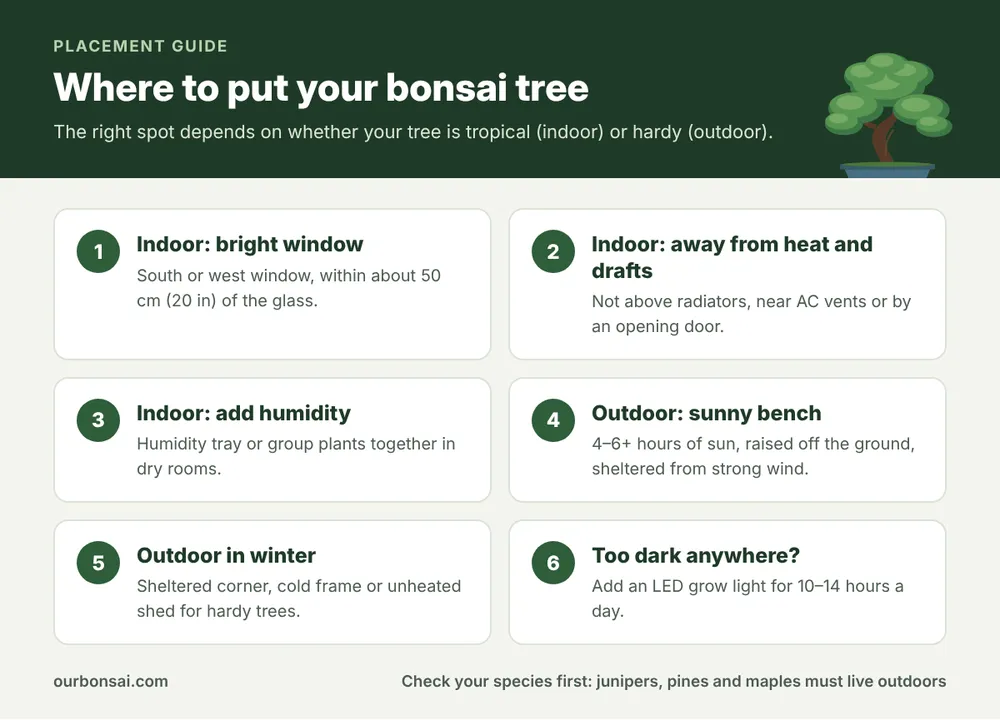
- Next to a bright window. A south-facing window (in the Northern Hemisphere) is best, then west and east. Keep the tree within about 50 cm (20 in) of the glass, because light drops quickly with distance.
- Away from heat and drafts. Avoid spots above radiators, next to heaters or air-conditioning vents, and near outside doors that open in winter.
- Stable temperature. Most tropical bonsai like 15–25°C (60–77°F) with no sudden swings.
- Some humidity. Heated rooms are dry. A humidity tray under the pot or grouping plants together helps.
- Room to rotate. Turn the tree a quarter turn every week or two so it grows evenly.
If no window is bright enough, add an LED grow light for 10–14 hours a day. See how much light a bonsai tree needs and how to take care of a bonsai indoors.

Which room is best?
The best room is simply the one with the brightest window and a steady temperature, often the living room or a sunroom. Bathrooms are humid but usually too dark. Kitchens can work if the tree is away from the stove and oven. Bedrooms are fine if they have a bright window and are not kept very cold or very warm.
Best place for a bonsai tree outdoors
- Sun: most outdoor bonsai need at least 4–6 hours of direct sun. Junipers and pines want more; maples and azaleas prefer morning sun and afternoon shade in hot climates.
- Off the ground: place trees on a bench, shelf or stand at about waist to eye height. This keeps slugs and soil splash away and makes watering easier.
- Shelter from wind: a fence, wall or hedge stops pots drying out and blowing over.
- Close to water: in summer, small pots may need water daily, so keep a hose or tap nearby.
- Space between trees: good airflow reduces fungal problems.
For layout ideas, see our outdoor bonsai display ideas.

Best place for a bonsai in winter
Outdoor bonsai in winter
Hardy trees still need cold to rest, so do not bring them into a warm house. Instead, protect the roots, which are more exposed in a pot than in the ground:
- Move pots to a sheltered spot against a house wall, out of wind.
- Below about -5 to -10°C (23 to 14°F), use a cold frame, unheated greenhouse, shed or garage with some light.
- Mulch around pots or bury them in the ground or in wood chips.
- Keep watering lightly whenever the soil dries.
Indoor bonsai in winter
Winter days are short and heating dries the air, so move tropical trees to the brightest window, add a grow light if needed, keep them away from radiators, and water less often. See watering indoor bonsai in winter.

Where to put a bonsai tree for feng shui
In feng shui, bonsai trees are linked with growth, balance and harmony. Common suggestions are the living room, near the main entrance, the east area of the home (associated with family and health) or the southeast (associated with wealth). Some traditions avoid placing bonsai in the bedroom. If you follow feng shui, choose a spot that also has good light; a healthy tree matters more than its exact position.

Bonsai on a desk or in an office
A desk is only a good place if it is right next to a bright window or under a grow light. Offices often have low light and air-conditioning, so choose a tough tropical species such as ficus or jade, and take it home or into the light at weekends if needed.

Safety from pets and children
Some bonsai species, such as jade and ficus, can be harmful if pets chew them. Keep trees on a high shelf or windowsill out of reach. See are bonsai trees poisonous to cats and dogs?
Frequently asked questions
Where should I place my bonsai tree at home?
Tropical bonsai: by the brightest window, away from heaters and drafts. Hardy bonsai: outside on a sunny bench, not inside the house.
Can I keep my bonsai in a room without windows?
Only with a strong LED grow light on a timer for 12–14 hours a day. Without it, the tree will slowly decline.
Is direct sunlight good for bonsai?
Yes, for most species. Indoor trees benefit from direct sun through a window. Outdoors, give shade-sensitive trees like maples some afternoon protection in hot summers.
Should I move my bonsai around?
Avoid moving it often. Bonsai, especially ficus, can drop leaves after a sudden change in light. Choose a good spot and keep it there, apart from seasonal moves.
Conclusion
The best place for a bonsai is wherever its species gets the right light and temperature: a bright, steady windowsill for tropical trees, and a sunny, sheltered outdoor bench for hardy trees, with root protection in winter. Get the position right and watering, feeding and styling all become easier.