
How to Prevent Whiteflies on Bonsai

Quick Answer
To prevent whiteflies on bonsai, inspect leaf undersides regularly, quarantine new plants, keep the tree healthy, and catch adults before they reproduce. UC IPM whitefly guidance also recommends monitoring, protecting natural enemies, and using lower-impact controls when treatment becomes necessary.
Best Whitefly Prevention Habits
- Inspect weekly: Check new growth and leaf undersides for adults, eggs, and flat nymphs.
- Quarantine arrivals: Keep new bonsai and houseplants separated before placing them near your collection.
- Use sticky traps: Yellow traps help reveal flying adults early but should not be your only control.
- Reduce plant stress: Give each species suitable light, watering, drainage, and airflow.
- Avoid unnecessary sprays: Broad-spectrum pesticides can also kill insects that naturally suppress whiteflies.
- Act immediately: Isolate any bonsai that releases tiny white insects when its foliage is disturbed.
Fast Confirmation Tip
- Gently tap or move a branch. A cloud of tiny white insects rising from the leaves strongly suggests adult whiteflies.
Learning how to prevent whiteflies on bonsai is much easier than fighting a large infestation. These tiny sap-feeding insects hide beneath leaves, reproduce quickly in favorable conditions, and can move between nearby plants.
I treat whitefly prevention as a routine part of bonsai care rather than an emergency treatment. A few minutes of inspection often tells me more than reaching for a spray bottle too soon.
In This Guide
- What Are Whiteflies on Bonsai?
- How Do You Prevent Whiteflies on Bonsai?
- How Often Should You Inspect a Bonsai for Whiteflies?
- Should You Spray Neem Oil to Prevent Whiteflies?
- What Should You Do at the First Sign of Whiteflies?
- Is Whitefly Prevention Different Indoors and Outdoors?
- Frequently Asked Questions
What Are Whiteflies on Bonsai?
Whiteflies are tiny sap-feeding insects in the family Aleyrodidae. Adults usually look like miniature white moths, while immature stages stay flattened against leaf undersides.
Whitefly definition: A whitefly is a small piercing-sucking insect related to aphids, scale insects, and mealybugs rather than a true fly.
Many adults measure around 1/16 inch, or roughly 1–2 mm. Their pale wings often make them easiest to notice when they fly after a branch is disturbed.
What signs appear first?
Do not wait for a bonsai to look weak. Early whitefly infestations can remain almost invisible from above.
- Tiny white adults: They flutter from the foliage when disturbed.
- Flat nymphs: Look for small oval, scale-like forms beneath leaves.
- Sticky honeydew: Sap-feeding whiteflies release sugary waste onto leaves and nearby surfaces.
- Sooty mold: Black fungal growth may develop on accumulated honeydew.
- Yellow foliage: Heavy feeding can weaken leaves and reduce plant vigor.
- Premature leaf drop: Severe infestations may cause stressed foliage to fall.
Whiteflies can be confused with mealybugs, scale, or pale aphids. The easiest clue is usually the sudden flight of small white adults.
Why can bonsai develop problems quickly?
A bonsai is a normal tree growing within a restricted root volume. Small containers leave less margin for watering, heat, drainage, and nutrient mistakes.
That does not mean bonsai automatically attract whiteflies. It means pest feeding may become more noticeable when the tree is already stressed.
The basic care principles described by Bonsai Empire’s bonsai care guide are useful here. Placement, watering, soil, and species-specific care all influence overall vigor.
How Do You Prevent Whiteflies on Bonsai?
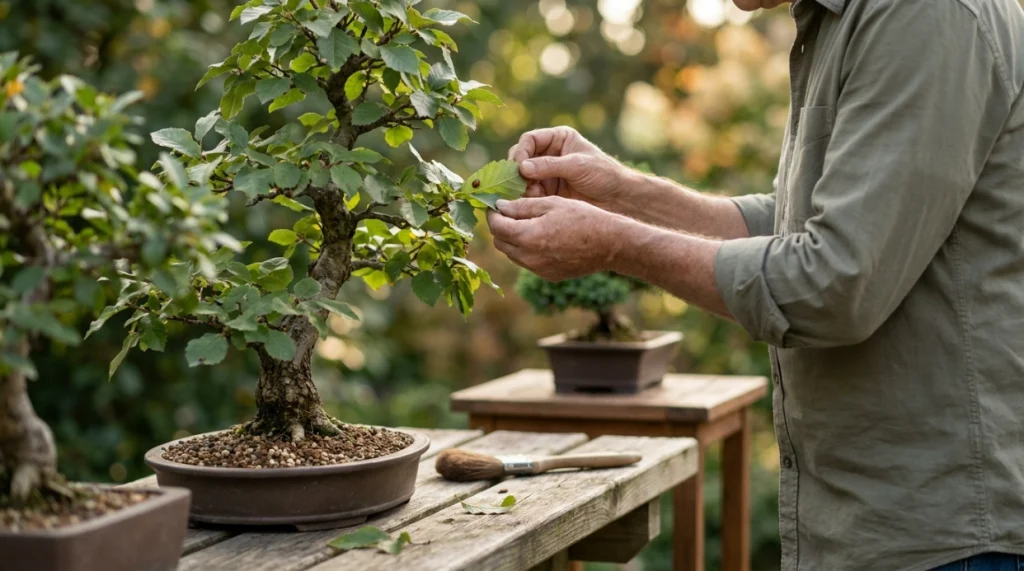
The best prevention strategy combines inspection, quarantine, good growing conditions, and early monitoring. No single product creates reliable long-term protection.
1. Quarantine every new bonsai or companion plant
New plants are one of the easiest ways to introduce whiteflies into a collection. Inspect them before they sit beside established bonsai.
I pay special attention to recently purchased tropical trees because dense foliage can conceal insects. Ficus, hibiscus, and other warm-growing ornamentals deserve a careful underside check.
- Keep new plants physically separated from healthy trees.
- Inspect the youngest leaves and shoot tips.
- Check older leaf undersides for immobile nymphs.
- Disturb the canopy gently and watch for flying adults.
- Inspect nearby houseplants as well.
2. Keep the bonsai healthy without forcing soft growth
A healthy tree handles stress better, but excessive fertilizer is not a pest-control strategy. Feed according to the species, season, and actual growth rate.
Water according to soil condition rather than a rigid calendar. Bonsai in free-draining substrates can dry quickly, while constantly saturated roots create a different type of stress.
3. Maintain useful airflow and clean growing areas
Space trees so foliage is not packed tightly together. Better access makes inspection easier and reduces direct plant-to-plant movement.
- Remove fallen leaves from benches and shelves.
- Clean empty pots before reusing them.
- Check weeds growing near outdoor bonsai.
- Avoid allowing infested plants to touch healthy plants.
- Inspect tools and working surfaces after handling pest-infested material.
4. Protect beneficial insects outdoors
Lady beetles, lacewings, predatory insects, and tiny parasitoid wasps can attack whiteflies. Outdoor biological control is easiest to preserve when unnecessary broad-spectrum pesticides are avoided.
The American Bonsai Society also provides educational resources and access to bonsai clubs. A local club can be valuable when you need species-specific advice for your climate.
Section Takeaway: Prevent whiteflies by controlling how pests enter your collection and by making routine inspection easy. Healthy, properly placed bonsai give you more time to catch problems early.
How Often Should You Inspect a Bonsai for Whiteflies?
Inspect susceptible bonsai at least weekly during active growth and warm conditions. Check more frequently when whiteflies have appeared nearby.
A 10× hand lens makes eggs and small nymphs easier to see. Good daylight or a bright work lamp also helps.
Use the same inspection route every time
- Start with new growth: Look around tender leaves and shoot tips.
- Turn leaves over: Whiteflies spend much of their life beneath foliage.
- Check older leaves: Immobile nymphs may remain attached there.
- Tap one branch: Watch for small white adults taking flight.
- Look for honeydew: Shiny or sticky surfaces are an important clue.
- Inspect nearby plants: Adults can move beyond the original bonsai.
Where do yellow sticky traps fit?
Yellow sticky cards are monitoring tools that also catch some adults. Place them near susceptible plants without allowing leaves to become stuck to the adhesive.
Traps cannot remove eggs or nymphs attached beneath foliage. I use them as an early-warning system rather than as proof that an infestation is solved.
Colorado State University Extension identifies early detection and yellow sticky traps as useful parts of whitefly management. Prevention works best while populations remain low.
Should You Spray Neem Oil to Prevent Whiteflies?
Routine spraying of a healthy bonsai is usually unnecessary. Neem oil, horticultural oil, and insecticidal soap make more sense when a pest is present and the product label permits use on that plant.
These products depend heavily on direct coverage. Whitefly nymphs hiding beneath leaves can escape a careless surface spray.
| Method | Best Use | Main Limitation |
|---|---|---|
| Leaf inspection | Early detection | Requires consistent checking |
| Yellow sticky trap | Monitoring flying adults | Does not control eggs or attached nymphs |
| Water rinse | Small early populations | Must reach leaf undersides |
| Insecticidal soap | Direct contact with susceptible stages | Coverage and label directions are critical |
| Neem or horticultural oil | Targeted treatment when labeled | May require repeat applications |
Never assume a natural product is automatically harmless. Oils and soaps can damage sensitive foliage if mixed incorrectly or applied under unsuitable conditions.
- Read the entire product label.
- Confirm that the plant type is suitable for treatment.
- Test a small area before treating valuable foliage.
- Avoid spraying drought-stressed or heat-stressed trees.
- Cover the leaf undersides when treatment is required.
- Repeat only as the label allows.
As of 2026, integrated pest management remains the more sensible approach. Start with prevention and monitoring, then escalate only when the population justifies treatment.
What Should You Do at the First Sign of Whiteflies?
Isolate the bonsai immediately and confirm that the insects are whiteflies. Early containment protects both the affected tree and the rest of your collection.
- Move the bonsai: Separate it from other bonsai and houseplants.
- Confirm the pest: Check adults, nymphs, honeydew, and leaf undersides.
- Inspect neighboring plants: Adults may already have moved.
- Rinse manageable populations: Use a gentle stream where appropriate for the species and soil setup.
- Add a sticky trap: Monitor adult activity during treatment.
- Use a labeled treatment if needed: Insecticidal soap or horticultural oil may be suitable options.
- Recheck repeatedly: Eggs and hidden nymphs can survive a single treatment.
The University of Maryland Extension’s whitefly guidance for indoor plants notes the importance of checking leaf undersides and using carefully labeled treatments when needed.
Do not return the bonsai to the collection just because flying adults disappear for a day. Continue checking new and older leaves for immature stages.
What if whiteflies keep returning?
Repeated infestations usually mean one part of the cycle remains untouched. Hidden nymphs, nearby host plants, or incoming infested plants can restart the problem.
- Inspect every nearby plant.
- Replace heavily contaminated sticky traps.
- Look beneath older foliage.
- Check greenhouse, windowsill, or bench weeds.
- Review whether treatments actually covered leaf undersides.
- Protect natural enemies where possible.
Section Takeaway: The first few whiteflies are a warning, not a reason to panic. Isolation, identification, and repeated monitoring usually matter more than using the strongest pesticide available.
Is Whitefly Prevention Different Indoors and Outdoors?
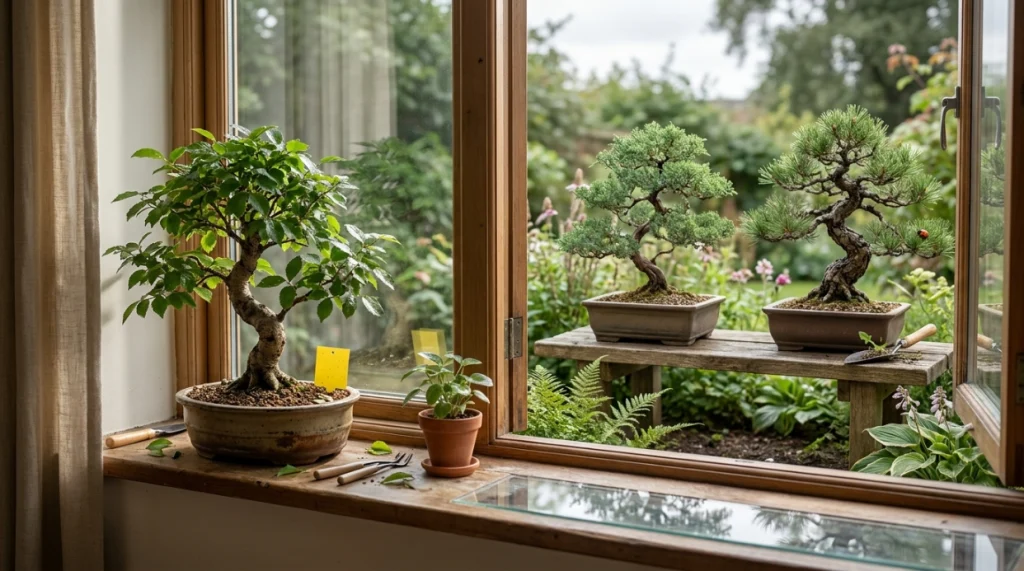
Yes. Indoor bonsai rely more heavily on quarantine and manual monitoring, while outdoor trees may receive meaningful help from predators and parasitoids.
Indoor bonsai
- Inspect houseplants near the bonsai.
- Use yellow sticky cards as early-warning tools.
- Check warm windows and grow-light areas carefully.
- Avoid crowding foliage against walls or neighboring plants.
- Quarantine every new tropical plant before mixing collections.
Indoor conditions can allow whiteflies to persist when cold outdoor weather would normally interrupt their development. Warm protected spaces deserve year-round attention.
Outdoor bonsai
- Preserve beneficial insects whenever practical.
- Control weeds that may serve as alternate hosts.
- Inspect trees brought outside after winter.
- Watch nearby ornamentals and vegetable plants for infestations.
- Avoid unnecessary broad-spectrum pesticide applications.
I adjust my inspection routine with the season rather than relying on one fixed schedule. Warm weather, tender new growth, and new plant purchases all make me look more closely.
This matters most with dense broadleaf bonsai because the lower leaf surfaces disappear from view quickly. Turning the pot and lifting foliage gives a much better picture.
Frequently Asked Questions
Can whiteflies kill a bonsai tree?
A small infestation usually does not kill a healthy bonsai immediately. Heavy or prolonged feeding can weaken growth, yellow foliage, cause leaf drop, and add stress to an already vulnerable tree.
What attracts whiteflies to bonsai?
Whiteflies are attracted to suitable host plants rather than bonsai styling itself. Infested nearby plants, warm protected conditions, tender foliage, and movement of contaminated nursery material can all contribute to an infestation.
Do yellow sticky traps prevent whiteflies completely?
No. Sticky traps catch flying adults and help reveal population changes, but eggs and nymphs remain attached to leaves. Combine traps with regular inspection and plant isolation.
Can I use neem oil on every bonsai species?
No. Plant sensitivity varies, and formulations differ. Check the product label, confirm compatibility with your species, avoid treating stressed foliage, and test a small area before wider application.
Where should I look for whitefly eggs?
Start on the undersides of younger leaves. Eggs are tiny and may require magnification, while older leaves can hold flattened nymphs that resemble small scales.
Will spraying water remove whiteflies?
A gentle rinse can physically remove some adults, eggs, and young stages from suitable plants. It is unlikely to eliminate an established infestation by itself, so continue monitoring afterward.
How can I stop whiteflies spreading to other bonsai?
Isolate the affected tree immediately, inspect nearby plants, clean the growing area, and prevent foliage from touching. Continue checking the quarantined bonsai until repeated inspections show no active infestation.
The simplest whitefly strategy is prevention first. Inspect your bonsai regularly, quarantine new plants, protect beneficial insects, and respond while populations are still small.
Make leaf-underside inspection part of your normal watering routine. That small habit can catch whiteflies long before sticky leaves, yellow foliage, or a cloud of adults becomes obvious.