Bonsai Watering Schedule: A Simple Season-by-Season Plan

The best bonsai watering schedule is not “water every Monday and Thursday”. It is a schedule for checking your trees, usually once a day in the morning, and watering only the ones that are drying out. In practice that means most outdoor bonsai get water daily in summer, every two to three days in spring and autumn, and every week or so in winter. Indoor trees typically need water every two to four days. Pot size, soil, species and weather shift those numbers, and this guide shows you how to build a routine that adjusts to them.
In this guide
- Why fixed watering days fail
- The daily routine
- Bonsai watering schedule by season
- Adjusting for pot size and soil
- Adjusting for species
- A sample week in summer
- Weekly and monthly tasks
- When you cannot stick to the schedule
- Tools that make a schedule easier
- Common bonsai watering schedule mistakes
- FAQ: bonsai watering schedule
- Final thoughts
Why fixed watering days fail
A bonsai has only a small amount of soil, so its water reserve is tiny. On a hot, windy day that reserve can run out in hours. On a cool, rainy week the same pot can stay wet for days. Plants lose most of their water through their leaves, a process called transpiration, and transpiration rises sharply with heat, sun, wind and dry air.
So a calendar that ignores the weather will either drown your tree in cool weeks or let it dry out in hot ones. The fix is to put your checking on a schedule and let the soil decide when to water.
The daily routine
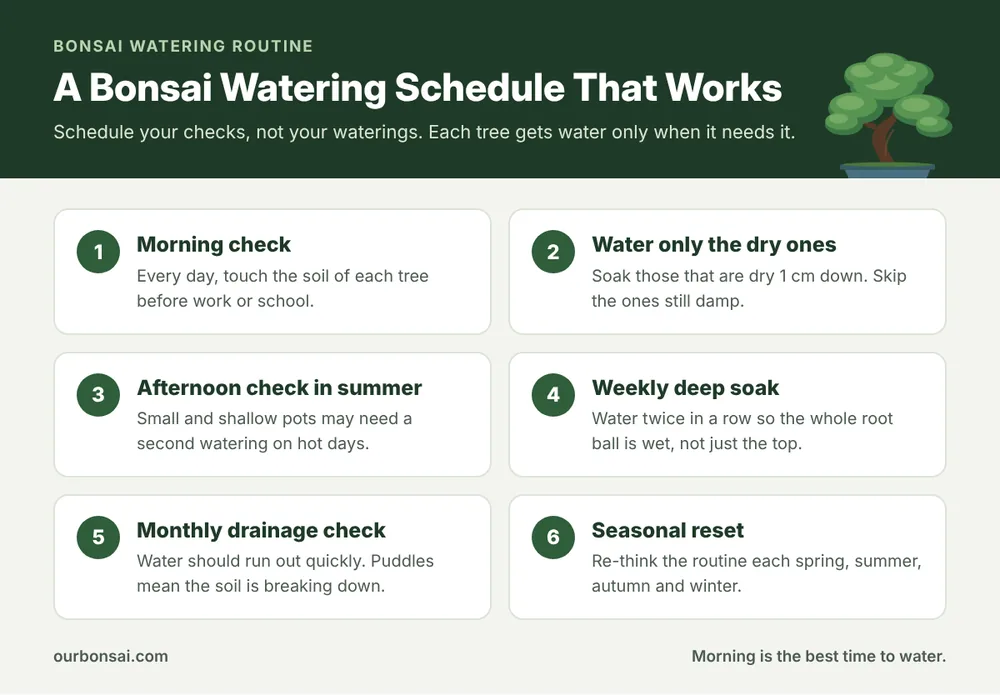
- Morning check. Walk past every tree. Push a finger about 1 cm into the soil, or look at the color of the surface. Dry soil looks lighter.
- Water the dry ones thoroughly. Water until it runs from the drainage holes, wait a minute, then water again.
- Skip the damp ones. Damp soil does not need water, even if you watered yesterday.
- Afternoon check in hot weather. Small pots, shallow pots and trees in full sun may need a second round.
Morning watering is best. The tree has water for the hottest part of the day, and leaves dry before evening, which reduces fungal problems.
Bonsai watering schedule by season
| Season | Outdoor bonsai | Indoor bonsai | Notes |
|---|---|---|---|
| Spring | Every 1 to 3 days | Every 3 to 5 days | Water use climbs fast as leaves open |
| Summer | Daily, sometimes twice | Every 2 to 3 days | Check again in late afternoon on hot days |
| Autumn | Every 2 to 4 days | Every 3 to 5 days | Growth slows, rain does more of the work |
| Winter | Every 5 to 10 days | Every 4 to 7 days | Do not water frozen soil, but never let it dry out |
Remember, these are typical frequencies to expect, not instructions to water without checking. For summer specifics, see our guide on watering bonsai in summer. For the cold months indoors, see watering indoor bonsai in winter.
Adjusting for pot size and soil
| Pot | Dries out | Typical summer schedule |
|---|---|---|
| Mame / shohin (under 15 cm) | Very fast | Twice a day possible |
| Shallow display pot | Fast | Daily |
| Medium pot (15 to 30 cm) | Moderate | Daily or every other day |
| Deep training pot or grow box | Slow | Every 2 to 3 days |
Soil matters just as much. Gritty bonsai soil of akadama, pumice and lava drains fast and needs more frequent watering, but it is very hard to overwater. Dense potting compost holds water much longer and is the main reason for root rot. Our guide to bonsai soil vs regular soil explains why, and the bonsai soil mix ratio guide shows how to blend your own.
Adjusting for species
Some trees like it wetter, others drier. Group your trees on the bench by thirst, so your checks are faster.
- Thirsty: azalea, bald cypress, willow, hornbeam, maple in summer. Keep evenly moist.
- Average: elm, ficus, boxwood, pomegranate, schefflera. Water when the top starts to dry.
- On the dry side: juniper, pine, olive, jade and other succulents. Let the top dry a bit more before watering.
If you are not sure what your tree is, our bonsai species overview can help you identify it.
A sample week in summer
Here is what a real bonsai watering schedule looks like for a small collection of five outdoor trees in July: a juniper, a Chinese elm, a Japanese maple, an azalea and a small shohin pine.
| Day | Weather | What got watered |
|---|---|---|
| Monday | Hot and sunny | All five in the morning, azalea and shohin pine again at 5 pm |
| Tuesday | Hot, windy | All five in the morning, maple and azalea again in the afternoon |
| Wednesday | Cloudy, mild | Elm, maple and azalea. Juniper and pine still damp |
| Thursday | Rain overnight | Nothing in the morning. Checked the azalea at noon, still wet |
| Friday | Warm, sunny | All five |
| Saturday | Hot | All five, plus a deep soak with fertilizer added |
| Sunday | Warm, breezy | Maple, azalea and shohin pine |
Notice that no two days are the same. That is what a schedule based on checking looks like in real life. The trees that like it drier, such as the juniper and the pine, were skipped whenever their soil was still damp.
Weekly and monthly tasks
- Weekly deep soak. Once a week in the growing season, water in three passes or stand the pot in a basin for 10 minutes. This wets any dry pockets in the root ball.
- Monthly drainage check. After watering, water should disappear from the surface in seconds. Slow drainage means the soil is breaking down and the tree needs repotting soon.
- Fertilizer day. Many growers add liquid fertilizer to the watering can once every one to two weeks in the growing season.
When you cannot stick to the schedule
Work trips and holidays happen. For a few days, group trees in the shade, water deeply before you leave and add a humidity tray. For longer trips, a simple drip system or a neighbor who has had a quick lesson is the safest choice. Our guide to the best automatic watering system for bonsai compares options.
Tools that make a schedule easier
- A watering can with a fine rose, such as a Japanese bonsai watering can, so soil is not washed out.
- A wooden chopstick pushed into the soil as a quick moisture indicator.
- A simple soil moisture meter for indoor trees.
Common bonsai watering schedule mistakes
- Watering everything at once. Different pots dry at different speeds. Water each tree on its own needs.
- Light sprinkles. A quick splash wets the top and leaves the roots dry. Always water until it drains.
- Trusting rain. A dense canopy can shed rain away from the pot. Check after rain too.
- Ignoring winter. Dormant trees still need some water.
FAQ: bonsai watering schedule
How often should I water my bonsai?
Check daily. Outdoors, most trees need water daily in summer and every few days in spring and autumn. Indoors, every two to four days is typical.
What time of day is best for watering bonsai?
Morning. In very hot weather, a second check in the late afternoon is a good idea.
Can I water my bonsai on a timer?
Automatic systems work, but set them conservatively and still check the trees regularly, especially after rain or in cool weather.
Is it better to underwater or overwater a bonsai?
Neither, but slight dryness between waterings is safer than constantly wet soil for most species.
Final thoughts
A reliable bonsai watering schedule is really a daily habit of checking. Look at every tree each morning, water the dry ones thoroughly, add an afternoon check in summer and ease off in winter. Adjust for pot size, soil and species, and your trees will get exactly the water they need, no more and no less.