Juniper Bonsai Yellow Needles: Causes and How to Fix Them

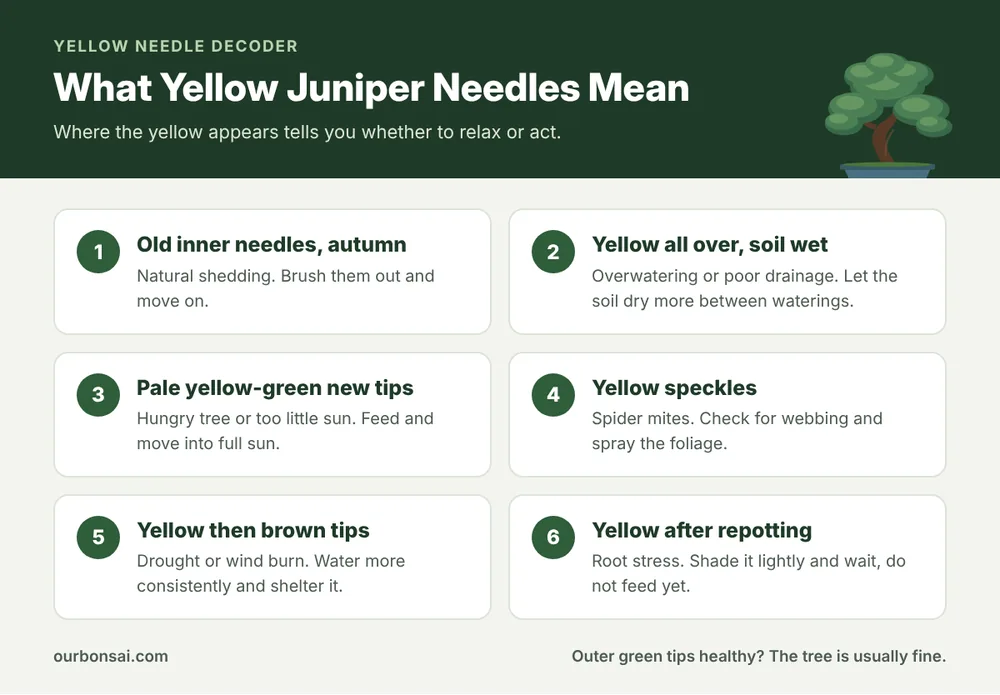
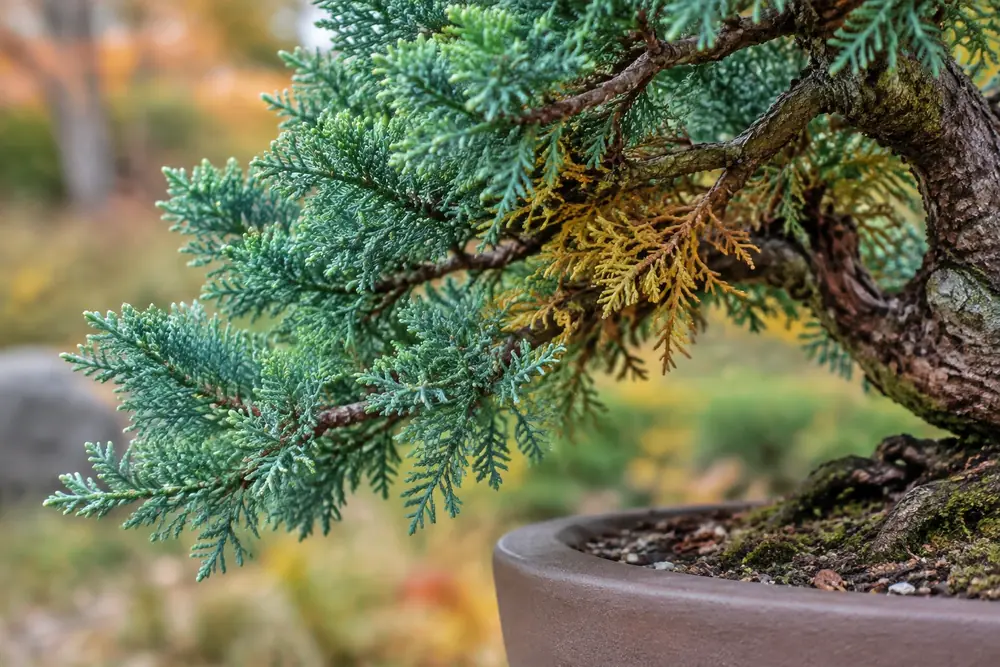
Finding juniper bonsai yellow needles can be alarming, but it does not always mean trouble. Every autumn junipers shed some of their oldest foliage, deep inside the canopy, and those needles turn yellow and then brown before they fall. That is completely normal. Yellowing becomes a concern when it shows up on the outer, growing tips, spreads over the whole tree, or comes with soggy soil, webbing or a dull gray look. The usual culprits then are overwatering, too little light, a hungry tree or spider mites.
In this guide
This guide helps you read the pattern of the yellowing and fix the cause.
Normal yellowing: seasonal needle shedding
Junipers are evergreen, but no needle lives forever. Each year, typically from late summer into autumn, the oldest foliage closest to the trunk turns yellow and drops. Shade from the outer pads also causes inner growth to weaken and yellow over time.
Signs that the yellowing is normal:
- It is mostly on the inside of the tree, close to the trunk and main branches.
- The outer tips are bright, healthy green or blue-green.
- It happens in late summer or autumn.
- The yellow needles come off easily when you brush the foliage.
Clean them out with your fingers or tweezers. Better airflow inside the canopy also helps prevent pests. Our guide to Japanese juniper bonsai turning brown shows what normal shedding looks like.
Juniper bonsai yellow needles: problem causes
| Pattern | Most likely cause | Fix |
|---|---|---|
| Yellow all over the tree, soil stays wet | Overwatering, poor drainage | Gritty soil, water only when the top dries |
| Pale, yellow-green new growth | Lack of nutrients or sun | Feed regularly, move to full sun |
| Yellow speckling, fine webbing | Spider mites | Spray foliage, treat mites |
| Yellow then brown tips on one side | Wind burn or drought | Shelter, water consistently |
| Yellow after repotting | Root disturbance | Light shade, patience |
| Yellow with brown dieback on twig tips | Fungal blight | Remove affected tips, improve airflow |
1. Overwatering
Junipers like their soil to dry slightly between waterings. In dense soil that stays wet, roots lose oxygen and stop taking up nutrients, and the whole tree turns a sickly yellow. A sour smell from the soil points to root rot in bonsai. Repot into a free-draining mix, such as our juniper bonsai soil recipe.
2. Not enough sun
Junipers need full sun, ideally at least six hours a day. In shade, or indoors, new growth turns pale and weak and the interior yellows quickly. Junipers kept indoors almost always decline. See our Japanese juniper bonsai indoors guide for why.
3. Lack of nutrients
Bonsai soil contains almost no food, so a juniper that has not been fed for a season turns yellow-green. Nitrogen shortage gives an overall pale color. A lack of iron or magnesium can cause yellowing on new growth while older foliage stays darker. This kind of yellowing is called chlorosis. Feed from spring to autumn with a balanced fertilizer, see our best fertilizer for juniper bonsai list.
4. Spider mites
These tiny pests suck the sap from juniper foliage and leave it speckled, yellowish and then bronze. Hold a white paper under a branch and tap it. If tiny dots start moving, you have mites. Our guide to spider mites on bonsai trees covers treatment.
5. Drought and wind
A juniper that dries out completely, or sits in a windy, exposed spot in winter, gets yellow and then brown tips, often on one side. Water consistently and give it shelter from drying winds.
6. Repotting stress
Some yellowing in the weeks after repotting is common, especially if a lot of roots were removed. Keep the tree out of strong wind and afternoon sun for two to three weeks, water carefully and do not fertilize for about a month.
How to fix yellow needles step by step
- Check where the yellow is. Inner and autumn? Clean it out and relax. Outer tips? Keep going.
- Check the soil moisture. Wet for days means water less. Dusty dry means water more consistently.
- Check the light. Move the tree to a spot with full sun outdoors.
- Check for pests. Do the white paper test for mites and look for scale.
- Feed if it has not been fed. Start a regular feeding routine in the growing season.
- Give it time. Yellow needles will not turn green again. Judge success by the color of new growth over the next few weeks.
Yellow needles on different juniper types
Not all junipers show stress the same way, so it helps to know what is normal for yours.
- Procumbens ‘Nana’ (Japanese garden juniper). The most common beginner juniper. It sheds a lot of inner needle foliage in autumn, which can look dramatic but is natural. Prickly needle foliage that yellows on the outer tips is the warning sign.
- Shimpaku and other Chinese junipers. Scale foliage that turns a little yellow-green when hungry. Regular feeding in the growing season brings back the deep color.
- Blue junipers (such as ‘Blue Pacific’ or ‘Blue Star’). Naturally a silvery blue-green, so a duller shade can be harder to read. Compare against new growth on the same tree.
- Needle junipers (Juniperus rigida). Shed older needles along the inside of branches. Keep the inside open with thinning so light reaches it.
A quick note on juvenile foliage
After hard pruning or stress, scale-foliage junipers sometimes push sharp, needle-like juvenile growth. It is often lighter green than the adult foliage, but it is not yellowing. Once the tree is strong again, the normal foliage returns.
Yellow needles by season
- Spring: Pale new growth often means hunger after winter. Start feeding once growth begins.
- Summer: Yellow speckling in hot, dry weather usually means spider mites. Drying out is also common.
- Autumn: Inner needle shedding is normal.
- Winter: Some junipers turn bronze or purple in cold weather. That is not yellowing, and they green up again in spring.
Common mistakes
- Cutting off every yellow bit. Inner yellowing is often natural. Just brush out loose needles.
- Watering more when it yellows. Overwatering is a more common cause than drought.
- Bringing it indoors to recover. Junipers recover outdoors, not inside.
- Overfeeding a weak tree. Fix roots and light first, then feed.
For a complete routine, see our main juniper bonsai care guide.
FAQ: juniper bonsai yellow needles
Is it normal for juniper bonsai needles to turn yellow?
Yes, for old needles on the inside of the tree, especially in autumn. Yellowing on the outer tips is a sign to check watering, light and pests.
Will yellow juniper needles turn green again?
No. Yellow needles will eventually fall. What matters is that new growth comes in green.
Can overwatering cause yellow needles on a juniper?
Yes. Constantly wet soil damages the roots, and the whole tree slowly turns yellow. Let the soil dry slightly between waterings.
Should I fertilize a juniper with yellow needles?
Only if the roots are healthy and the tree is growing. Fix watering and light first, then feed.
How much yellowing is too much?
If more than about a quarter of the foliage is yellow, or the yellow is on the outer tips where new growth should be, treat it as a problem and work through the checks above.
Final thoughts
Juniper bonsai yellow needles are often just part of the tree’s yearly cycle. If the yellowing is inside the canopy in autumn, clean it out and carry on. If it is on the outer growth, check the soil, the sunlight, feeding and pests. Fix the cause, keep the tree outdoors in full sun, and the new growth will come in green.