How to Clean Bonsai Leaves and Trunk (Safely)

This post contains affiliate links. As an Amazon Associate, OurBonsai earns from qualifying purchases at no extra cost to you. Read our disclosure.
In this guide
- Why you should clean bonsai leaves
- How to clean bonsai leaves step by step
- How to remove hard water spots
- How to clean sticky leaves
- How to clean the bonsai trunk
- Cleaning the soil surface and pot
- Products to avoid
- How often should you clean bonsai leaves?
- Common mistakes when cleaning bonsai
- FAQ: clean bonsai leaves
- Final thoughts
Knowing how to clean bonsai leaves and the trunk is a small skill that makes a real difference, especially for indoor trees. Dust builds up on leaves in the house and blocks light, sticky residue signals pests, and the trunk can turn green with algae over time. A gentle rinse or wipe every few weeks keeps the tree healthy, lets it make the most of the light it gets and helps you spot problems early.
This guide covers how to clean leaves of different sizes, how to remove hard water spots and sticky residue, how to clean the trunk without damaging the bark, and which products you should never use.
Why you should clean bonsai leaves
Leaves are where a tree makes its energy through photosynthesis. A layer of dust acts like a filter, cutting down the light that reaches the leaf. The Wikipedia article on photosynthesis explains how much depends on that light. Indoors, where light is already weaker than outside, every bit counts.
Cleaning also:
- Removes spider mites, aphids and their eggs before they spread
- Clears sticky honeydew that can grow black sooty mold
- Lets you inspect every leaf and branch closely
- Keeps the tree looking its best
Outdoor bonsai are usually cleaned naturally by rain. They rarely need more than an occasional rinse in dry, dusty weather.
How to clean bonsai leaves step by step
Method 1: the gentle shower (all bonsai)
This is the easiest and safest method, and it works for small-leaved trees like Chinese elm, juniper and Fukien tea.
- Cover the soil with a plastic bag or a piece of cardboard so it does not wash out of the pot.
- Hold the tree at an angle over a sink, bath or outdoors.
- Rinse the foliage from above and below with a gentle stream of lukewarm water. A shower head on a soft setting or a hose spray nozzle with a mist setting works well.
- Gently shake off excess water and let the tree dry in bright, indirect light, not in hot sun.
Do this every three to four weeks indoors, preferably in the morning so leaves dry quickly.
Method 2: wiping large leaves (ficus, schefflera, jade)
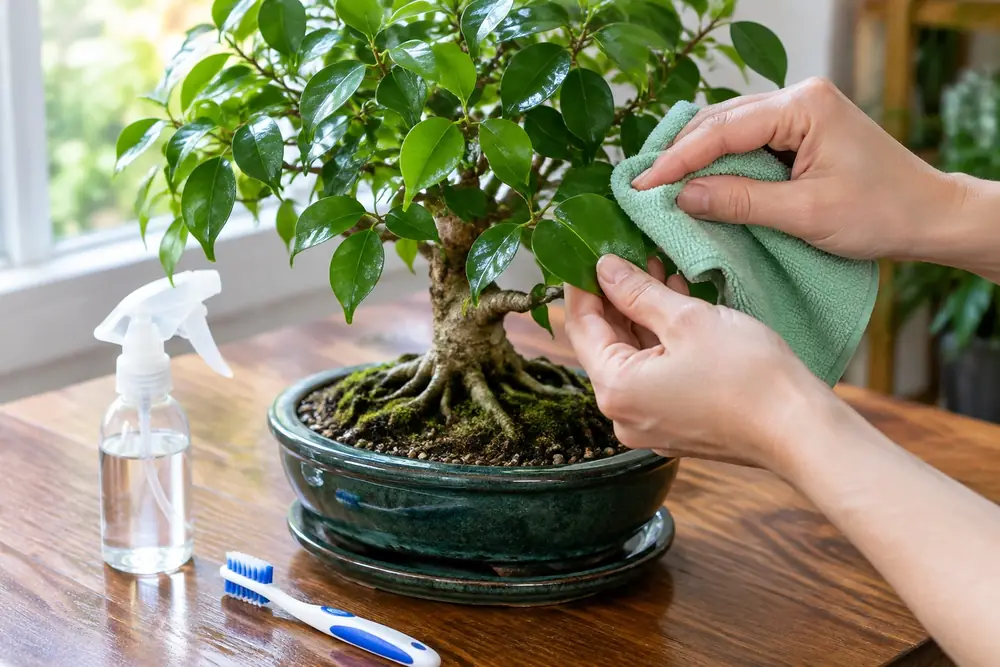
Larger leaves can be wiped clean.
- Dampen a soft microfiber cloth with lukewarm water.
- Support each leaf from below with one hand.
- Wipe gently from the stem toward the tip, top side and then underside.
- Rinse the cloth often so you do not spread dust or pests.
Be gentle with young leaves, which tear easily. For jade, use a barely damp cloth, because the fleshy leaves dislike staying wet.
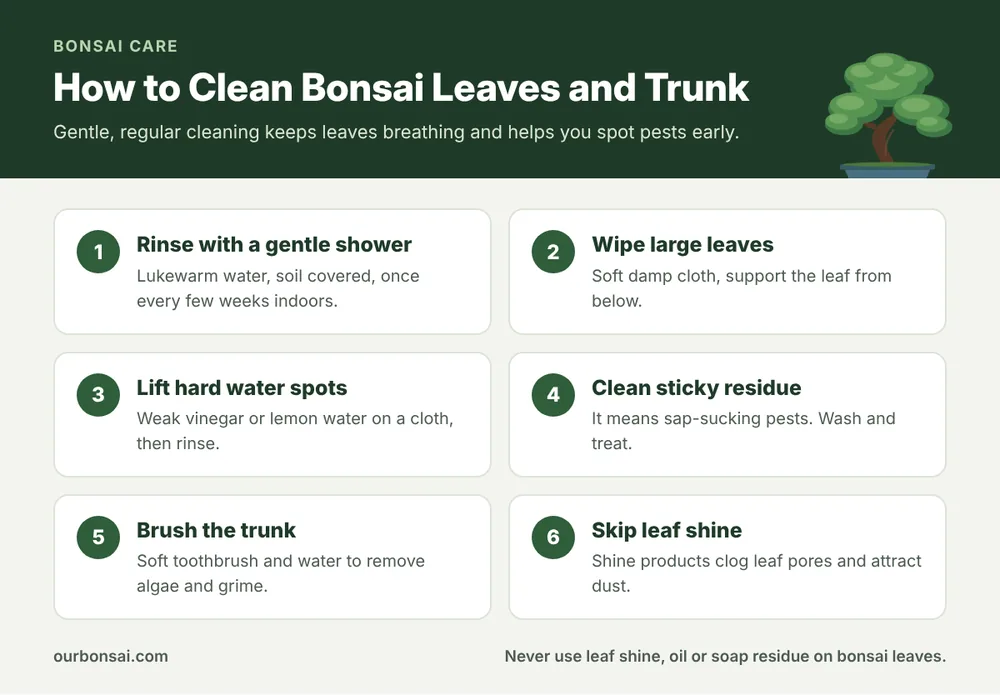
How to remove hard water spots
White spots on dark leaves are often mineral deposits from hard tap water or misting. They are harmless but block light and look untidy.
- Mix one teaspoon of white vinegar or lemon juice in a liter of water.
- Wipe the spots with a soft cloth dipped in this solution.
- Follow up with a cloth dipped in plain water.
- Switch to rain water or filtered water for misting in future.
If the white spots do not wipe off, they may be something else entirely, such as powdery mildew or scale insects. Our guide on why bonsai leaves have white spots helps you tell them apart.
How to clean sticky leaves
Sticky leaves are a warning sign, not just a cleaning job. The stickiness is honeydew, a sugary waste produced by sap-sucking insects like aphids, scale and mealybugs.
- Rinse the tree well with lukewarm water, top and underside of the leaves.
- Look for the insects along stems, at leaf joints and on leaf undersides.
- Treat with insecticidal soap or neem oil, following the product label. Rinse residue off after the recommended time.
- Repeat checks weekly until no new stickiness appears.
Our guide to why bonsai leaves are sticky and our article on tiny bugs on bonsai leaves explain how to identify and treat the cause.
How to clean the bonsai trunk
A thin layer of moss or lichen on old bark can look attractive and natural. But thick green algae, especially on young or smooth-barked trees, traps moisture against the bark and hides pests.
- Wet the trunk with water.
- Gently scrub with a soft toothbrush, working with the direction of the bark.
- For stubborn algae, use a little diluted lime sulfur only on deadwood, or simply repeat the water scrub over a few sessions.
- Never scrape flaking or plated bark on species like pines and junipers, where rough bark is part of the tree’s character.
- Rinse and let dry.
Avoid wire brushes and harsh scrubbing, which damage the thin living layer under the bark.
Cleaning the soil surface and pot
While you are cleaning the tree, take a minute for the pot and soil too:
- Pick up fallen leaves and flowers from the soil surface. Rotting plant matter attracts fungus gnats and can spread leaf diseases. Our guide to fungus gnats on bonsai trees explains why this matters.
- Remove white crust. A white, crusty layer on the soil or pot rim is mineral and fertilizer salt build-up. Scrape off the top layer gently and flush the pot with rain water or filtered water.
- Wipe the pot. A damp cloth removes water marks and soil splashes. For unglazed pots, a soft brush and plain water are enough. A tiny amount of plant-safe oil rubbed on the outside of an unglazed pot gives it a traditional patina, but keep it away from the soil.
- Check the drainage holes. Make sure roots or soil are not blocking them, so water can escape freely.
Products to avoid
| Product | Why to avoid it |
|---|---|
| Leaf shine sprays | Clog leaf pores (stomata) and attract more dust |
| Milk, mayonnaise or oil | Leave a film that blocks pores and can rot |
| Dish soap left on leaves | Can burn leaves if not rinsed off |
| Household cleaners | Damage leaf tissue and roots |
| Hot water | Scalds leaves and roots |
Plain lukewarm water does almost everything you need. Use insecticidal soap or neem oil only when treating pests.
How often should you clean bonsai leaves?
| Situation | How often |
|---|---|
| Indoor bonsai, dusty room | Every 2 to 4 weeks |
| Indoor bonsai, clean room | Every 1 to 2 months |
| Outdoor bonsai | Only when dusty in dry weather |
| Bonsai with pests | Weekly until pests are gone |
Cleaning is also a good moment to rotate the tree a quarter turn so all sides get even light. For more on light needs, see our guide on how much light a bonsai tree needs.
Common mistakes when cleaning bonsai
- Washing out the soil. Always cover it before rinsing.
- Rinsing in cold water. Cold shocks tropical indoor trees.
- Leaving leaves wet overnight. Damp foliage in a cool, still room invites fungus.
- Using leaf shine. It makes leaves glossy but harms them.
- Scrubbing too hard. Bark and young leaves damage easily.
FAQ: clean bonsai leaves
Can I use soap to clean bonsai leaves?
Only insecticidal soap, and only to treat pests. Rinse it off as the label directs. Regular dish soap can harm leaves.
Should I mist my bonsai to keep the leaves clean?
Misting adds a little humidity but does not clean leaves well, and hard water misting leaves white spots. Use a gentle shower instead.
How do I clean dust off a juniper bonsai?
Rinse it with a gentle spray of water, outdoors if possible. Do not wipe junipers, because the foliage is too fine.
Is moss on a bonsai trunk bad?
A thin layer on old bark is fine. Thick, wet moss or algae on young bark should be gently brushed off.
Final thoughts
To clean bonsai leaves well, keep it simple: a gentle lukewarm shower for small-leaved trees, a soft damp cloth for large leaves, and a soft brush for the trunk. Skip leaf shine and harsh products, and treat sticky leaves as a sign of pests. Regular cleaning keeps your tree breathing, catching the light and looking its best. For the complete care routine, see our main bonsai care guide.