Is My Jade Bonsai Dying? Signs and How to Save It

This post contains affiliate links. As an Amazon Associate, OurBonsai earns from qualifying purchases at no extra cost to you. Read our disclosure.
In this guide
A jade bonsai dying usually gives you plenty of warning: leaves go soft or wrinkled, start falling off, and the stems lose their firmness. Jade (Crassula ovata) is a succulent that can survive weeks without water, so when one is in serious trouble, the cause is almost always too much water rather than too little, and the damage starts at the roots. The faster you act once you notice soft stems or mushy leaves, the better the chance of saving it. Even if the main trunk is lost, healthy branch tips can be rooted to start again.
This guide covers the warning signs, how to tell rot from thirst, the main causes of decline, a step-by-step rescue, and how to use cuttings as a backup.
Signs your jade bonsai is dying
| Sign | What it usually means |
|---|---|
| Wrinkled leaves, dry soil | Thirsty. Easy to fix with a good soak |
| Wrinkled leaves, wet soil | Roots have rotted and cannot take up water |
| Soft, translucent or mushy leaves | Overwatering, cells bursting from excess water |
| Leaves dropping while still plump | Overwatering or a sudden cold shock |
| Soft, black or brown stem at soil level | Stem rot, the most serious sign |
| Long, thin, pale stems with gaps between leaves | Too little light |
| White cotton in leaf joints | Mealybugs |
The key distinction is between wrinkled leaves on dry soil, which is easy, and wrinkled or mushy leaves on wet soil, which means the roots are failing.
What a healthy jade bonsai looks like
It helps to know the target. A healthy jade bonsai has firm, glossy, plump leaves that feel cool and solid when squeezed. In good light the leaf edges often turn red. The trunk is firm all the way to the soil, the bark on older stems is grey-brown and slightly rough, and new pairs of leaves appear at the branch tips in spring and summer. Some older lower leaves yellow and drop now and then; that is normal turnover.
Compare your tree with that picture. If most of it still looks like this and only a few leaves are off, you probably have a small, fixable problem. If the trunk is soft or most leaves are mushy, move quickly.
Is it thirst or rot?
Push a chopstick deep into the soil. If it comes out dry and the leaves are wrinkled, the jade is simply thirsty. Soak it well and the leaves should plump up within three to five days.
If the soil is wet and the leaves are still wrinkled or soft, the roots are not working. Press gently at the base of the trunk where it meets the soil. A firm trunk is good news. A trunk that feels soft, spongy or looks dark and wet is rotting from the base up, and needs surgery today.
Common causes of a jade bonsai dying
Overwatering and root rot
By far the most common cause. Jade kept in regular potting soil, watered on a fixed schedule, or left standing in a saucer of water will rot. The Wikipedia page on root rot explains how waterlogged soil starves roots of oxygen and lets fungi take over. Our guide to root rot in bonsai covers the bonsai-specific details.
Cold
Jade tolerate cool rooms but not frost. A night below about 40°F (4°C), especially in wet soil, can turn leaves to mush. A tree left outside too late in autumn often shows damage a few days later.
Low light
A jade in a dim room weakens slowly. It stretches toward the light, drops lower leaves, and becomes prone to rot because it uses so little water. Our guide to how much light a bonsai tree needs covers what jade needs indoors.
Pests
Mealybugs hide in leaf joints and under branches, and scale settles on stems. A heavy infestation weakens the tree. Our jade bonsai pests and diseases guide shows how to treat them, and mealybugs on bonsai trees goes into detail on the most common one.
How to save a dying jade bonsai
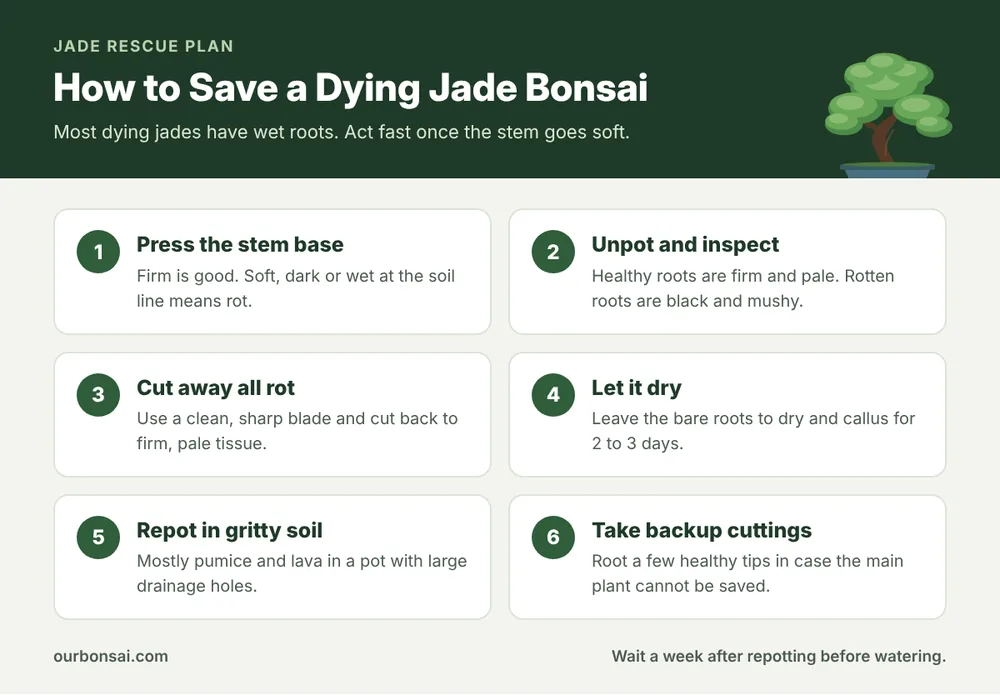
Step 1: Unpot and inspect the roots
Take the tree out and shake off the soil. Healthy jade roots are pale and firm. Rotten roots are dark, mushy and smell bad.
Step 2: Cut away all rot
With a clean, sharp blade, cut off every rotten root. If the trunk base is soft, cut upward until the cut surface is clean, pale green or cream, with no brown streaks. Wipe the blade with alcohol between cuts.
Step 3: Let it dry
Leave the tree out of the pot, bare-rooted, in a shaded, airy spot for two to three days. The cut surfaces will dry and callus, which protects them from new infection.
Step 4: Repot into gritty soil
Use a fast-draining mix of mostly pumice and lava with a little akadama, or a gritty succulent bonsai soil. Choose a small pot with large drainage holes. Our bonsai soil mix ratio guide explains how to adjust a mix.
Step 5: Water sparingly
Wait about a week before the first watering, then water only when the soil has dried out completely. Keep the tree in bright, indirect light until it shows new growth.
Take cuttings as a backup
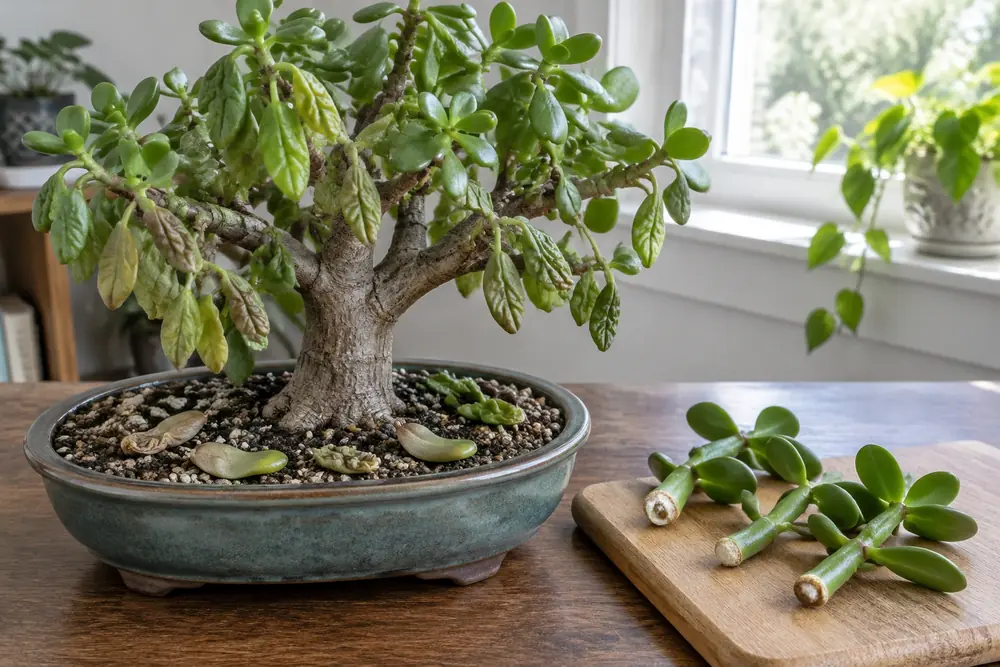
If the rot has spread far up the trunk, the main plant may not survive. Before it is too late, take a few healthy branch tips, each 5 to 10 cm long with firm leaves. Let them dry for a few days until the cut ends callus, then set them in dry, gritty soil and water lightly after a week. Jade roots easily, and in a year or two a cutting can become a nice small bonsai.
How to keep a jade healthy afterwards
- Water only when the soil is dry all the way down, typically every one to two weeks in summer and every few weeks in winter.
- Use gritty soil and never leave the pot in water.
- Give it as much light as possible, including summer outdoors in a sheltered, sunny spot.
- Keep it above 45°F (7°C) and bring it in well before frost.
- Check leaf joints for mealybugs every few weeks.
FAQ: jade bonsai dying
Can a jade bonsai recover from root rot?
Yes, if you catch it before the rot reaches far up the trunk. Cut away all rot, let it dry, and repot into gritty soil.
Why is my jade bonsai losing leaves?
Usually overwatering, cold or low light. Check the soil moisture and the stem base first.
Why are my jade leaves wrinkled?
Either the tree is thirsty (dry soil) or the roots have rotted (wet soil). The soil tells you which.
How long does a jade take to recover?
Expect new roots in three to four weeks and new leaves within one to two months.
Final thoughts
A jade bonsai dying is almost always a root problem caused by too much water, too little light or cold. Check the stem, cut out any rot, let it dry, and repot into gritty soil. Take cuttings as insurance, and the tree, or its offspring, will live on.