Juniper Bonsai Winter Care: Keep It Outside and Healthy


This post contains affiliate links. As an Amazon Associate, OurBonsai earns from qualifying purchases at no extra cost to you. Read our disclosure.
In this guide
- Why junipers need to be outdoors in winter
- How cold can a juniper bonsai handle?
- Juniper bonsai winter care checklist
- Why is my juniper turning purple or bronze in winter?
- Light in winter
- Watering a juniper bonsai in winter
- Protecting the roots
- Pruning, wiring and repotting around winter
- Preparing your juniper for winter
- Common juniper winter mistakes
- What a healthy juniper looks like in late winter
- Juniper winter care in mild climates
- Bringing a juniper back into growth in spring
- FAQ: juniper bonsai winter care
- Final thoughts
Juniper bonsai winter care starts with one rule that surprises many beginners: junipers are outdoor trees. The popular Japanese garden juniper (Juniperus procumbens ‘Nana’), the Chinese juniper (Juniperus chinensis) and their relatives all need a cold winter to stay healthy. A juniper kept on a warm windowsill may look fine for a few months, then slowly turns brown and dies. Outdoors, with a little protection for its roots, a juniper is one of the toughest bonsai you can own.
This guide covers how cold junipers can handle, why the foliage changes color, how to water in winter and how to protect the roots.
Why junipers need to be outdoors in winter
Junipers come from temperate and mountain regions. They need a period of cold dormancy each year. Indoors, with warm temperatures, low light and dry air, they never rest properly and weaken over time. Many junipers are sold as “indoor bonsai”, but that is a marketing label, not a growing reality. Our article on Japanese juniper bonsai indoors explains the limits of growing them inside.
How cold can a juniper bonsai handle?
In the ground, many junipers are hardy to USDA zone 4 or colder. In a pot, the roots are more exposed.
| Conditions | What to do |
|---|---|
| Down to about -5°C (23°F) | Keep on its normal bench, sheltered from wind |
| -5 to -10°C (23 to 14°F) | Pot on the ground, mulch around it |
| Long spells below -10°C (14°F) | Cold frame, unheated greenhouse, or bury the pot |
| Very severe winters | Unheated shed or garage during the worst cold |
You can check your area on the USDA plant hardiness map.
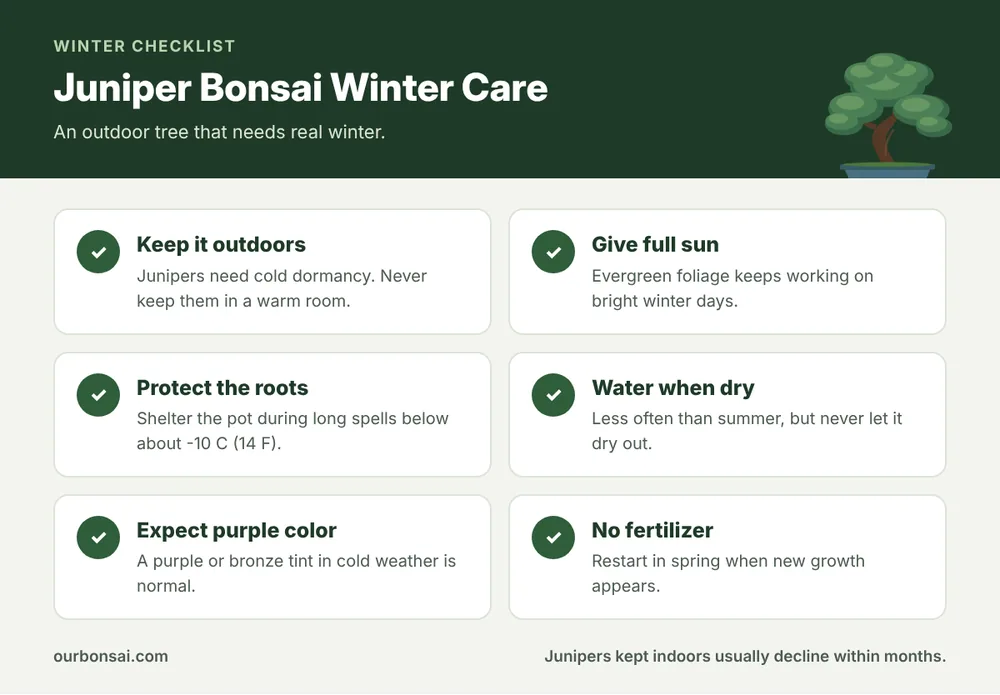
Juniper bonsai winter care checklist
Why is my juniper turning purple or bronze in winter?
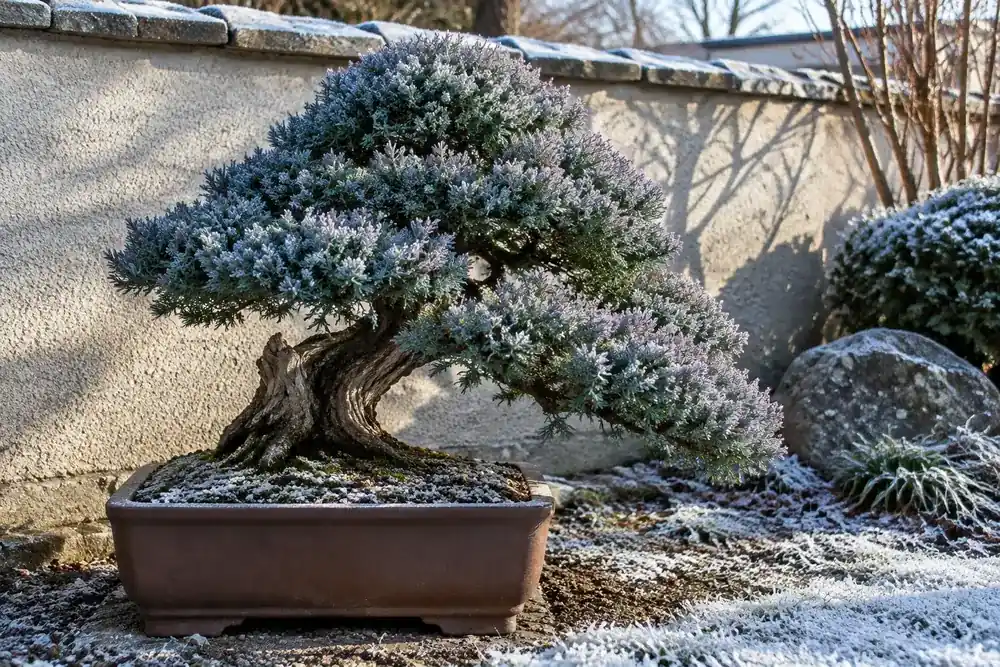
Many junipers, especially Japanese garden juniper, take on a purple, bronze or brownish tint in cold weather. This is a normal protective response to cold and strong winter sun. The foliage turns green again in spring as temperatures rise.
Purple color is not the same as dying. Signs of real trouble are:
- Foliage that turns dry, crispy and brown, especially from the inside out.
- Brown patches that do not recover in spring.
- Foliage that falls off when touched.
These are often caused by dry roots, root rot or pests. Our guide to Japanese juniper bonsai turning brown helps you work out the cause.
Light in winter
Junipers keep their foliage all winter and continue to photosynthesize on sunny days. Keep them in full sun whenever possible. A few weeks in a darker shed during a hard freeze is fine, but bring them back out as soon as the worst cold passes.
Watering a juniper bonsai in winter
Junipers like their soil to dry slightly between waterings, and they dislike soggy roots, especially in cold weather. But they also lose water through their foliage on sunny, windy winter days.
- Check every few days.
- Water when the surface has dried, ideally in the morning.
- Do not water a frozen pot.
- In shelters without rain, check more often.
A free-draining soil is the best protection against winter root rot. See our juniper bonsai soil recipe for a good mix.
Protecting the roots
The most common cause of winter loss is roots freezing solid for long periods in a shallow pot. To protect them:
- Move the pot off high benches onto the ground.
- Surround it with mulch, bark or straw, or sink it into a garden bed.
- Use a cold frame or unheated greenhouse in very cold regions.
- Group pots together so they insulate each other.
Wrapping the pot in bubble wrap or burlap also helps. A simple plant frost cover can protect the foliage during extreme cold snaps.
Pruning, wiring and repotting around winter
- Pruning: Light thinning in late autumn is fine. Avoid heavy foliage pruning in winter.
- Wiring: Late autumn and winter are good times to wire junipers, since growth has slowed. Avoid bending branches when they are frozen, as they become brittle.
- Repotting: Early to mid spring, when new growth begins.
- Fertilizer: None in winter. Start again in spring. Our juniper fertilizer picks list good options.
For styling plans for next year, see our guide to juniper bonsai styles for beginners.
Preparing your juniper for winter
- Keep feeding through late summer so the tree is strong going into winter.
- Check for spider mites and scale in late summer; they love junipers. Our guide to juniper bonsai pests and diseases explains treatment.
- Let it harden off naturally as nights cool.
- Decide where it will go during hard freezes.
Common juniper winter mistakes
- Bringing it indoors to “protect” it, where it weakens and browns.
- Keeping the soil soggy in cold, wet weather, which leads to root rot.
- Letting the roots dry out in cold, windy, sunny spells.
- Bending frozen branches, which can snap.
- Leaving it on a high, exposed bench during a long, deep freeze.
- Panicking at purple foliage and moving the tree into warmth.
What a healthy juniper looks like in late winter
By late winter, a healthy juniper may still have a purple or bronze tint, but the foliage feels flexible and springy, not dry or brittle. The tips are intact, the inner foliage is not falling out in handfuls, and the soil dries at a steady pace. If you see this, your tree has come through the cold well and is ready for spring.
Juniper winter care in mild climates
In areas with mild winters, junipers can stay on their normal bench all year. The main risk is soggy soil during long rainy spells. Use a coarse, fast-draining soil and make sure the drainage holes are clear. Junipers still benefit from the cooler temperatures; just avoid placing them against warm walls.
Bringing a juniper back into growth in spring
As days lengthen and temperatures rise, the purple tint fades and bright green new tips appear at the ends of the shoots. That is your signal to return the tree to its normal spot in full sun if it spent winter under cover. Increase watering gradually as growth speeds up, and start feeding once you see steady new growth. Spring is also the time to repot if the tree is root-bound, and to clean out dead inner foliage so light reaches the center of each pad. Our Japanese juniper bonsai tree care guide covers the full growing season.
FAQ: juniper bonsai winter care
Can I keep my juniper bonsai indoors for winter?
No. It needs a cold dormancy outdoors. An unheated garage during the worst freezes is fine for short periods.
Is it normal for my juniper to turn purple in winter?
Yes. It is a natural cold response. The foliage greens up again in spring.
How often should I water a juniper in winter?
When the soil surface has dried. Depending on weather, that may be every few days or once a week.
When should I start fertilizing again?
In spring, once new green growth appears. The Wikipedia page on Juniperus procumbens describes the species’ natural hardiness.
Final thoughts
Juniper bonsai winter care is simple once you accept that junipers belong outside. Keep the tree in full sun, protect the roots from long hard freezes, water when the soil dries and enjoy the purple winter color as a sign of a healthy, resting tree. In spring it will reward you with bright new growth.