Best Bonsai Wire: Aluminium and Copper Compared

As an Amazon Associate we earn from qualifying purchases. See our affiliate disclosure.
In this guide
- Our Top Picks at a Glance
- Aluminium or Copper?
- 1. Grow A Bonsai Tree 5-Size Starter Set (Best Overall Starter Set)
- 2. RASKOO 7-Roll Wire Kit with Cutter (Best Value Kit)
- 3. Hotop 10-Roll Bonsai Wire (Best for Lots of Small Trees)
- 4. Mudder 5-Roll Wire with Cutter (Best for Beginners and Indoor Trees)
- 5. WZAEROUU 6-Roll Kit with Cutter (Best Budget Kit with Cutter)
- 6. Wazakura Annealed Copper Wire 1.2 mm (Best Copper Wire)
- 7. Grow A Bonsai Tree 4.0 mm Large Roll (Best Heavy Gauge Roll)
- 8. Antrader 2.5, 3 and 4 mm Set (Best Thick-Gauge Set)
- Also Worth a Look
- How to Choose Bonsai Wire
- Frequently Asked Questions
- Final Verdict
Quick answer: the best bonsai wire for most people is anodised aluminium in a range of gauges, and the Grow A Bonsai Tree five-size starter set is the cleanest version of that: 1 to 3 mm, labelled rolls, 147 feet, in black, brown or green. If you want more wire and a cutter thrown in, the RASKOO seven-roll kit gives 189 feet. For conifers, where aluminium is too soft to hold a stiff juniper branch, buy annealed copper: the Wazakura 1.2 mm copper roll from Sanjo, Japan is the best we found. And when you reach trunks and primary branches, add a single 4 mm roll rather than paying for thick wire in a kit you will not use.
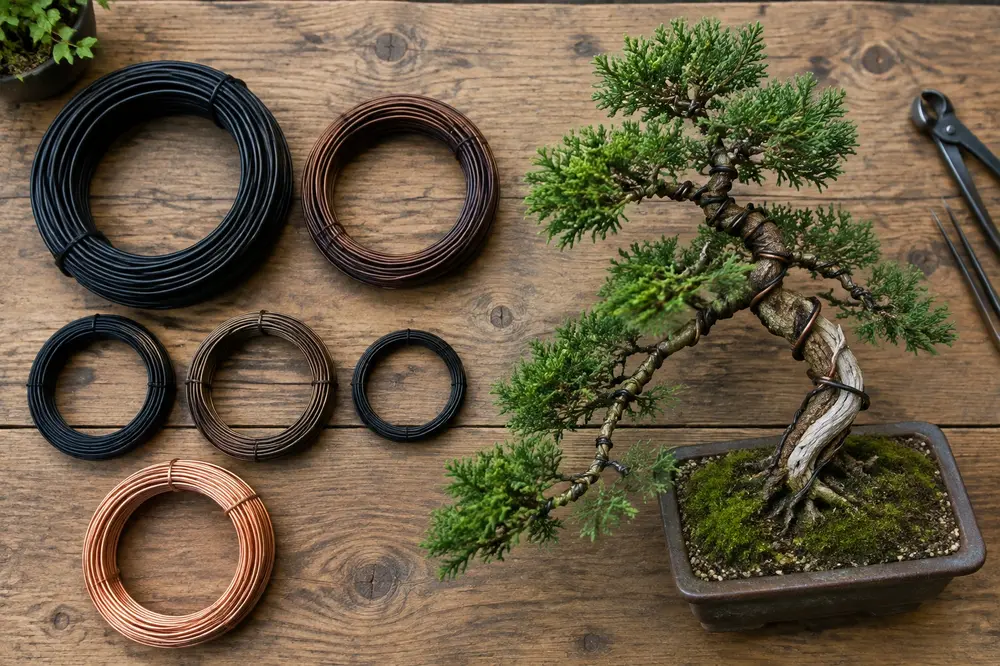
Wire is how a bonsai is shaped. Shears decide what stays; wire decides where it goes. There are two metals. Anodised aluminium is soft, easy to bend, reusable and sold in coloured coatings that disappear against bark; it is the wire to learn with and the right wire for deciduous and tropical trees. Annealed copper is softened by heat so it bends easily, then work-hardens as you apply it, so it holds a branch with a thinner gauge; it is the traditional wire for pines and junipers.
Our Top Picks at a Glance
| Wire | Metal and sizes | Best for |
|---|---|---|
| Grow A Bonsai Tree 5-Size Starter Set | Anodised aluminium, 1 to 3 mm, 147 ft, canvas bag | Best overall starter set |
| RASKOO 7-Roll Wire Kit with Cutter | Anodised aluminium, 1 to 3 mm, 189 ft | Best value kit |
| Hotop 10-Roll Bonsai Wire | Anodised aluminium, 1 to 3 mm, 164 ft | Best for lots of small trees |
| Mudder 5-Roll Wire with Cutter | Anodised aluminium, 1 to 2 mm, 160 ft | Best for beginners and indoor trees |
| WZAEROUU 6-Roll Kit with Cutter | Anodised aluminium, 1 to 2.5 mm, 160 ft | Best budget kit with cutter |
| Wazakura Annealed Copper Wire 1.2 mm | Annealed copper, 300 g, 95 ft, Japan | Best copper wire |
| Grow A Bonsai Tree 4.0 mm Large Roll | Anodised aluminium, 250 g, 23 ft | Best heavy gauge roll |
| Antrader 2.5, 3 and 4 mm Set | Anodised aluminium, 100 g rolls, antique copper colour | Best thick-gauge set |
Aluminium or Copper?
Buy aluminium first. It bends by hand, it can be unwound and reused on another tree, it does not mark bark the way an over-tight copper wire does, and the anodised colours look tidy while the tree trains. Its weakness is holding power: to fix a stiff branch you need roughly one third the branch thickness in aluminium, which gets thick and ugly on conifers. Copper solves that. Annealed copper is soft off the roll and hardens as you wrap, so 1.2 mm copper does the job of 2 mm aluminium and weathers to a brown that vanishes against pine bark. The cost is that it is a single-use wire, it needs more skill to apply without kinks, and it will bite a fast-growing branch sooner. Our guide to how to wire a bonsai walks through the technique, and bonsai wire bite explains how to spot wire that has been left on too long.
1. Grow A Bonsai Tree 5-Size Starter Set (Best Overall Starter Set)
| Metal | Anodised aluminium |
|---|---|
| Gauges | 1.0, 1.5, 2.0, 2.5, 3.0 mm |
| Length | 147 ft total: 75 ft of 1 mm down to 8 ft of 3 mm |
| Rolls | 5 x 50 g, labelled, in a canvas bag |
| Colours | Black, brown or green |
Grow A Bonsai Tree is a US bonsai supplier rather than a general gadget brand, and its starter set is the one we point beginners to. Five labelled 50 g rolls cover every gauge a small or medium tree needs, with the quantities weighted the right way: lots of 1 mm, which you use everywhere, and a short length of 3 mm for the main branches. The canvas bag keeps the rolls together, and you can choose black, brown or green anodising.
When you run out of one gauge, the same company sells single rolls to top up, including the 4 mm roll further down this list. If you are shopping for a gift for a new grower, this set and a wire cutter is the obvious pair.
Pros
- Sensible gauge mix for real trees
- Labelled rolls
- Choice of three colours
- Refillable with single rolls from the same maker
Cons
- No cutter included
- Less total footage than the budget kits
Best for: anyone buying their first bonsai wire.
2. RASKOO 7-Roll Wire Kit with Cutter (Best Value Kit)
| Metal | Anodised aluminium |
|---|---|
| Gauges | 1.0, 1.5, 2.0, 2.5, 3.0 mm |
| Length | 189 ft across 7 rolls |
| Included | Wire cutter |
The most wire per dollar on this list, with the full 1 to 3 mm range, 189 feet across seven rolls and a basic cutter. The maker describes the wire as easy to bend but strong enough to hold, which is exactly the trade-off anodised aluminium makes. The included cutter is a general-purpose one rather than a rounded-jaw bonsai cutter, so treat it as a starter and move to a proper bonsai wire cutter when you can.
Good for someone with several trees to wire in a season.
Pros
- 189 ft is a lot of wire
- Full gauge range
- Cutter included
Cons
- Generic cutter
- Rolls not as clearly labelled as the Grow A Bonsai Tree set
Best for: growers with a bench of trees who go through wire quickly.
3. Hotop 10-Roll Bonsai Wire (Best for Lots of Small Trees)
| Metal | Anodised aluminium |
|---|---|
| Gauges | 1.0, 1.5, 2.0, 2.5, 3.0 mm, two rolls each |
| Length | 164 ft total |
| Colours | Black or brown |
Ten small rolls, two of each gauge, so you can keep a set at the bench and a set in the tool roll, or split them with a friend. Total length is 164 feet. The wire is standard anodised aluminium, reusable and rust-free, in black or brown.
Nothing fancy, but a very practical way to buy.
Pros
- Two rolls of every gauge
- Black or brown
- Good price
Cons
- No cutter
- Small rolls run out of 2.5 and 3 mm quickly
Best for: people who want duplicate sets or wire for a club workshop.
4. Mudder 5-Roll Wire with Cutter (Best for Beginners and Indoor Trees)
| Metal | Anodised aluminium |
|---|---|
| Gauges | 1.0, 1.5, 2.0 mm |
| Length | 160 ft: 5 x 32 ft |
| Colours | 3 black, 1 green, 1 brown |
| Included | Wire cutter |
If your trees are indoor ficus, Chinese elm, jade or a starter kit tree, you may never need anything thicker than 2 mm, and this Mudder pack gives you 160 feet of the three fine gauges plus a cutter. The mix of black, green and brown rolls is useful for seeing which wire is which on the tree.
Buy a thicker roll later if a tree outgrows it.
Pros
- Plenty of the fine gauges beginners actually use
- Three colours in one pack
- Cutter included
Cons
- Nothing above 2 mm
- Basic cutter
Best for: indoor and small-tree growers.
5. WZAEROUU 6-Roll Kit with Cutter (Best Budget Kit with Cutter)
| Metal | Anodised aluminium |
|---|---|
| Gauges | 1.0, 1.5, 2.0, 2.5 mm |
| Length | Over 160 ft across 6 rolls |
| Included | Wire cutter |
A budget kit that adds the useful 2.5 mm gauge to the beginner set and still includes a cutter. Four sizes, six rolls, over 160 feet, in black, brown or green. The wire is the same rust-proof anodised aluminium as the others here.
A fine first purchase if the price is right on the day.
Pros
- Includes 2.5 mm
- Cutter included
- Low price
Cons
- No 3 mm
- Lesser-known brand
Best for: budget buyers who want one kit to start.
6. Wazakura Annealed Copper Wire 1.2 mm (Best Copper Wire)
| Metal | Annealed copper |
|---|---|
| Gauge | 1.2 mm (about 18 AWG); 2 mm also available |
| Length | 29 m (95 ft), 300 g roll |
| Made in | Sanjo, Japan |
This is the wire for pines and junipers. Wazakura's copper is annealed so it bends smoothly by hand, then work-hardens on the branch for a hold that aluminium of the same gauge cannot match. The 1.2 mm roll suits twigs and thin branches; the maker's 2 mm roll covers thicker branches and small trunks. Copper weathers quickly to a dull brown that disappears against conifer bark.
Copper is a single-use wire and less forgiving of mistakes, so practise on aluminium first. The maker's own guidance, choose a wire about one third the branch thickness, is a good starting point; see our branch wiring guide for the details. Stock was limited when we checked.
Pros
- Holds conifer branches with thinner wire
- Japanese annealed copper from Sanjo
- Blends into bark as it weathers
- Generous 300 g roll
Cons
- Single use
- Needs more skill than aluminium
- Limited stock
Best for: anyone styling pines, junipers and other conifers.
7. Grow A Bonsai Tree 4.0 mm Large Roll (Best Heavy Gauge Roll)
| Metal | Anodised aluminium |
|---|---|
| Gauge | 4.0 mm (other sizes available) |
| Length | 23 ft (7 m), 250 g |
| Colours | Black or brown |
Kits stop at 3 mm because thick wire is heavy and expensive to ship, so when you need to move a trunk or a primary branch you buy it as a single large roll. This 250 g roll of 4 mm gives 23 feet, enough for several trunks, in black or a copper-coloured brown. The same listing offers other sizes, so it doubles as the refill for the starter set above.
For branches too thick even for 4 mm wire, read our guide to bending thick branches and using guy wires; two strands of 3 mm or a guy wire is often kinder to the tree than one 5 mm wire.
Pros
- Thick gauge sold on its own
- Refill for the starter set
- Brown blends with bark
Cons
- Only 23 ft per roll
- Heavy wire marks soft bark if over-tightened
Best for: moving trunks and main branches on developing trees.
8. Antrader 2.5, 3 and 4 mm Set (Best Thick-Gauge Set)
| Metal | Anodised aluminium, antique copper colour |
|---|---|
| Gauges | 2.5 mm (7.4 m), 3.0 mm (5.2 m), 4.0 mm (2.9 m) |
| Rolls | 3 x 100 g |
The complement to a fine-gauge beginner kit: three 100 g rolls of 2.5, 3 and 4 mm in a dark copper-brown coating. Lengths are short, as they always are at these gauges, but this is the cheapest way to have the thick sizes on the shelf for the day a tree needs them.
Pair it with the Mudder or Hotop fine set and you have 1 to 4 mm covered.
Pros
- Covers the three thick gauges in one buy
- Bark-coloured coating
- Inexpensive
Cons
- Short lengths
- No fine gauges
Best for: topping up a starter kit with heavy wire.
Also Worth a Look
- moheaaei 5-roll 1 to 3 mm set: rubber-coated aluminium, 165 ft, for growers worried about marking very soft bark.
- If you already own a knob cutter and shears, a wire set is the last piece of the basic kit; see what tools a bonsai grower needs.
How to Choose Bonsai Wire
Start with the one-third rule
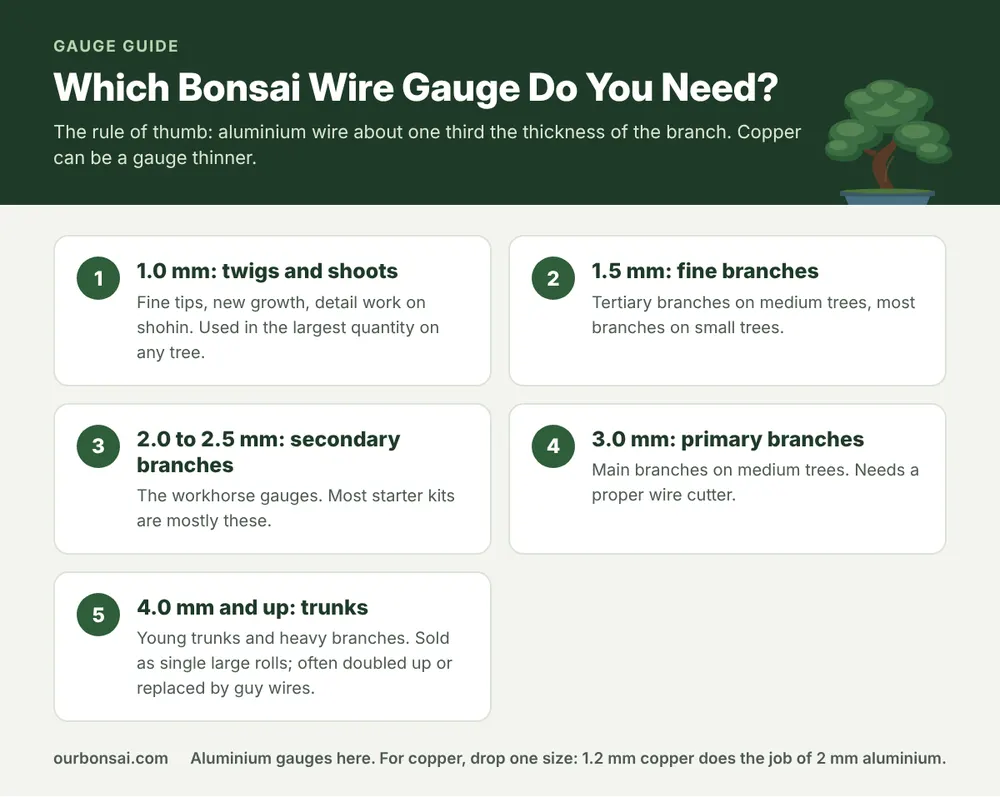
Aluminium wire should be about one third the thickness of the branch you are bending. A 6 mm branch wants 2 mm wire. If the wire you have does not hold, do not wrap a second wire tightly over the first; go up a gauge or use two strands side by side.
Buy more fine wire than thick
Most of the wiring on any tree is 1 and 1.5 mm on twigs and shoots. Kits weighted towards the fine gauges, like the Grow A Bonsai Tree set with 75 feet of 1 mm, reflect real use. Thick wire is bought separately, by the roll, when a specific job calls for it.
Colour
Black is the default and the most visible, which helps when you remove it. Brown disappears against most bark, green against foliage. Copper weathers brown on its own. Colour does not change how the wire behaves.
When to switch to copper
When you start styling conifers seriously, or when aluminium is getting so thick it looks clumsy. Annealed copper from a bonsai supplier is not the same as copper from a hardware store, which is hard-drawn and will not bend evenly; the annealing process is what makes it workable.
Get the wire off in time
Aluminium can usually stay on a deciduous tree for a season; copper on a slow conifer for a year or more. Check monthly in the growing season and cut the wire off with a proper cutter as soon as it starts to press into the bark.
Frequently Asked Questions
What wire is best for bonsai?
Anodised aluminium for beginners, deciduous and tropical trees; annealed copper for pines, junipers and other conifers that need a firmer hold with thinner wire.
What gauge bonsai wire do I need?
About one third the thickness of the branch for aluminium. Most trees use mainly 1 to 2 mm, with 2.5 and 3 mm for main branches and 4 mm or more for trunks.
Can I use regular aluminium or copper wire for bonsai?
Hardware-store copper is hard-drawn and bends unevenly; bonsai copper is annealed. Bare aluminium can be used but anodised bonsai wire is softer, coated and sold in the right gauges.
How long can bonsai wire stay on?
Until it starts to press into the bark. That can be a few months on a fast deciduous tree or more than a year on a slow conifer. Check regularly.
Is copper wire better than aluminium for bonsai?
Copper holds better at a given gauge and suits conifers, but it is single-use and harder to apply well. Aluminium is easier, reusable and better for learning and for deciduous trees.
What is the best bonsai wire kit for beginners?
The Grow A Bonsai Tree five-size starter set, for its sensible gauge mix and labelled rolls. The RASKOO seven-roll kit is the value choice with a cutter included.
Can bonsai wire be reused?
Aluminium wire can be straightened and reused several times. Copper work-hardens and should be used once.
Final Verdict
Start with the Grow A Bonsai Tree five-size set or, for more wire and a cutter, the RASKOO kit. Add the Wazakura copper when you take on conifers and a 4 mm roll when a trunk needs moving. Fine aluminium in quantity, thick wire by the roll, copper for the pines: that is the whole shopping list.