Azalea Bonsai Light Requirements: How Much Sun It Needs

This post contains affiliate links. As an Amazon Associate, OurBonsai earns from qualifying purchases at no extra cost to you. Read our disclosure.
In this guide
Azalea bonsai light requirements are simple once you know the pattern: about 4 to 6 hours of direct morning sun, bright shade after midday once summer temperatures pass roughly 29 C (85 F), and a cold, bright position outdoors in winter. Satsuki (Rhododendron indicum) and Kurume azaleas grew up in Japan as shrubs at forest edges and on rocky stream banks, where they got strong light but not the full force of afternoon sun. Copy that, and you get compact leaves and a full set of flower buds. Get it wrong, and you see either scorched brown leaves or long, weak shoots with few flowers.
Why azaleas need sun but hate afternoon heat
Flower buds on azaleas form in mid to late summer, on the tips of the shoots that grew that spring. Building those buds takes energy, and energy comes from light. A tree kept in deep shade all summer stays green and healthy-looking but blooms poorly the next spring.
On the other hand, azaleas have fine, shallow, hair-like roots that sit near the soil surface. A small pot in full afternoon sun heats up fast, and those roots cook. The leaves follow: they turn bronze, crisp at the edges, or drop. Satsuki azaleas also have relatively thin leaves compared to many evergreen bonsai, so they lose water quickly in hot, dry wind.
That is why the classic advice for azalea bonsai, both in Japan and in the US Southeast, is morning sun and afternoon shade. For how azaleas compare with other species, see our overview of how much light a bonsai tree needs.
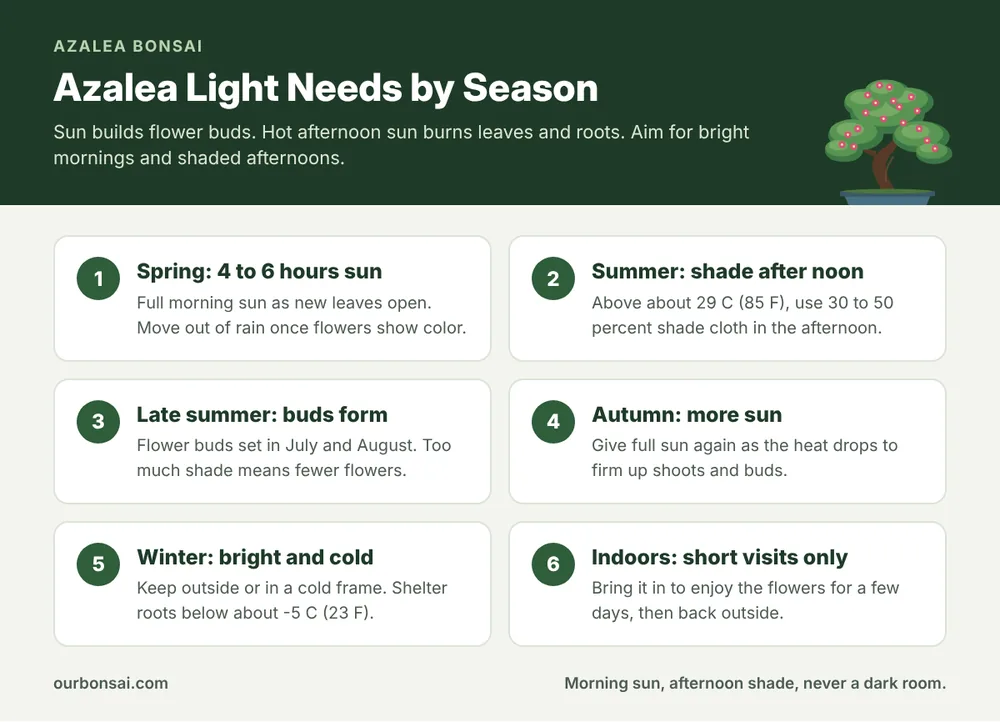
Azalea bonsai light requirements by season
| Season | Daily direct sun | Notes |
|---|---|---|
| Early spring (bud swell) | 4 to 6 hours, morning | Full sun is fine while it is cool |
| Flowering (May to June) | Bright shade, keep off rain | Strong sun and rain shorten flower life |
| Summer above 29 C | 3 to 4 hours morning only | 30 to 50 percent shade cloth after noon |
| Late summer (bud set) | 4 to 5 hours | Too much shade means fewer flowers |
| Autumn | 5 to 6 hours | More sun hardens growth for winter |
| Winter | Bright, cold, sheltered | Protect roots below about -5 C |
The best spot for an azalea bonsai
East-facing bench or patio. This is the easiest setup. The tree gets full morning sun and natural shade from the house in the afternoon.
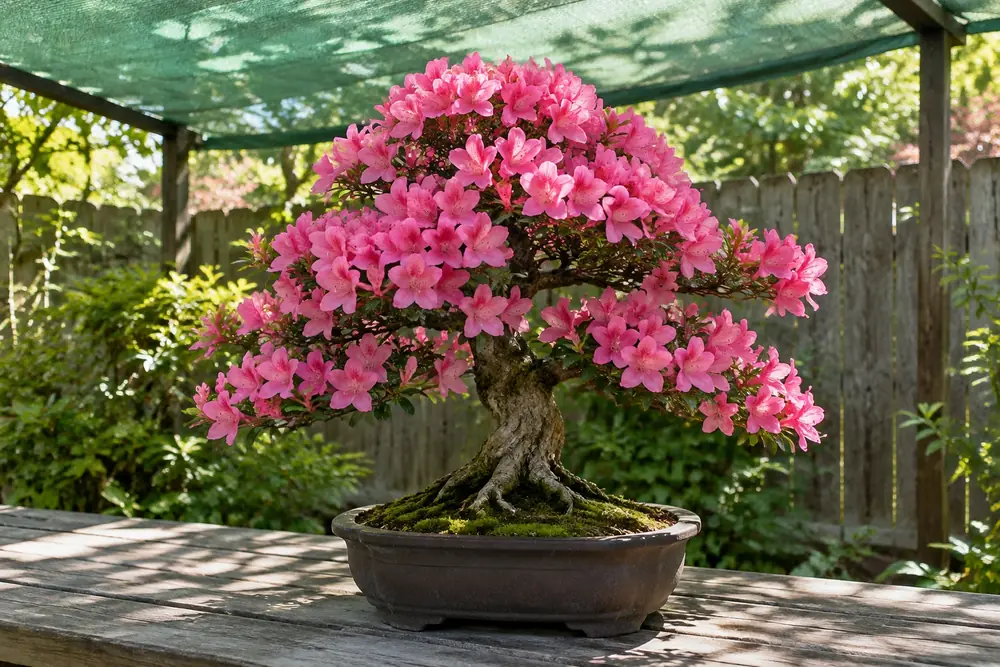
South-facing garden with shade cloth. If your only bright spot is south facing, build a simple frame above the bench and fit 30 to 50 percent shade cloth from June to early September. A search for 30 percent shade cloth shows the options.
Under a high deciduous tree. Dappled light through tall trees is close to the natural habitat. Avoid low, dense trees that block almost all light.
Avoid west walls. Late afternoon sun bouncing off a wall is the hottest light in the garden.
Signs your azalea is getting the wrong light
Too much sun:
- Leaves turn yellowish-bronze or reddish on the sunny side.
- Brown, crispy patches in the middle of leaves or along the edges.
- Flowers fade or brown within a day or two.
- Soil dries out by noon.
Too little sun:
- Long gaps between leaf clusters (leggy growth).
- Large, dark leaves.
- Few or no flower buds at the shoot tips by late summer.
- Weak, thin new shoots that flop.
Brown tips can also come from salt buildup or dry roots, so look at the whole picture before blaming sun. Our guide to satsuki azalea bonsai indoor care covers what happens when an azalea is kept too dark.
Can an azalea bonsai live indoors?
Not for long. Azaleas need the light intensity of outdoors and a cold winter rest to flower well. Indoors, even in a south window, the light is a fraction of what it gets outside, and the warm room prevents the dormancy that triggers good blooming.
It is fine to bring a flowering azalea inside for a few days to enjoy it, ideally in a cool, bright room away from heaters. Then return it outside. If your climate is too cold for winter outdoors, keep it in a cold frame or an unheated porch with a window from December to March.
If you bought an azalea as a gift tree from a shop where it was kept indoors, acclimate it to outdoor sun over 1 to 2 weeks: a few hours of morning light first, then more each day.
Light, water and soil work together
More sun means faster drying. A satsuki in 5 hours of sun in July may need water every day, sometimes twice. In bright shade, every 2 to 3 days can be enough. Use rainwater or low-lime water when you can, because azaleas need acidic soil around pH 5.0 to 6.0, and hard tap water slowly raises it.
Kanuma, a soft, acidic volcanic soil from Japan, is the standard for azaleas because it holds water and stays acidic. It does make light management easier because the roots stay evenly moist. See our best soil for azalea bonsai list for mixes and brands, and our azalea fertilizer guide for acid feeds.
Frequently asked questions
Can azalea bonsai take full sun?
In cool climates and in spring and autumn, yes. In hot summers above about 29 C (85 F), full afternoon sun usually scorches leaves and dries the roots. Give morning sun and afternoon shade during the hottest months.
How many hours of light does an azalea bonsai need?
About 4 to 6 hours of direct sun, mostly in the morning, plus bright indirect light the rest of the day.
Do grow lights work for azalea bonsai?
They can keep an azalea alive for a few weeks in a cold region, but they are not a long-term replacement for outdoor light and a cold winter. Most growers use a cold frame instead.
Why are my azalea bonsai flowers fading so quickly?
Strong sun and rain both shorten bloom life. Move the tree to bright shade and keep it under cover from rain while it flowers. Water the soil, not the flowers.
Final thoughts
Think of an azalea as a tree that loves a bright morning and a shady lunch. Give it 4 to 6 hours of early sun, shade it through the hottest part of summer days, and keep it cold and bright in winter, and it will reward you with a pot covered in flowers. For more on the species itself, see the Wikipedia entry for Rhododendron indicum, and Clemson Extension’s azalea care factsheet explains the sun and shade needs of landscape azaleas in a hot climate.