Conifer Bonsai Trees: Types and Care Basics

Conifer bonsai are bonsai made from cone-bearing trees: pines, junipers, spruces, firs, cedars, larches, cypresses, hemlocks and yews. They make up about half of classical Japanese bonsai, and most are hardy outdoor trees that need full sun, a gritty soil that dries within 1 to 3 days in summer, and a cold winter rest below roughly 5 C (41 F) for several weeks. The biggest difference from broadleaf bonsai is pruning: most conifers, especially pines and junipers, do not reliably sprout new buds from branches that have no green foliage left, so you can never cut a branch back to bare wood and expect it to recover.
In this guide
What counts as a conifer
Conifers (division Pinophyta) are seed plants that carry their seeds in cones rather than in fruit. Most are evergreen with needles or scale-like leaves, but not all:
- Larch, bald cypress and dawn redwood are conifers that drop all their needles every autumn.
- Yew produces a red, fleshy aril rather than a woody cone, but is still classed with the conifers.
- Junipers have berry-like cones, which is where gin gets its flavor.
For bonsai purposes, it helps to sort conifers by how they grow and how they react to cutting, because that determines how you look after them.
Popular conifer bonsai types
| Tree | Example species | Hardiness (approx.) | Beginner-friendly? |
|---|---|---|---|
| Juniper | Procumbens, Chinese, shimpaku | Zones 4 to 9 | Yes |
| Pine | Japanese black, Japanese white, Scots | Zones 3 to 8 | Moderate |
| Spruce | Ezo, Norway, dwarf Alberta | Zones 2 to 7 | Moderate |
| Larch | Japanese, European | Zones 3 to 7 | Yes |
| Bald cypress | Taxodium distichum | Zones 4 to 10 | Yes, in warm areas |
| Dawn redwood | Metasequoia | Zones 5 to 8 | Yes |
| Yew | Japanese, English | Zones 4 to 7 | Yes |
| Hinoki cypress | Chamaecyparis obtusa | Zones 4 to 8 | Moderate |
Junipers are the classic beginner conifer because they are tough, widely sold and forgiving of repotting. Our guide to juniper bonsai styles for beginners is a good starting point. Pines take more knowledge but are rewarding; see our loblolly pine bonsai care guide for a North American native that is easy to find. Deciduous conifers like larch and dawn redwood behave much like broadleaf trees in the way they bud back.
Conifer bonsai care basics
Light and placement
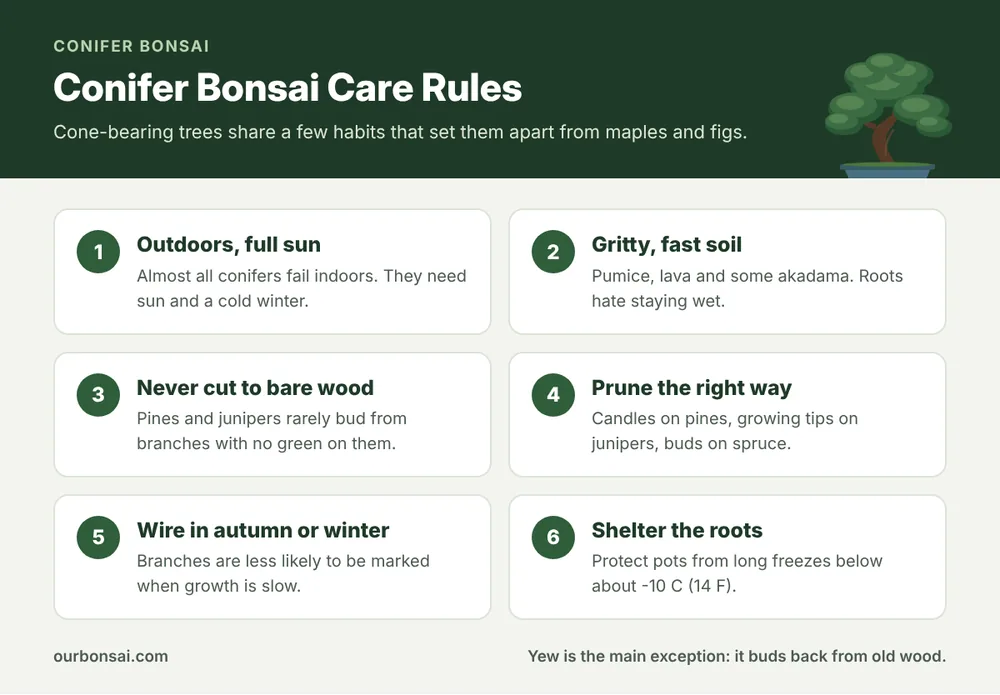
Every conifer on the list above is an outdoor tree. They need several hours of direct sun a day, and most need at least 4 to 6. Indoors, light levels are a fraction of what they need and the warm winter prevents dormancy. A juniper kept indoors usually dies within a year or two, often slowly enough that the owner does not notice until it is too late.
Soil and watering
Conifer roots like air. A mix of pumice, lava and akadama, roughly equal parts and sifted to 3 to 6 mm, suits most species. Pines and junipers prefer to dry slightly between waterings; spruces and hinoki like a bit more moisture; bald cypress tolerates wet feet better than any of them. Water when the top centimeter is dry rather than on a schedule. The mix for black pine, described in our article on the best soil for Japanese black pine bonsai, works as a template for most conifers.
Feeding
Feed from spring to autumn with a balanced fertilizer. Many growers use slow-release organic cakes. Pines in development are often fed heavily to build strength, then fed lightly once refined to keep needles short.
Winter
Hardy conifers need cold to stay healthy, but their roots are vulnerable in pots. Shelter them from long freezes below about -10 C (14 F) and from drying winter winds. Evergreen conifers still lose water through their foliage in winter, so check the soil every week or two even in cold weather.
Pruning: the rule that separates conifers from broadleaf trees
Cut a maple back hard and new buds appear from old bark. Most conifers do not work that way. If you remove all the foliage from a pine or juniper branch, that branch usually dies.
So each group gets its own technique:
- Pines: shorten or remove the new spring shoots (candles) and, for two-flush pines like black pine, cut candles in early summer to produce a second, smaller flush.
- Junipers: cut back to a growing tip or a side shoot with foliage, rather than shearing. Shearing turns the foliage brown and weak.
- Spruces: pinch the soft new shoots in spring, leaving a few needles at the base.
- Yews: the exception. Yew buds back readily from old wood and tolerates hard pruning.
- Larch and bald cypress: prune like deciduous trees, cutting back to buds.
Deadwood is the other conifer specialty. Jin (stripped dead branches) and shari (stripped sections of trunk) are created on junipers and pines to suggest age and harsh mountain conditions.
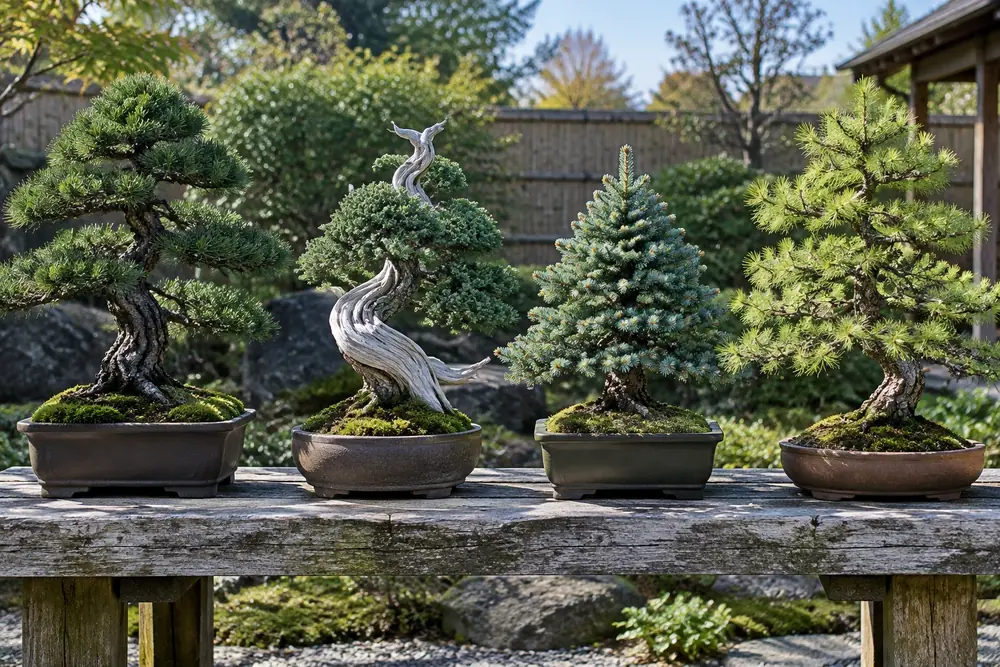
Wiring conifers
Conifers are wired more than most broadleaf trees because their branches are styled into pads that suggest an old tree. The best time is late autumn through winter, when growth has slowed and the bark is less likely to be marked. Check the wire every few weeks in spring; branches thicken quickly and wire can bite in.
Common mistakes with conifer bonsai
- Keeping them indoors. The single most common cause of death, especially for junipers sold as “indoor bonsai.”
- Shearing like a hedge. Produces weak, crowded growth and browning on junipers.
- Cutting back to bare branches. The branch rarely recovers on pines and junipers.
- Overwatering in winter. Cold, wet roots rot. Water only when the surface dries.
- Panicking at autumn needle drop. Pines shed their oldest needles each autumn, and larches lose all their needles. Brown inner needles at that time of year are normal.
If a juniper is browning in summer, our guide to Japanese juniper bonsai turning brown walks through the causes.
Frequently asked questions
Which conifer is best for a beginner?
A procumbens or Chinese juniper is usually the easiest. A larch is also a good choice because it buds back like a deciduous tree and recovers from mistakes.
Can any conifer bonsai be kept indoors?
Not long term. Even subtropical conifers like the Norfolk Island pine are not suited to classical bonsai indoors. Keep conifers outside.
Why are my conifer’s inner needles turning yellow in autumn?
Usually normal seasonal shedding of older needles. If new growth at the tips is yellowing or browning, look for a watering or pest problem.
When should I repot a conifer?
Most in early spring as buds begin to extend, every 3 to 5 years for mature trees, keeping some old soil to preserve the beneficial fungi on the roots.
Final thoughts
Conifer bonsai are outdoor trees with a few strict rules: full sun, gritty soil, a cold winter, and pruning that always leaves green on a branch. Learn the technique for your particular species and they can live for centuries. For the botany of the group, the Wikipedia article on conifers is a solid overview, and our list of evergreen bonsai trees compares conifers with broadleaf evergreens.