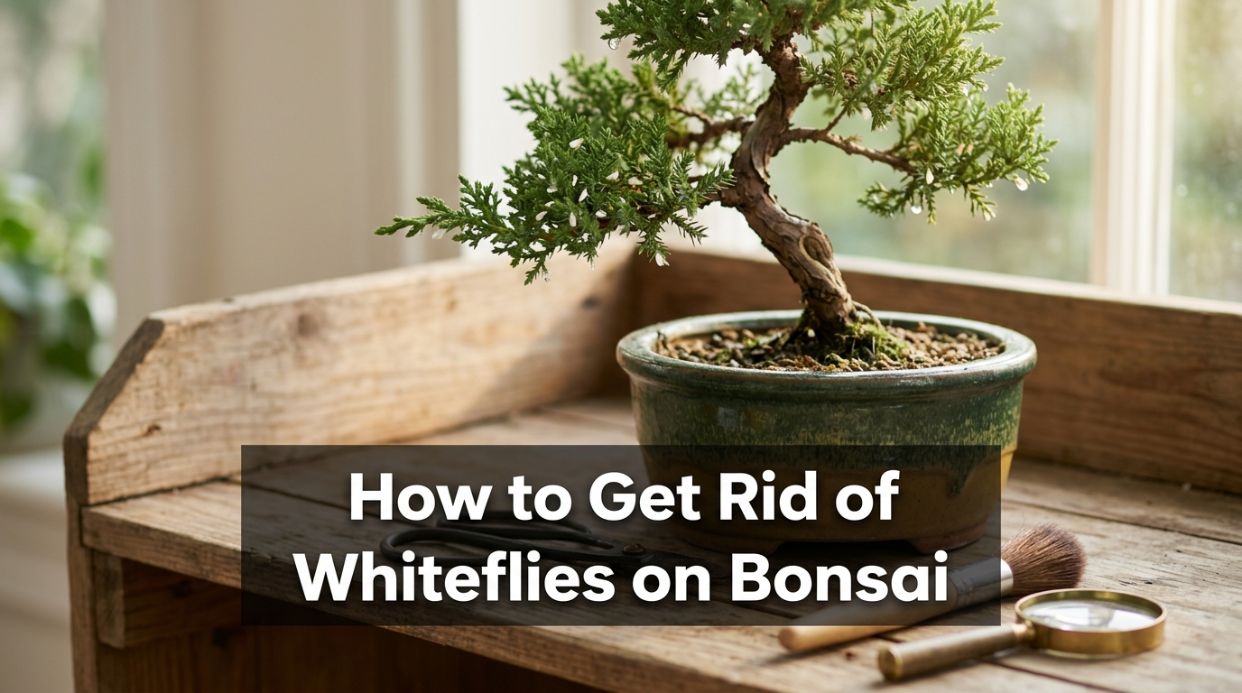
How to Get Rid of Whiteflies on Bonsai
Quick Answer
To get rid of whiteflies on bonsai, isolate the tree, rinse adults from the foliage, remove badly infested leaves, and treat the undersides with insecticidal soap or horticultural oil labeled for your plant. Because eggs and immature stages can survive one treatment, inspect the tree repeatedly and follow the product label for repeat applications, using UC IPM whitefly guidance as a reliable reference.
What to do first
- Isolate the bonsai: Keep it away from other bonsai and houseplants while you treat it.
- Check leaf undersides: Whitefly eggs and nymphs are usually concentrated beneath leaves.
- Rinse the foliage: A controlled stream of water can knock many adults from the tree.
- Remove heavy colonies: Prune individual badly infested leaves when removing them will not weaken the bonsai.
- Spray thoroughly: Insecticidal soap or horticultural oil must contact the pests to work well.
One important precaution
- Test any spray on a small section first, especially on delicate bonsai foliage, and always follow the product label.
Whiteflies can multiply quietly beneath bonsai leaves before you notice them. The first obvious sign is often a cloud of tiny white insects when you touch the foliage.
I treat whiteflies as both a pest problem and an identification problem. Removing the flying adults helps, but lasting control depends on finding the immature insects hiding underneath the leaves.
In This Guide
What Do Whiteflies Look Like on Bonsai?
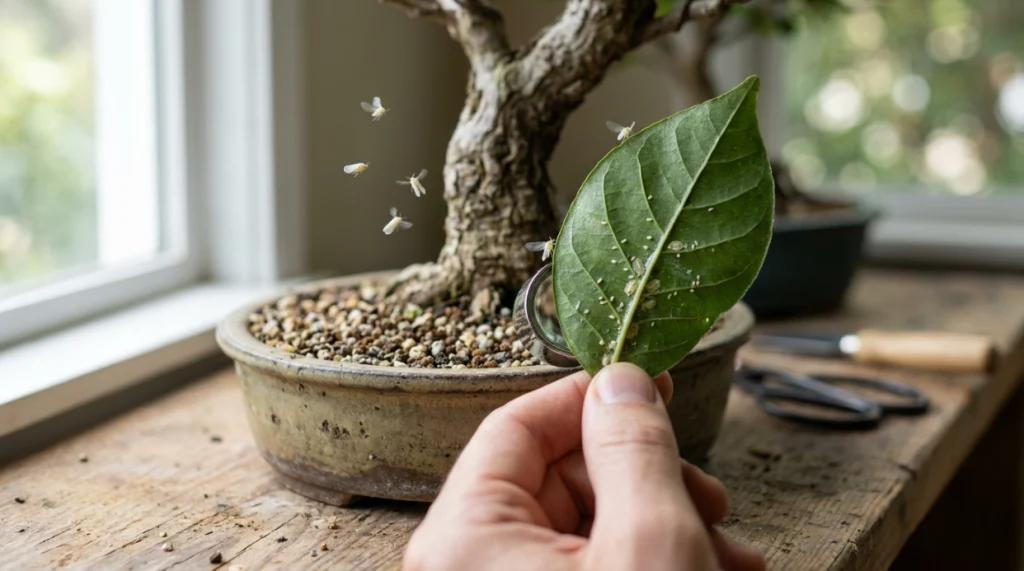
Whiteflies are tiny sap-feeding insects that usually live on the undersides of leaves. Adults have pale, powdery-looking wings and often fly upward when disturbed.
Definition: Whiteflies are insects in the family Aleyrodidae. Despite their name, they are not true flies and are more closely related to aphids, scale insects, and mealybugs.
The flight test is useful. Gently move a branch or tap a leaf, and adult whiteflies commonly rise from the foliage before settling again.
Don’t stop after finding adults. Turn several affected leaves over and look for pale eggs and flat, oval immature stages attached to the surface.
Whiteflies vs. other white bonsai pests
- Whiteflies: Winged adults fly when foliage is disturbed, while immature stages remain beneath leaves.
- Mealybugs: Usually look cottony or powdery and crawl rather than flying away in a cloud.
- Woolly aphids: May have fluffy wax, but the insect underneath has an aphid-like body.
- Scale insects: Often resemble fixed bumps attached to leaves, twigs, or stems.
- Spider mites: Cause stippling and sometimes fine webbing rather than clouds of white adults.
If identification remains uncertain, a hand lens helps. Good pest identification matters because the treatment that works for one sap-feeding pest may not be ideal for another.
General bonsai pest and disease guidance also emphasizes identifying the pest before choosing treatment.
Section Takeaway: Flying white adults plus flat immature insects beneath the leaves strongly point toward whiteflies.
What Damage Do Whiteflies Cause to Bonsai?
Whitefly adults and nymphs feed on plant sap. A small population may cause little visible damage, but a growing colony can weaken foliage and reduce vigor.
Bonsai deserve close attention because their canopies are deliberately compact. Damage concentrated across a few important shoots can quickly affect the appearance of the whole tree.
Common signs of a whitefly infestation
- Flying white insects: Adults scatter when branches or leaves are disturbed.
- Sticky foliage: Feeding whiteflies produce sugary waste known as honeydew.
- Black coating: Sooty mold can grow on accumulated honeydew.
- Yellow leaves: Heavy feeding may cause foliage to discolor or decline.
- Premature leaf drop: Severely affected leaves can dry and fall.
- Weak growth: Persistent infestations may reduce the tree’s overall vigor.
Sticky residue is an especially useful clue. Check the leaves directly above the sticky area because colonies often feed there.
Sooty mold is usually a secondary problem rather than the original cause. Control the honeydew-producing insects first, then clean remaining residue gently.
How Do You Get Rid of Whiteflies on Bonsai?
The most reliable approach combines isolation, physical removal, monitoring, and careful treatment. I prefer this layered approach because targeting only the flying adults leaves immature stages behind.
1. Isolate the affected bonsai
Move the infested tree away from other plants as soon as possible. Whitefly adults can move between suitable hosts.
A separate treatment area also makes monitoring easier. You can tell whether the whiteflies you see belong to the affected tree instead of nearby plants.
2. Inspect every section of foliage
Check the undersides of leaves first. Pay extra attention to protected interior foliage and leaves with honeydew, yellowing, or visible white insects.
- Inspect the newest leaves.
- Check lower and interior branches.
- Look for eggs and flat nymphs.
- Note leaves carrying dense colonies.
- Inspect nearby plants for adults.
3. Rinse adults from the foliage
Use a controlled stream of plain water to dislodge adults from sturdy foliage. Support delicate branches so the water doesn’t damage your bonsai’s structure.
Avoid blasting loose soil from the shallow bonsai pot. Cover the soil surface temporarily if needed while rinsing the canopy.
4. Remove heavily infested leaves when practical
A single leaf carrying many immobile nymphs can sometimes be removed more easily than treated. This works best when the infestation is localized and the tree has enough healthy foliage remaining.
Pro tip: Removing live foliage is irreversible, so avoid aggressive defoliation on weak trees. Ask an experienced grower or local bonsai club for help if you’re unsure how much foliage the species can safely lose.
5. Apply insecticidal soap or horticultural oil
Choose a product specifically labeled for use on ornamental plants and the pest you’re treating. Cover both leaf surfaces, especially the undersides where whiteflies feed and develop.
Contact treatments only work well when they reach the insects. A quick spray across the top of the canopy is rarely enough.
6. Add a yellow sticky card for monitoring
Yellow sticky traps catch flying adults and help you track activity. They should support your treatment plan rather than replace treatment of immature stages.
Place the trap near the foliage without letting sticky material touch leaves or branches. Check it regularly for fresh adults.
7. Keep inspecting after the first treatment
Don’t assume the infestation is gone because adults disappear for several days. Eggs or immature insects may still remain beneath the leaves.
Follow the pesticide label for retreatment timing. Continue checking the bonsai until repeated inspections show no new activity.
Section Takeaway: Remove as much of the population physically as possible, then target remaining insects with thorough, label-directed treatment.
Which Whitefly Treatment Works Best?
No single method solves every infestation. The best treatment depends on the population size, bonsai species, growing location, and how much foliage is affected.
| Method | Best Target | Best Use | Main Limitation |
|---|---|---|---|
| Water rinse | Adults | Early population reduction | Doesn’t reliably remove every egg or nymph |
| Leaf removal | Localized nymph colonies | Small, concentrated infestations | Too much pruning can weaken a bonsai |
| Yellow sticky card | Flying adults | Monitoring population changes | Doesn’t treat immature stages |
| Insecticidal soap | Directly contacted soft-bodied stages | Targeted foliar treatment | Requires thorough coverage and may need repeating |
| Horticultural or neem oil | Directly contacted stages | Integrated whitefly control | Incorrect use can injure sensitive or stressed foliage |
I would not make sticky cards the main treatment. They tell you whether adults remain active, while the real population may still be developing under the foliage.
Contact sprays need good coverage to work. Apply them only under conditions allowed by the label and never assume that stronger concentrations are better.
UC IPM advises avoiding soap or oil applications on drought-stressed plants and notes a risk of plant injury in hot conditions. Their guidance specifically recommends keeping applications below 90°F, or about 32°C.
For bonsai, I add another precaution: test a small area first. Species with tender foliage can respond differently to sprays, especially when the tree is already stressed.
Section Takeaway: Physical removal plus careful contact treatment usually makes more sense than relying on traps or a single spray alone.
Why Do Whiteflies Come Back After Treatment?
Whiteflies have several life stages, and one treatment may not contact all of them. Eggs are laid on leaves, followed by a mobile crawler stage and several mostly immobile nymphal stages before adults emerge.
The Utah State University Extension whitefly guide summarizes the same egg, nymph, and adult cycle. Warm protected environments can allow populations to continue developing rapidly.
This explains a common pattern. You spray the tree, see almost no adults, and then notice another group several days later.
What to do between treatments
- Inspect leaf undersides regularly.
- Remove newly discovered heavy colonies when safe.
- Watch sticky cards for fresh adults.
- Check neighboring plants again.
- Follow the pesticide label’s retreatment interval.
Don’t create your own stronger mixture or spray schedule. Product labels account for application concentration, plant safety, and other precautions that vary between formulations.
How Can You Prevent Whiteflies From Returning?
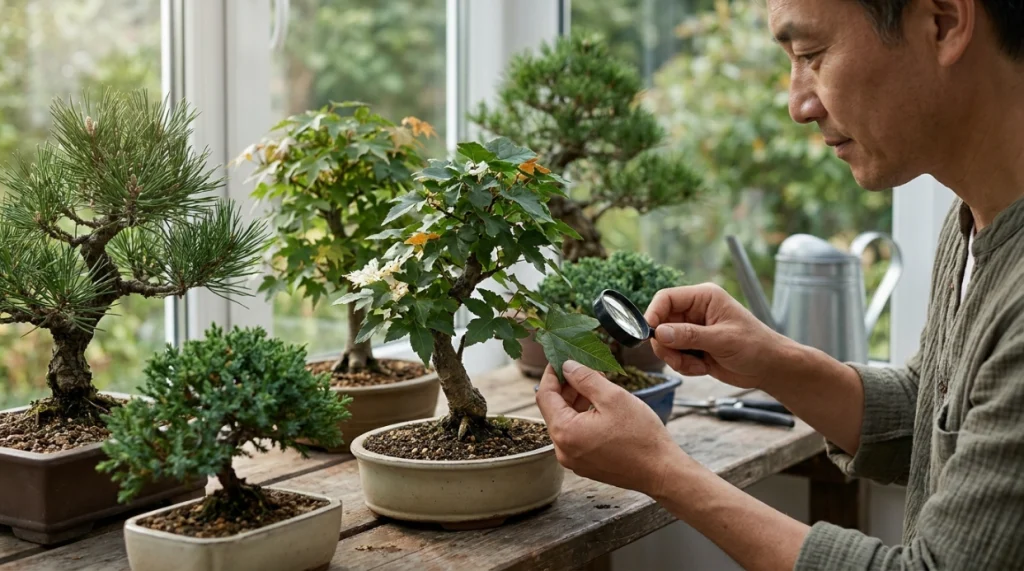
Prevention starts with catching the first few insects before they become a colony. I make the underside of leaves part of a normal bonsai inspection rather than waiting for visible damage.
Inspect new plants before introducing them
New bonsai, houseplants, cuttings, and nursery plants can carry pests unnoticed. Examine both leaf surfaces before placing a new plant beside an established collection.
Keep enough space between plants
Crowded foliage makes inspection difficult and helps mobile pests move between plants. Better spacing also improves airflow around the canopy.
Keep the bonsai healthy without overcorrecting
Provide the light, watering, drainage, and seasonal care appropriate for your species. A pest problem is not a reason to suddenly flood, heavily fertilize, or completely change the tree’s normal care routine.
Check for honeydew and ants
Sticky leaves can reveal sap-feeding insects before the population becomes obvious. Ant activity around honeydew-producing pests can also be a useful warning sign.
Monitor after the infestation appears gone
Continue checking the previously affected foliage and surrounding plants. A short inspection while watering can reveal new adults before another large colony develops.
As of 2026, integrated pest management remains the approach I prefer: identify the pest, reduce it physically, use targeted controls when needed, and keep monitoring afterward.
Section Takeaway: Regular inspection is easier on a bonsai than fighting a large whitefly population after it becomes established.
Frequently Asked Questions
Can whiteflies kill a bonsai tree?
A few whiteflies usually won’t kill a healthy bonsai. A heavy or persistent infestation can weaken foliage, reduce vigor, cause leaf loss, and place extra stress on an already struggling tree.
Will dish soap kill whiteflies on bonsai?
I prefer a commercially formulated insecticidal soap labeled for plants instead of homemade dish-soap mixtures. Household detergents vary in formulation and can injure leaves, while registered plant products provide specific concentration and safety instructions.
Does neem oil get rid of whiteflies?
Neem-based horticultural products may help reduce whiteflies when they directly contact susceptible stages. Complete coverage of leaf undersides and label-directed repeat applications are more important than simply spraying the visible adults.
Should I repot a bonsai because it has whiteflies?
Usually not. Whiteflies primarily live and feed on foliage, so unnecessary repotting may add root stress without solving the main infestation.
Should I remove every leaf with whitefly nymphs?
No. Removing several heavily infested leaves can help, but extensive defoliation may weaken the bonsai and should only be considered when appropriate for the species, season, and tree health.
Why are my bonsai leaves sticky when I have whiteflies?
Whiteflies excrete a sugary material called honeydew while feeding. This residue makes leaves sticky and can support black sooty mold growth.
How do I know when the whiteflies are gone?
Don’t judge only by the absence of flying adults. Continue inspecting the undersides of leaves until you repeatedly find no fresh adults, eggs, or developing colonies.
Final Takeaway: Whiteflies are easiest to control when you catch them early. Isolate the bonsai, inspect leaf undersides, reduce the population physically, use an appropriate labeled treatment, and keep checking until the entire life cycle has been interrupted.
If you’re caring for several bonsai, make pest inspection part of your normal watering routine. Those few extra seconds can prevent one infested tree from becoming a collection-wide problem.