How to Identify Aphids on a Bonsai
Quick Answer
To identify aphids on a bonsai, look for clusters of tiny, soft-bodied, pear-shaped insects around new shoots, buds, stems, and leaf undersides. Most are about 2–4 mm long, and close inspection may reveal two small tube-like structures called cornicles near the rear of the abdomen, a useful identification feature described by the University of Minnesota Extension aphid guide.
Signs That Point to Aphids
- Small soft bodies: Aphids usually look pear-shaped rather than hard, flat, or shell-like.
- Clustered colonies: Several insects often feed together around tender new growth.
- Paired cornicles: Two tiny rear-facing tubes can confirm an aphid under magnification.
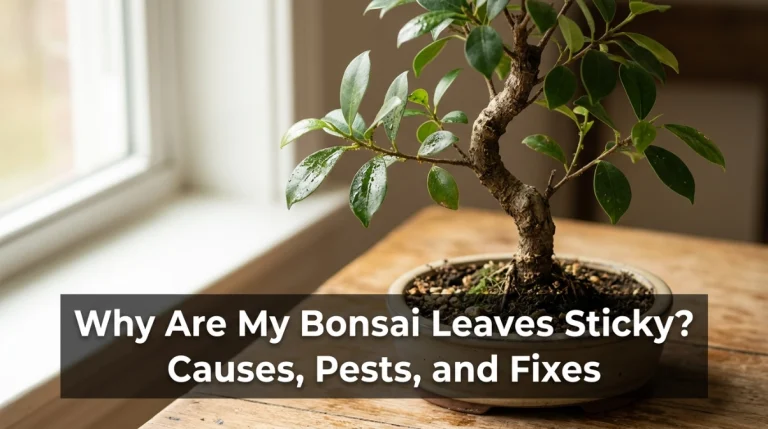
- Sticky honeydew: Leaves or branches may feel shiny or sticky below feeding colonies.
- Distorted growth: New leaves may curl, twist, yellow, or develop poorly.
- Ant activity: Ants repeatedly visiting shoots can indicate honeydew-producing insects nearby.
Best Confirmation Tip
- Use a 10x hand lens and check the insect’s body shape, cornicles, location, and surrounding plant symptoms before treating the bonsai.
Finding tiny insects on a bonsai can be unsettling because several common pests look similar at first glance. Correct bonsai aphid identification matters because treating the wrong pest wastes time and can stress an already weakened tree.
I prefer to identify the insect first, then decide whether intervention is needed. This guide shows you exactly what aphids look like, where they hide, and how to separate them from common look-alikes.
In This Guide
What Do Aphids Look Like on a Bonsai?
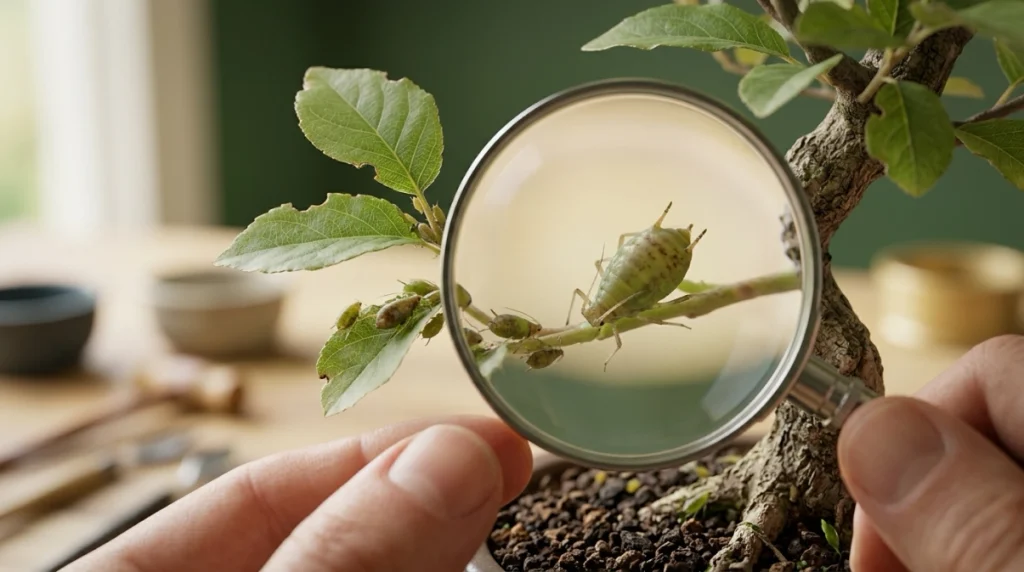
Aphids are small, soft-bodied insects with a rounded or pear-shaped profile. Many adults measure roughly 2–4 mm long, although exact size varies by species.
Color alone isn’t reliable. Aphids may be green, yellow, brown, gray, reddish, or nearly black.
Definition: An aphid is a sap-feeding insect that uses piercing-sucking mouthparts to draw fluids from tender plant tissue. One of its most useful identification features is a pair of rear abdominal structures called cornicles.
Look for the pear-shaped body
From above, aphids usually appear broader toward the rear and narrower near the head. Their bodies look softer than the protective shells of scale insects.
A hand lens makes this shape easier to recognize. On small-leaved bonsai, the difference can be difficult to see with the naked eye.
Check for two cornicles
Cornicles are small tube-like projections near the back of an aphid’s abdomen. They can resemble two tiny exhaust pipes when viewed under magnification.
Colorado State University Extension also lists these paired structures as a key aphid characteristic. Its overview of aphids on ornamental plants provides useful close-up identification context.
Some aphids have wings
Don’t rule out aphids just because an insect has wings. Aphid colonies can produce winged individuals that move to new host plants.
- Wingless aphids: Common within established colonies on shoots and leaves.
- Winged aphids: Often appear when populations disperse or conditions change.
- Nymphs: Immature aphids resemble smaller versions of wingless adults.
For identification, body shape and cornicles are more dependable than color or the presence of wings.
Where Do Aphids Hide on a Bonsai?
Aphids prefer areas where plant tissue is tender and sap is easy to access. Start your inspection with fresh growth rather than staring at the trunk or soil.
Check growing tips first
Soft shoots and newly unfolding leaves are prime feeding locations. I inspect these areas first because even a small colony stands out against pale new growth.
- Growing tips
- Fresh shoots
- Developing buds
- New leaf stems
- Soft branch tips
Turn leaves over
Leaf undersides provide shelter and can hide colonies from a quick top-down inspection. Gently lift several leaves instead of removing them.
Check along the central vein and where the leaf stem meets the shoot. Small aphids can blend closely with green plant tissue.
Inspect branch joints and flower buds
On flowering or rapidly growing bonsai, aphids may gather around buds and crowded branch junctions. These protected spaces can hide insects until the population increases.
Bonsai Empire also advises checking foliage, branches, and new growth when identifying common bonsai insects. Its general bonsai pest and disease guide illustrates aphids alongside other common bonsai pests.
Aphids may appear on many deciduous and flowering bonsai rather than one single species. Maples, elms, quince, and other trees producing soft seasonal growth deserve careful inspection during active growth.
What Signs Confirm Aphids Are Feeding?
Visible insects provide the strongest evidence, but plant symptoms can lead you to a hidden colony. Aphid feeding often affects the youngest growth first.
Sticky leaves or branches
Aphids excrete a sugar-rich waste called honeydew. It can leave leaves, branches, benches, or surfaces below the bonsai feeling sticky.
Honeydew doesn’t prove aphids by itself. Soft scale, mealybugs, and whiteflies can also produce it.
Curled or twisted new leaves
Heavy aphid feeding can distort developing tissue. New leaves may curl, twist, yellow, or remain smaller than surrounding healthy growth.
That pattern deserves attention because established leaves may still look normal. Always inspect inside curled leaves because pests can remain hidden there.
White flakes around a colony
You may see pale or white shell-like pieces near active aphids. These can be shed skins left behind as growing aphids molt.
Don’t automatically assume every white speck is a whitefly or mealybug. Use magnification and look for living insects beside the debris.
Ants repeatedly climbing the bonsai
Ant activity can be an indirect clue because ants may collect honeydew from sap-feeding insects. A single ant means little, but repeated traffic toward the same shoot deserves inspection.
- Follow the ants to their destination.
- Check tender shoots and leaf undersides.
- Look for sticky residue.
- Confirm the actual insect before treating.
Black surface growth
Sooty mold can grow on honeydew-coated surfaces, creating a dark film. The mold itself doesn’t identify which honeydew-producing pest is responsible.
The Pennsylvania State University Extension describes pear-shaped bodies, cornicles, and piercing-sucking feeding in its aphid identification guidance for ornamental plants. Those physical clues should take priority over secondary symptoms.
Section Takeaway: Confirm aphids by combining the insect’s soft pear-shaped body and cornicles with its location and feeding signs. Sticky leaves or curled growth alone are not enough for a confident diagnosis.
How Can You Tell Aphids From Other Bonsai Pests?
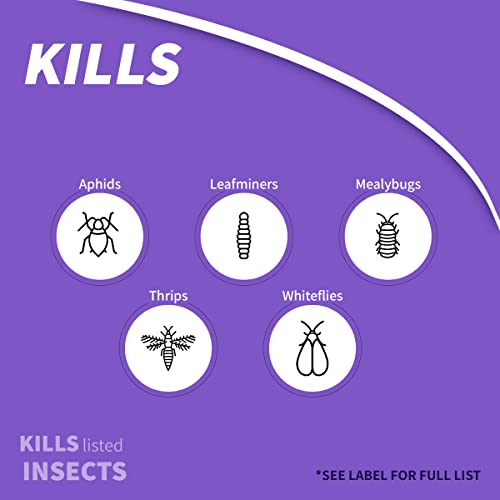
Aphids are commonly confused with scale insects, mealybugs, whiteflies, and spider mites. Looking at several traits together is safer than relying on one symptom.
| Pest | Typical Appearance | Common Clue | Best Separation Clue |
|---|---|---|---|
| Aphids | Soft, pear-shaped insects, commonly about 2–4 mm | Clusters, honeydew, curled new growth | Two rear cornicles under magnification |
| Scale insects | Fixed bumps or shell-like coverings | Honeydew may occur with soft scale | Mature scales usually remain attached like bumps |
| Mealybugs | White, waxy, cotton-like insects or deposits | Cottony material around joints | Waxy white covering rather than exposed pear-shaped bodies |
| Whiteflies | Tiny pale insects with obvious wings as adults | Adults may rise from foliage when disturbed | Winged adults fly readily from leaf undersides |
| Spider mites | Extremely tiny mite-like dots | Fine stippling and sometimes webbing | No cornicles; advanced infestations may produce fine webs |
Aphids versus scale
If the object resembles a hard bump attached tightly to a stem, suspect scale rather than an aphid. Aphids retain an obvious insect body with legs and antennae when viewed closely.
Aphids versus whiteflies
Gently disturbing a leaf can provide another clue. Adult whiteflies commonly fly away, while wingless aphids usually remain clustered or crawl slowly.
Aphids versus spider mites
Spider mites are much harder to see clearly without magnification. Fine leaf stippling or delicate webbing points toward mites rather than aphids.
Aphids versus mealybugs
Mealybugs often appear covered with white wax and may resemble tiny cottony patches. Aphids usually have more clearly exposed bodies without that cotton-like coating.
As of 2026, photographs from identification apps can help narrow possibilities, but I wouldn’t treat an app result as final. Confirm the physical traits on the tree whenever possible.
What Should You Do After Identifying Aphids?
Once you are confident the insects are aphids, assess the size of the colony before reaching for a pesticide. A few aphids on an otherwise vigorous bonsai are different from colonies covering multiple shoots.
Separate the tree when practical
If your bonsai sits among other plants, temporarily moving it away can make monitoring easier. Isolation also reduces opportunities for mobile aphids to reach nearby plants.
Photograph the infestation
Take close photographs before disturbing the colony. Include both the insects and the affected shoot so you can compare changes during later inspections.
Check the whole tree
Don’t treat the first cluster as the entire infestation. Inspect all growing tips, branch junctions, leaf undersides, and nearby plants.
- Estimate how many shoots are affected.
- Look for winged aphids.
- Check for honeydew and ants.
- Inspect neighboring plants.
- Note whether the bonsai already appears stressed.
Start with the least disruptive appropriate response
Small colonies can sometimes be reduced by carefully removing insects or rinsing suitable foliage with water. Any pesticide or insecticidal product should be labeled for the intended plant and pest and used exactly as directed.
Avoid mixing random household chemicals because bonsai foliage can react badly to untested concentrations. Treatment is safer when identification comes first.
Repeated or severe infestations deserve advice from an experienced grower, local bonsai club, horticulture professional, or extension service. This is especially important for valuable or already weakened specimens.
How Do You Inspect a Bonsai for Aphids?
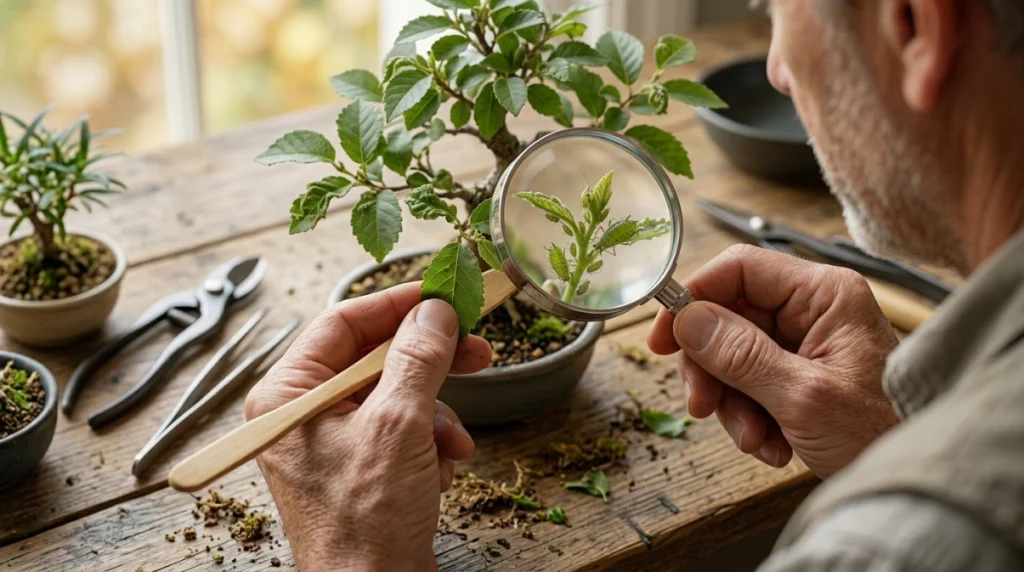
A useful aphid inspection takes only a few minutes once you know where to look. I like to combine it with routine watering checks so pest monitoring becomes automatic.
- Step back first: Look for uneven growth, curling, yellow patches, or unusually weak shoots.
- Inspect new growth: Examine buds, shoot tips, and newly opening leaves.
- Turn leaves over: Check several leaf undersides from different areas of the canopy.
- Follow sticky areas: Trace honeydew upward to possible feeding colonies.
- Watch ant traffic: Follow repeated ant movement toward branch tips.
- Use magnification: Look for pear-shaped bodies, antennae, legs, and paired cornicles.
- Check nearby plants: Inspect anything touching or sitting close to the affected bonsai.
When should you inspect more often?
Weekly checks are a practical baseline for healthy trees, but active growth deserves closer attention. Tender spring and early-summer shoots can change quickly.
- During vigorous new growth
- After buying a new bonsai
- After moving plants indoors or outdoors
- When nearby plants have aphids
- After finding honeydew or repeated ant activity
- During follow-up after an infestation
On a Chinese elm with dense foliage, I find a small hand lens especially useful around inner shoots. Crowded leaves can hide several insects only a few centimeters from apparently clean foliage.
Section Takeaway: Make aphid inspection systematic rather than random. New growth, leaf undersides, honeydew, ant trails, and a 10x hand lens give you a much better chance of finding a colony early.
Frequently Asked Questions
What do aphids look like on a bonsai tree?
Aphids are tiny, soft-bodied insects that often look pear-shaped. They may be green, yellow, brown, gray, red, or nearly black, and colonies often gather around tender shoots. Under magnification, look for two small cornicles projecting from the rear of the abdomen.
How small are bonsai aphids?
Many common aphids measure roughly 2–4 mm long, though exact size depends on species and life stage. Young nymphs can be smaller. Because bonsai leaves and shoots may also be small, a 10x hand lens makes body shape and cornicles easier to confirm.
Do aphids always make bonsai leaves sticky?
No. Honeydew is common when aphids are feeding, but a light infestation may produce little noticeable residue. Sticky foliage also occurs with pests such as soft scale, whiteflies, and mealybugs, so honeydew should trigger inspection rather than serve as the only diagnosis.
Can aphids be black instead of green?
Yes. Aphid color varies widely, and some species can appear black, brown, gray, yellow, reddish, or green. Color is therefore a weak identification feature. Body shape, clustered feeding, cornicles, and the location of insects on new growth provide stronger evidence.
Are white skins around my bonsai aphids?
They may be shed aphid skins rather than living insects. Aphids molt while developing, leaving pale exoskeletons near colonies. Check the surrounding shoot with magnification for living pear-shaped insects before assuming the white material is a different pest such as whiteflies or mealybugs.
Do ants on a bonsai mean it has aphids?
Not automatically. Ants may visit bonsai for several reasons, but repeated trails toward sticky shoots can indicate honeydew-producing insects. Follow the ants and inspect the destination carefully for aphids, scale, mealybugs, or whiteflies before choosing any treatment.
Should I spray my bonsai as soon as I find aphids?
Not necessarily. First confirm the pest and judge how widespread the infestation is. Small colonies may allow less disruptive controls, while larger infestations may require a labeled treatment. Always follow product directions because bonsai species and tender foliage can differ in sensitivity.
Final takeaway: The most reliable way to identify aphids on a bonsai is to combine several clues: a small soft pear-shaped body, paired cornicles, colonies around tender growth, honeydew, and distorted young leaves.
Make close inspection part of your normal bonsai routine. Catching a few aphids early is much easier than diagnosing a crowded colony after new growth has already curled and weakened.