How to Tell if Your Bonsai Has a Pest or Disease: A Practical Diagnosis Guide
A bonsai that suddenly develops yellow leaves, brown patches, weak growth, or dying twigs can make any grower worry. The difficult part is that pests, diseases, and ordinary care problems often produce similar symptoms.
Learning how to tell if your bonsai has a pest or disease helps you avoid treating the wrong problem. Spraying an already-stressed tree with an unnecessary pesticide can make matters worse, while ignoring an active infestation can allow it to spread quickly.
The best approach is simple: observe the symptoms, look for physical evidence, review recent care changes, and only then decide whether treatment is needed. This guide walks you through that process step by step.
Quick Answer
To tell if your bonsai has a pest or disease, inspect the leaves, stems, bark, soil surface, and roots for insects, webbing, sticky residue, spots, mold, soft roots, or spreading dieback. Then rule out watering, light, temperature, and fertilizer stress. Pests usually leave physical evidence; diseases often create progressive tissue damage.
Is It a Pest, Disease, or Care Problem?
Before treating your bonsai, separate the problem into three broad categories.
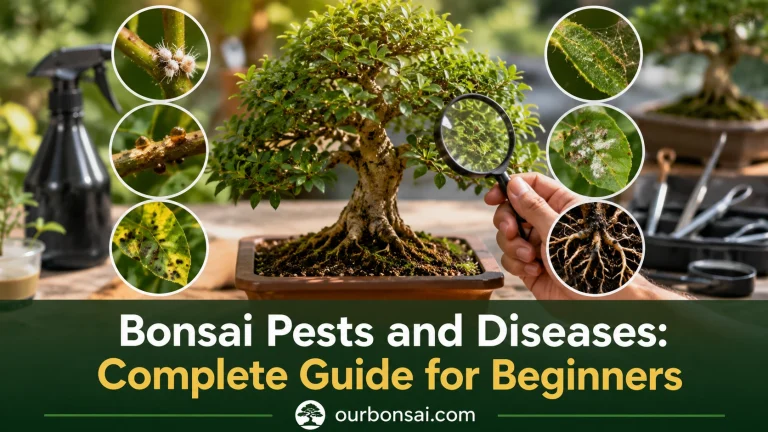
Pests are living organisms that feed on the tree. Common bonsai pests include aphids, spider mites, scale insects, mealybugs, whiteflies, caterpillars, and fungus gnats.
Diseases are usually caused by fungi, bacteria, viruses, or other pathogens. Common warning signs include unusual leaf spots, powdery coatings, rotting tissue, cankers, and progressive dieback.
Care-related stress is not an infection. It results from problems such as overwatering, underwatering, poor drainage, excessive fertilizer, insufficient light, sudden temperature changes, or root disturbance.
This distinction matters because stressed plants can look surprisingly similar to diseased plants. University of Maryland Extension’s guide to diagnosing indoor plant problems notes that wilting, yellowing, and leaf damage can have multiple causes, including water problems, root disease, pests, excess fertilizer salts, and environmental stress. (University of Maryland Extension)
Pest vs Disease vs Stress: Warning Signs Checklist
| What You See | More Likely Cause | What to Check Next |
|---|---|---|
| Fine webbing and tiny pale dots | Spider mites | Undersides of leaves |
| Sticky leaves or shiny residue | Aphids or scale | Stems, buds, leaf joints |
| White cotton-like clumps | Mealybugs | Leaf joints, bark crevices, roots |
| Hard brown bumps on stems | Scale insects | Young branches and leaf undersides |
| Irregular chewed edges or holes | Caterpillars or other chewing pests | Leaves and nearby hiding places |
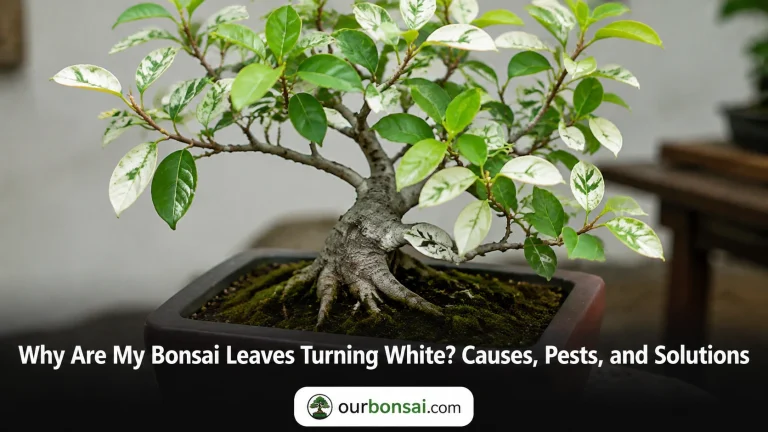
| White powder on foliage | Powdery mildew or similar disease | Airflow and affected leaves |
| Expanding brown or black spots | Leaf disease or environmental injury | Pattern and rate of spread |
| Yellow leaves with constantly wet soil | Overwatering/root problems | Drainage and root condition |
| Dark, soft, unpleasant-smelling roots | Root rot | Soil moisture and drainage |
| Crispy leaf tips after feeding | Fertilizer/salt stress | Recent fertilizer use |
| Sudden leaf drop after relocation | Environmental stress | Light, temperature, humidity |
| Progressive twig or branch death | Disease, root problem, or severe stress | Roots, bark, and branch pattern |
One symptom alone rarely proves the diagnosis. Look for a combination of symptoms and physical evidence.
Signs Your Bonsai Probably Has Pests
Most pest infestations eventually leave something you can see.
Tiny Insects on Leaves or Shoots
Check tender new shoots first. Aphids often gather around young leaves, buds, and soft stems because these areas are easy to feed from.
Heavy feeding can cause curled leaves, distorted growth, yellowing, and reduced vigor.
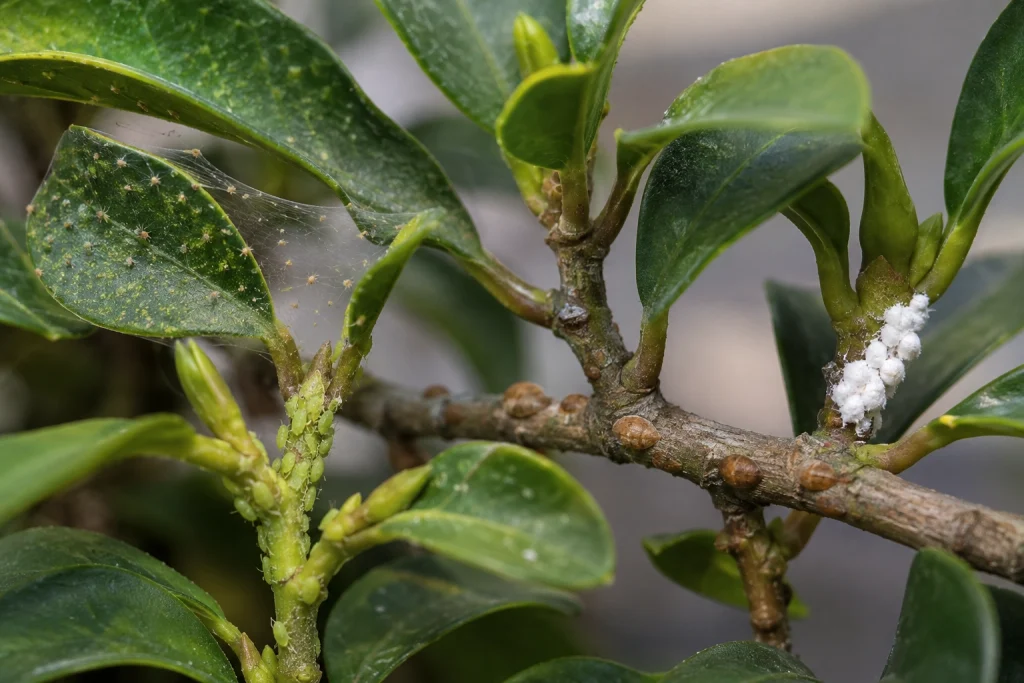
Scale insects look very different. They can resemble tiny brown, tan, or gray bumps attached firmly to stems or leaves. Beginners sometimes mistake them for part of the bark.
Fine Webbing and Speckled Leaves
Fine webbing combined with tiny pale dots on leaves strongly suggests spider mites.
The pale spotting is called stippling. It develops when mites damage individual plant cells while feeding.
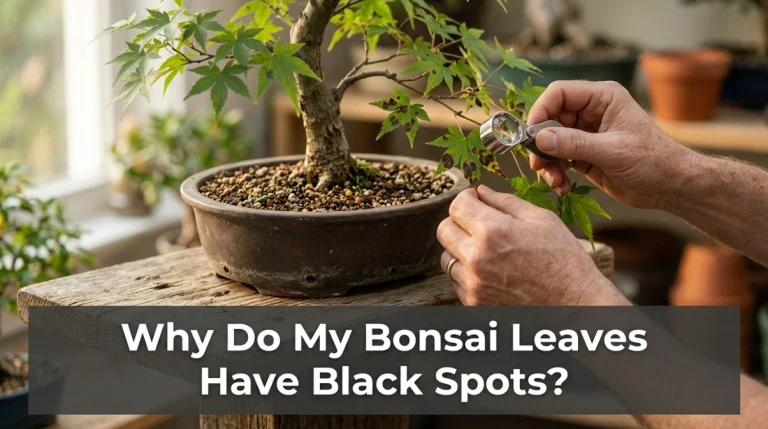
Spider mites can be extremely small, so a simple hand lens is useful. According to the University of Minnesota Extension’s spider mite identification guidance, mite feeding may produce white or yellow stippling, bronzing, leaf drop, and visible webbing as infestations become more serious. (University of Minnesota Extension)
Junipers and other conifer bonsai deserve especially careful inspection because mite damage can initially resemble drought stress or general browning.
Sticky Residue
A sticky coating on leaves, branches, the pot, or the shelf underneath your bonsai often indicates sap-feeding insects.
Aphids, scale insects, and some other pests produce a sugary substance called honeydew after feeding.
Dark sooty mold may later grow on this residue. The mold itself may not be the original problem—the insect infestation underneath it is what you need to find.
White Cotton-Like Material
White fuzzy patches around leaf joints, branch crotches, or protected bark areas may indicate mealybugs.
On tropical bonsai such as ficus, inspect sheltered areas carefully. Some mealybugs can also occur around roots, making infestations harder to notice.
Signs Your Bonsai May Have a Disease
Disease diagnosis can be more difficult because pathogens are not always visible.
Leaf Spots That Continue to Spread
A few brown spots do not automatically mean disease.
Sunburn, fertilizer damage, physical injury, or water stress can also create spots. Disease becomes more likely when lesions increase in number, expand over time, develop defined margins, or repeatedly appear on new leaves.
Remove badly affected fallen leaves from around the pot so they do not remain against moist soil.
White, Gray, or Fuzzy Growth
A powdery white coating may indicate powdery mildew.
Gray fuzzy growth can be associated with fungal decay, especially where dead or damaged plant material remains damp.
Poor airflow, crowded foliage, and prolonged moisture can make some disease problems easier to establish.
Dark or Soft Roots
Root problems deserve immediate attention because bonsai live in shallow containers with limited root space.
Healthy active roots are generally firm rather than mushy. Dark, soft, decaying roots combined with wilt, yellow foliage, weak growth, or persistently wet soil raise concern for root rot.
Penn State Extension describes slowing growth, yellowing foliage, root discoloration, and root deterioration among potential symptoms associated with fungal root rots. (Penn State Extension)
Do not automatically repot a severely stressed bonsai just because you suspect root trouble. Major root pruning can further weaken a tree that is already declining.
Cankers and Progressive Branch Dieback
A canker is a localized damaged or dead area of bark.
Look for unusual sunken areas, cracking, discoloration, or tissue death that appears to expand along a branch.
One dead twig may simply have dried out. Multiple branches declining progressively, especially when accompanied by bark lesions or root problems, deserve closer investigation.
How to Inspect a Bonsai Step by Step
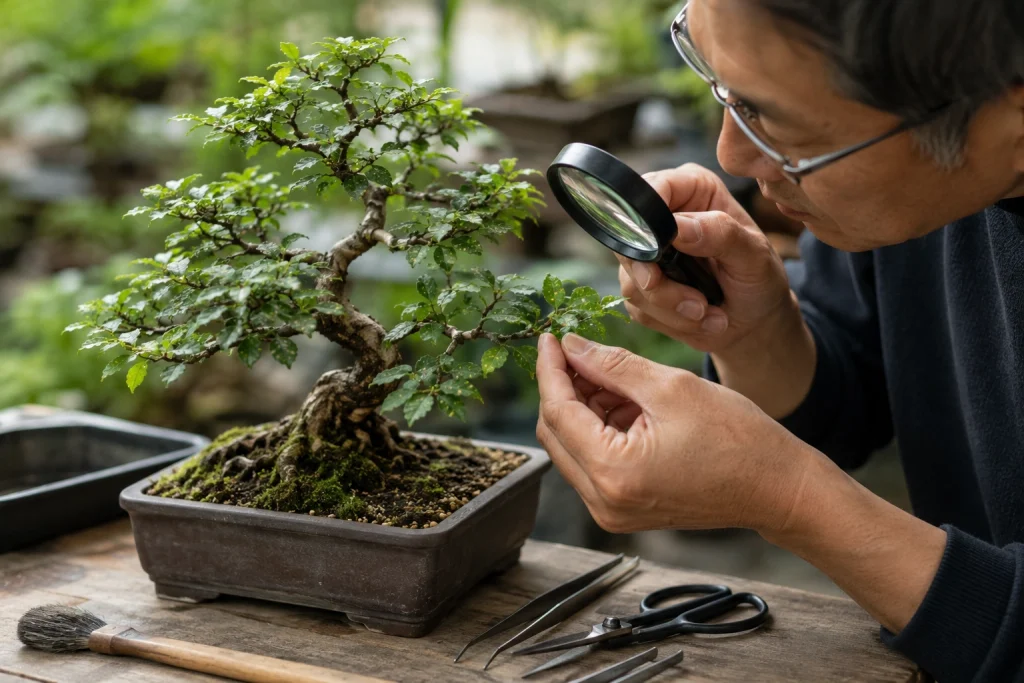
Diagnosing problems systematically is much safer than spraying first and asking questions later.
- Isolate the tree. Move a suspicious bonsai away from healthy trees when practical, especially if you see insects, webbing, or unexplained leaf damage.
- Inspect the newest growth. Aphids and other sap-feeding pests frequently gather around tender shoots.
- Turn the leaves over. Spider mites, whiteflies, scale, and other pests often hide on leaf undersides.
- Check branch joints and bark crevices. Protected areas are common hiding places for scale and mealybugs.
- Look at the soil surface. Watch for excessive moisture, algae, fungal growth, tiny flies, or decomposing organic material.
- Review the watering history. Ask whether the soil has been staying wet for unusually long periods or becoming completely dry.
- Consider recent changes. Moving indoors, intense afternoon sun, repotting, heavy pruning, fertilizer, wiring, or sudden cold can all produce stress symptoms.
- Inspect roots only when justified. If poor drainage, persistent wilt, sour-smelling soil, or root rot is strongly suspected, examine roots carefully without unnecessarily destroying the root ball.
Rule Out Common Care Problems First
Many apparent “diseases” are actually care problems.
Overwatering
Overwatering is particularly dangerous when the bonsai soil drains poorly.
Symptoms may include yellow leaves, reduced vigor, wilting despite wet soil, and eventually damaged roots.
Do not water according to a rigid calendar. Check the actual moisture level and the needs of the species.
Underwatering
Dry root balls can cause wilt, crispy leaf edges, foliage loss, and branch dieback.
A severely dried bonsai may continue losing foliage even after watering resumes because some damage has already occurred.
Too Much or Too Little Light
An indoor tropical bonsai receiving inadequate light may produce weak, stretched growth and eventually shed leaves.
Conversely, suddenly moving a shade-grown tree into intense direct sunlight can scorch foliage.
Fertilizer Stress
More fertilizer does not mean faster recovery.
Applying strong fertilizer to a sick or root-damaged bonsai can worsen stress. Excess salts may damage roots and create browning along leaf tips or margins.
Expert Tip: Before treating a bonsai for pests or disease, write down what changed during the previous two weeks—watering, location, weather, fertilizer, pruning, repotting, or a new plant nearby. The timeline often reveals the cause faster than the leaf symptoms alone.
What to Do When You Find a Pest
For a small infestation, physical removal can sometimes be enough.
Isolate the bonsai and remove easily visible pests where practical. Depending on the pest and tree species, rinsing foliage, pruning heavily infested disposable growth, or using an appropriately labeled horticultural product may help.
An Integrated Pest Management approach emphasizes identification and lower-risk controls before escalating treatment. University of Maryland Extension describes Integrated Pest Management as a research-based approach that combines monitoring, prevention, identification, and appropriate control measures. (University of Maryland Extension)
Never assume that a pesticide marketed for general garden plants is automatically suitable for every bonsai species.
Delicate foliage, stressed roots, high temperatures, and certain species can increase the risk of treatment injury.
If a pesticide is necessary, follow the manufacturer’s label exactly. The EPA’s pesticide safety guidance specifically recommends following label directions, precautions, and restrictions and keeping children and pets away as directed. (US EPA)
What to Do When You Suspect Disease
Start by correcting conditions that may be contributing to the problem.
Remove dead fallen material, improve appropriate airflow, avoid keeping foliage unnecessarily wet, and check drainage.
Do not automatically apply fungicide. A fungicide cannot correct sunburn, overwatering, fertilizer damage, or insect feeding.
If you suspect a serious root disease, widespread canker, bacterial infection, or another condition you cannot identify confidently, obtaining a proper diagnosis is usually more valuable than experimenting with several products.
Choosing Diagnostic and Treatment Supplies
You do not need an expensive bonsai toolkit to inspect a sick tree.
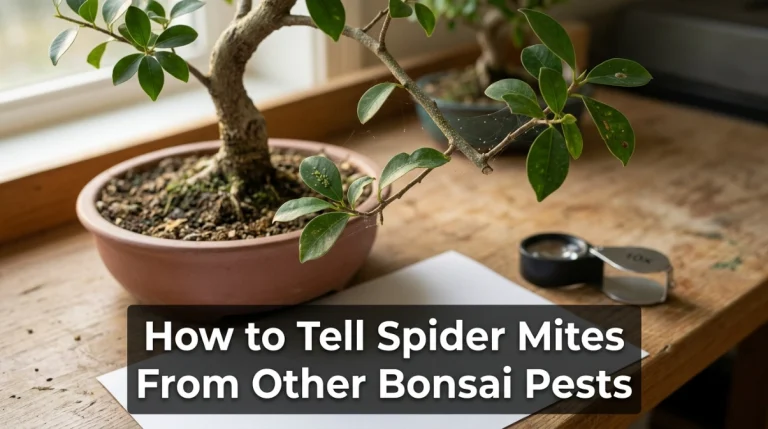
A bright light, a durable hand lens, a white sheet of paper for checking tiny moving pests, clean pruning tools, and good records are useful for almost every grower.
For beginners, diagnostic skill is more valuable than expensive equipment.
Species suitability also matters. A treatment tolerated by a hardy outdoor juniper may not be appropriate for a tender tropical bonsai. Similarly, spraying a weak or recently repotted tree can carry more risk than treating a vigorous specimen.
Quality matters most when it affects control and safety. Choose reliable pruning tools that can be cleaned easily and treatment products with clear labels rather than buying multiple low-cost remedies and mixing them experimentally.
When to Ask an Experienced Bonsai Grower or Arborist
Seek experienced help when the tree is valuable, old, structurally important, or declining rapidly.
Expert advice is particularly worthwhile when:
- Several branches are dying without an obvious cause.
- The trunk or major branches have expanding cankers.
- Most of the root system appears dark or rotten.
- Symptoms continue despite correcting watering and environmental problems.
- You cannot confidently identify a pest before applying treatment.
- A newly collected, recently repotted, or severely stressed bonsai requires major root work.
- Several bonsai in your collection develop the same unexplained symptoms.
For significant trees, a certified arborist, plant diagnostic laboratory, university extension service, or experienced bonsai professional may help distinguish disease from cultural stress.
Common Mistakes Bonsai Owners Should Avoid
- Treating yellow leaves as proof of disease. Yellowing can result from water, roots, light, temperature, pests, or normal seasonal changes.
- Spraying without identifying the pest. The wrong product wastes money and may damage the tree.
- Using stronger doses than the label allows. Stronger is not safer or necessarily more effective.
- Repotting every sick bonsai. Root disturbance can make an already weak tree worse.
- Fertilizing heavily to “bring it back.” Damaged roots may be unable to use extra nutrients.
- Ignoring leaf undersides. Many pests remain hidden there until infestations become severe.
- Leaving an infested tree beside healthy bonsai. Isolation makes monitoring and containment easier.
- Diagnosing from one symptom. Always consider the whole tree and its recent care history.
FAQs
Can yellow leaves mean my bonsai has pests?
Yes, but yellow leaves alone are not enough to diagnose pests. Check for insects, webbing, sticky residue, stippling, scale bumps, and distorted growth. Also review watering, light, temperature, and root health.
How can I tell if my bonsai has spider mites?
Look for tiny pale or yellow speckles on foliage, bronzing, fine webbing, and very small moving mites on leaf undersides. Holding white paper under a branch and gently tapping it can make tiny mites easier to notice.
How do I know if my bonsai has root rot?
Warning signs include persistently wet soil, poor vigor, yellowing, wilt, and dark, soft roots. Healthy roots should normally feel firm. Do not aggressively remove roots unless you have good reason to believe root decay is present.
Should I spray my bonsai as soon as I see leaf spots?
Usually not. Leaf spots may result from disease, sunburn, fertilizer injury, physical damage, or water stress. Identify the likely cause before applying fungicide or pesticide.
Can bonsai pests spread to other plants?
Yes. Many plant pests can move between suitable host plants. Isolating a newly infested or suspicious bonsai helps reduce the chance of spreading the problem while you identify it.
Why is my bonsai dying even though I cannot find pests?
The cause may be environmental or root-related rather than insects. Check watering, drainage, light, temperature, fertilizer use, recent pruning, repotting, and root condition before assuming the tree has a disease.
Can a sick bonsai recover?
Many can recover when the underlying problem is caught early and corrected. Recovery depends on the species, severity of damage, root health, season, and overall vigor. Avoid major pruning, repotting, or heavy feeding until a seriously stressed tree has stabilized.
Conclusion
Knowing how to tell if your bonsai has a pest or disease starts with observation rather than treatment.
Look for physical evidence such as insects, webbing, sticky residue, unusual coatings, spreading lesions, damaged roots, or progressive branch dieback. At the same time, rule out overwatering, poor drainage, inadequate light, fertilizer stress, and recent environmental changes.
The most useful habit is regular inspection. Check new growth, leaf undersides, branches, and soil whenever you water. Small problems are much easier to manage before they become serious.
When the diagnosis remains uncertain, especially with severe root damage or major branch dieback, get experienced help instead of experimenting with multiple treatments. Inspect first, identify the cause, and then choose the least disruptive solution that gives your bonsai the best chance to recover.