Best Pre-Bonsai Trees for Styling Practice: 9 Starters Compared

As an Amazon Associate we earn from qualifying purchases. See our affiliate disclosure.
In this guide
- Our Top Picks at a Glance
- What Makes a Good Pre-Bonsai Species
- 1. Bonsai Outlet Windswept Juniper 3-Tree Set (Best Overall Practice Set)
- 2. Trident Maple in a Quart Pot (Best Deciduous Starter)
- 3. Mikawa Japanese Black Pine, 1 Year (Best Pine Starter)
- 4. Florida Foliage Shimpaku Juniper, 3 Plants (Best Juniper for the Long Term)
- 5. My Shelfie Green Mound Juniper, 2 in Pot (Cheapest Way to Practise Wiring)
- 6. My Shelfie Dwarf Olive, 2 in Pot (Best Starter for Warm Climates)
- 7. Dwarf Myrtle Starter, 2 in Pot (Best Small-Leaved Starter)
- 8. Banshosho Japanese Black Pine, 2 Year (Best Dwarf Pine)
- 9. Jonsteen 5-Seedling Bonsai Bundle (Best Variety Pack)
- Also Worth a Look
- How to Choose Pre-Bonsai Material
- Frequently Asked Questions
- Final Verdict
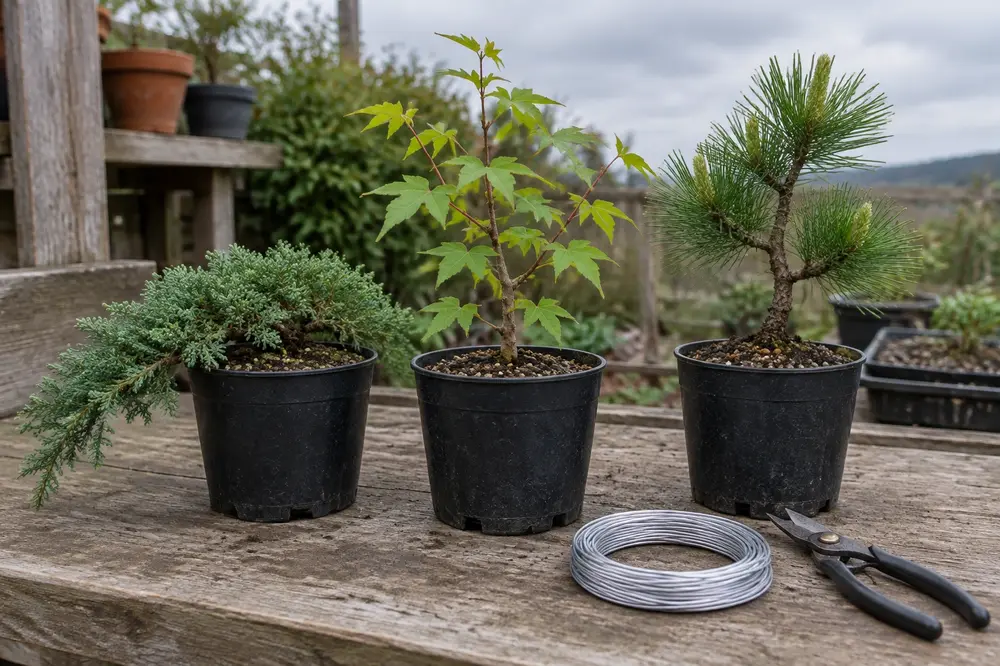
Quick answer: the best pre-bonsai for styling practice is the Bonsai Outlet Windswept Juniper 3-tree set: three young procumbens junipers in 4-inch pots, sold specifically as pre-bonsai, cheap enough to experiment on and forgiving of wiring. For a deciduous tree that develops fast, buy a trident maple in a quart pot. For pine, start with a one-year Mikawa Japanese black pine, the cultivar professionals use.
Pre-bonsai is a young tree with bonsai potential that has not been styled yet: a nursery plant, a rooted cutting or a seedling with a few years’ growth. It is the material experienced growers actually start from, and it is the best way to learn, because every technique (pruning, wiring, repotting, root work) is cheaper to get wrong on an inexpensive starter than on a finished tree. The trees below were chosen for species that respond well to training, and compared on the sellers’ listings as of November 1, 2026. Prices and stock change; we have not grown these particular plants.
Our Top Picks at a Glance
| Starter | Species | Size (per listing) | Best for |
|---|---|---|---|
| Bonsai Outlet Windswept Juniper, 3-tree set | Juniper | 5-8 in, 4 in pots | Best overall practice set |
| Trident Maple, quart pot | Trident maple | 10-16 in | Best deciduous starter |
| Mikawa Japanese Black Pine, 1 year | Black pine | 1-year tree | Best pine starter |
| Florida Foliage Shimpaku Juniper, 3 plants | Shimpaku | 3 live plants | Best juniper for the long term |
| My Shelfie Green Mound Juniper, 2 in pot | Juniper | 2 in pot | Cheapest way to practise wiring |
| My Shelfie Dwarf Olive, 2 in pot | Olive | 2 in pot | Best starter for warm climates |
| Dwarf Myrtle Starter, 2 in pot | Myrtle | 3-4 in | Best small-leaved starter |
| Banshosho Japanese Black Pine, 2 year | Dwarf black pine | 2-year plant | Best dwarf pine |
| Jonsteen 5-Seedling Bonsai Bundle | Pine, redwood, cypress | 5 seedlings | Best variety pack |
What Makes a Good Pre-Bonsai Species
Three things: small leaves or needles that reduce further with pruning, branches that bend and hold a wire without snapping, and a willingness to bud back on old wood after a hard cut. Juniper, trident maple, Chinese elm, Japanese black pine, olive and myrtle all qualify. Jacaranda, flame tree and most houseplants sold as “bonsai starters” do not, however fast they grow. If you want to understand the goal before you buy, our guide to the best trees to make bonsai from explains the species in more depth.
1. Bonsai Outlet Windswept Juniper 3-Tree Set (Best Overall Practice Set)
| Species | Procumbens juniper, windswept pre-bonsai form |
|---|---|
| Size | 5 to 8 in tall, 6 to 10 in spread, 4 in plastic pots |
| Seller | Bonsai Outlet / New England Bonsai Gardens |
| Where it lives | Strictly outdoors |
This is the only listing in our search that is sold explicitly as pre-bonsai by a bonsai nursery, and it shows: the trees have been grown with a leaning, windswept trunk already, the seller tells you the exact height and spread, and it is blunt that these are outdoor trees. Three trees means you can try three different ideas, or wire one, prune one and leave one to compare.
Procumbens juniper is the ideal wiring teacher. Its branches are flexible, it tolerates heavy bending, and mistakes rarely kill it. Use low-intensity morning sun as the seller suggests until the trees are established, then full sun. Our juniper styles for beginners guide gives you designs to aim for.
Pros
- Sold as pre-bonsai by a real nursery
- Three trees to experiment on
- Honest size and placement information
Cons
- Outdoor only
- Limited stock when we checked
Best for: beginners who want to learn wiring on a forgiving species.
2. Trident Maple in a Quart Pot (Best Deciduous Starter)
| Species | Acer buergerianum |
|---|---|
| Size | 10 to 16 in tall, quart pot |
| Where it lives | Outdoors, deciduous |
| Also available | 2-pack listing |
Trident maple is the species bonsai teachers use to show how fast a tree can develop: thick trunks in a few years in the ground, quick wound healing, strong back-budding and a flaring root base. A 10 to 16 inch tree in a quart pot is exactly the right stage to start: cut it back hard in spring to build taper, or plant it in a grow box to thicken. The two-tree listing is better value if you have the space.
Maples wire less happily than junipers (the bark marks easily), so this is the tree for learning clip-and-grow pruning. See how to prune maple bonsai and how to develop nebari.
Pros
- Fastest species to develop
- Excellent for learning pruning and root work
- Cheap
Cons
- Wire marks the bark quickly
- Needs cold winter dormancy
Best for: growers who want to see progress every season.
3. Mikawa Japanese Black Pine, 1 Year (Best Pine Starter)
| Species | Pinus thunbergii ‘Mikawa’ |
|---|---|
| Age | 1-year tree |
| Seller | Japanese Maples and Evergreens |
| Where it lives | Outdoors |
Mikawa is the black pine cultivar prized for bonsai because of its short, stiff needles and rough, early-forming bark. A one-year tree is a long project, but pine techniques (decandling, needle pulling, sacrifice branches) are best learned on cheap young trees over many years, and a Japanese black pine grown from this stage will have better low branching than a nursery pine cut down later.
Keep it in full sun, in gritty soil, and read our guide to candle pruning pine bonsai before you touch it. Buy two.
Pros
- The cultivar professionals use
- Cheap entry to pine bonsai
- Short needles
Cons
- Very young; years of growth needed
- Pine techniques take practice
Best for: patient growers who want to learn pines properly.
4. Florida Foliage Shimpaku Juniper, 3 Plants (Best Juniper for the Long Term)
| Species | Juniperus chinensis (shimpaku) |
|---|---|
| Quantity | 3 live plants |
| Where it lives | Outdoors (ignore the indoor claim) |
Shimpaku is the juniper of serious bonsai: soft, scale-like foliage, fine pads and bark that reddens with age. Three young plants give you material to train now and a tree to graft foliage from later, which is how many of the best junipers are made. The listing’s suggestion that it suits indoor spaces is wrong, as it is for every juniper; keep them outside.
Treat these as nursery starters rather than shaped trees: pot them into gritty soil, let them grow for a season, then start selecting trunk lines. Our juniper care guide covers the basics.
Pros
- The best juniper foliage for bonsai
- Three plants for the price
- Hardy
Cons
- Listing overstates indoor suitability
- Unstyled nursery material
Best for: growers planning junipers they will keep for decades.
5. My Shelfie Green Mound Juniper, 2 in Pot (Cheapest Way to Practise Wiring)
| Species | Juniperus procumbens ‘Nana’ |
|---|---|
| Size | 2 in nursery pot |
| Where it lives | Outdoors |
A tiny plug of the same species as the Bonsai Outlet set, at a fraction of the price. It is too small to style yet, but it is perfect for learning how aluminium wire feels on a live branch, how much a juniper will bend, and how to pot up a young plant. Buy several and grow them on. Our guide to wiring bonsai branches is the companion read.
Pros
- Very cheap
- Right species for wiring practice
Cons
- Years from styling
- Small plugs dry out fast
Best for: anyone who wants to practise wiring before touching a better tree.
6. My Shelfie Dwarf Olive, 2 in Pot (Best Starter for Warm Climates)
| Species | Olea europaea, dwarf |
|---|---|
| Size | 2 in pot |
| Where it lives | Outdoors in warm zones; bright indoors in winter elsewhere |
Olive is one of the most rewarding Mediterranean bonsai: small grey-green leaves, bark that fissures young, and extraordinary tolerance of hard pruning. A dwarf starter in a 2-inch pot is the cheapest way in. In hot, dry climates it can live outdoors all year; elsewhere it needs the sunniest window in winter. See our olive bonsai winter care guide.
Pros
- Tough, drought tolerant
- Takes hard pruning
- Attractive bark
Cons
- Slow to thicken in a small pot
- Needs strong light
Best for: growers in warm or sunny places.
7. Dwarf Myrtle Starter, 2 in Pot (Best Small-Leaved Starter)
| Species | Myrtus communis ‘Compacta’ |
|---|---|
| Size | 3 to 4 in tall, 2 in pot |
| Where it lives | Outdoors in mild climates, bright indoors in winter |
Dwarf myrtle has tiny aromatic leaves, dense twiggy growth and white summer flowers, and it is a traditional Mediterranean bonsai subject. It buds back well and suits clip-and-grow styling into small, refined trees. Like olive it wants sun and dislikes frost.
At 3 to 4 inches it is a plug to grow on for a year or two before styling, but the small leaves mean it reaches a convincing scale sooner than most species.
Pros
- Very small leaves
- Flowers
- Easy to shape by pruning
Cons
- Frost tender
- Small starter
Best for: growers who like small, detailed trees.
8. Banshosho Japanese Black Pine, 2 Year (Best Dwarf Pine)
| Species | Pinus thunbergii ‘Banshosho’ |
|---|---|
| Age | 2-year plant |
| Hardiness | Zones 5 to 8 per the seller |
| Where it lives | Outdoors |
Banshosho is a dwarf black pine with a compact, dense habit and upright, bottle-brush branches. It is slower and tighter than standard black pine, which makes it suited to small and medium bonsai without years of needle reduction. A two-year plant shipped in its original soil is a sound start.
Treat it like any pine: full sun, sharp drainage, patience.
Pros
- Naturally compact
- Two years old
- Good for smaller bonsai
Cons
- Slower trunk development
- Pine skills still required
Best for: growers who want a pine that stays small.
9. Jonsteen 5-Seedling Bonsai Bundle (Best Variety Pack)
| Species | Japanese black pine, dawn redwood, mugo pine, limber pine, bald cypress |
|---|---|
| Form | 5 live seedlings, seed-grown in California |
| Extras | Transplanting and care instructions |
Five conifer seedlings of species that all make good bonsai, grown from seed and shipped live, which skips the germination lottery of a seed kit. Dawn redwood and bald cypress are fast and forgiving; the three pines are slower, long-term projects.
Pot each into its own container with gritty soil and let them grow for two or three years before serious work. For the cypress, our cedar and cypress care notes will help.
Pros
- Five good bonsai species
- Live seedlings, not seeds
- Care instructions included
Cons
- Seedlings, so several years from styling
- Conifers need outdoor conditions
Best for: growers who want a small collection to develop over time.
Also Worth a Look
- Pixie Dwarf Japanese Maple, 2 year: a dwarf red-leaved Acer palmatum with short internodes, for maple lovers who want colour; it needs winter dormancy and is shipped dormant from November to May.
- Brussel’s Medium Trident Maple: already potted and lightly shaped, a step between pre-bonsai and bonsai. See our review.
- CZ Grain 40 bare-root trees, 20 varieties: for someone starting a growing field rather than a windowsill. Two each of twenty species, shipped dormant.
How to Choose Pre-Bonsai Material
Buy the species, then the trunk
Among suitable species, the one thing you cannot add later is trunk movement and low branching. A cheap tree with a bend in the first few inches of trunk is worth more than an expensive straight one.
Buy in multiples
Two or three of the same species let you compare approaches and absorb a loss. The Bonsai Outlet set, the Shimpaku trio and the Jonsteen bundle are built this way.
Do not style on arrival
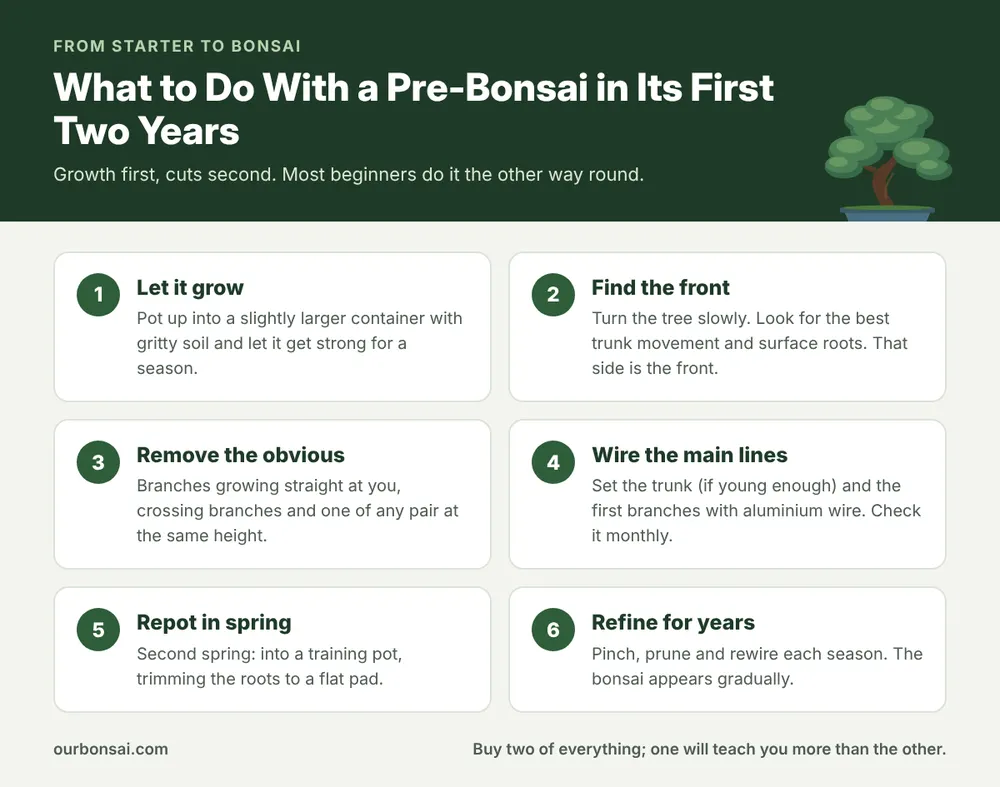
A plant that has just been shipped needs a season of growth in a slightly larger pot before it can take pruning and wiring. The infographic above sets out the order. For the soil, see our guide to bonsai soil mix ratios.
Consider the garden centre too
Landscape junipers, boxwood and cotoneaster in one-gallon pots are often thicker-trunked than anything sold as pre-bonsai online. Mail order wins on species choice; the garden centre wins on trunk size. Many growers use both. When you are ready for a finished tree, our guides to the best bonsai under $100 and best live bonsai on Amazon take over.
Frequently Asked Questions
What is pre-bonsai?
A young tree with bonsai potential that has not yet been styled or put in a bonsai pot: a nursery plant, cutting or seedling of a suitable species. It is the raw material bonsai are made from.
What is the best pre-bonsai for beginners?
Procumbens juniper for learning wiring, trident maple or Chinese elm for learning pruning. Both are cheap, forgiving and fast to respond.
How long until a pre-bonsai looks like a bonsai?
Two to five years of growth and seasonal work for a small tree, longer for a thick trunk. Faster species such as trident maple show progress each season.
Can I buy pre-bonsai on Amazon?
Yes. Bonsai Outlet sells junipers labelled as pre-bonsai, and several nurseries sell young trident maples, black pines, olives and myrtles that serve the same purpose.
Should I wire or prune a new pre-bonsai first?
Neither. Let it grow for a season in gritty soil. Then prune the obviously wrong branches and wire the main lines, in that order.
Is nursery stock the same as pre-bonsai?
Nursery stock is landscape material that can become pre-bonsai once you select and cut it back. Trees sold as pre-bonsai have usually been grown with bonsai in mind, with more trunk movement and lower branching.
What soil should I pot pre-bonsai in?
A gritty, free-draining mix, such as akadama, pumice and lava or a quality pre-mixed bonsai soil, in a pot only slightly larger than the roots.
Final Verdict
Start with the Bonsai Outlet Windswept Juniper set for wiring, a trident maple for pruning, and a Mikawa black pine for the long game. Three species, a few dollars each, and you will learn more in two seasons than from any finished tree. The tools you need are covered in our guide to the best Japanese bonsai tool kits.