Common Bonsai Diseases Every Grower Should Know
A bonsai can look healthy one week and begin dropping leaves, developing dark spots, or losing branches soon afterward. The difficult part is figuring out whether you are seeing a true disease or simply the effects of poor watering, weak roots, heat stress, or another care problem.
Understanding the common bonsai diseases every grower should know makes that decision much easier. Early recognition can protect foliage, branches, roots, and sometimes the entire tree.
This guide explains the most common disease problems, what their symptoms look like, what beginners can safely do at home, and when a bonsai needs more experienced help.
Quick Answer
The common bonsai diseases every grower should know include root rot, powdery mildew, fungal and bacterial leaf spots, anthracnose, rust, canker diseases, and vascular wilts such as Verticillium. Watch for unusual spots, white coatings, blackened roots, branch dieback, wilting, and premature leaf drop. Correct diagnosis should always come before treatment.
Why Disease Can Become Serious Quickly in a Bonsai
A bonsai is a normal tree or shrub trained to remain small. Its compact size does not create completely different diseases. Bonsai generally develop many of the same fungal, bacterial, and other plant diseases as their full-sized counterparts.
The difference is the growing environment.
A bonsai lives in a shallow container with a limited volume of roots and soil. If drainage fails, roots remain wet, or a large percentage of foliage is damaged, the tree has fewer reserves available for recovery.
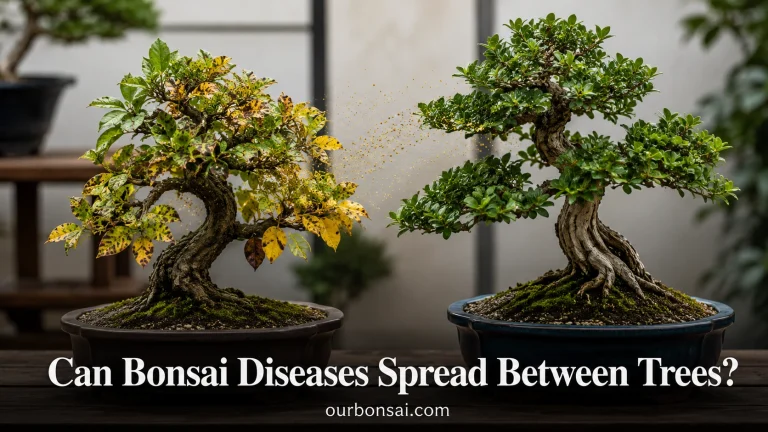
Problems can also spread when trees are grouped closely together.
Never assume every brown leaf or weak branch is a disease. Overwatering, underwatering, fertilizer burn, frost, sun scorch, poor drainage, root damage, and insect pests can produce remarkably similar symptoms.
Colorado State University Extension’s guidance on diagnosing plant disorders emphasizes identifying the actual problem before deciding how to manage it. That approach is especially useful with bonsai because treating the wrong problem can add more stress to an already weak tree. (CSU Engagement and Extension)
Disease or Care Problem? Check These Signs First
Use the entire tree rather than one damaged leaf when making your first assessment.
| What You See | Possible Disease | Possible Non-Disease Cause | First Check |
|---|---|---|---|
| Yellow leaves | Root disease, wilt | Overwatering, nutrient problem, seasonal change | Soil moisture and drainage |
| Brown leaf spots | Leaf spot, anthracnose | Sun scorch, chemical damage | Pattern and spread of spots |
| White powder | Powdery mildew | Mineral residue | Check whether coating rubs off and returns |
| Sudden wilting | Root rot, vascular wilt | Dry soil, heat stress | Root-zone moisture |
| Black or soft roots | Root disease | Prolonged waterlogging | Smell, texture, drainage |
| Dead branch tips | Canker, wilt | Wiring damage, drought, frost | Bark and branch condition |
| Black coating on leaves | Sooty mold | Usually linked to insects | Check for aphids or scale |
| Premature leaf drop | Several diseases | Water stress, heat, seasonal response | Recent care and weather |
Look for patterns. Disease symptoms frequently spread or repeat in characteristic areas, while environmental injury may correspond closely with an event such as a heat wave, repotting, fertilizer application, or missed watering.
1. Root Rot and Root Diseases
Root problems are among the most important conditions for a bonsai grower to recognize.
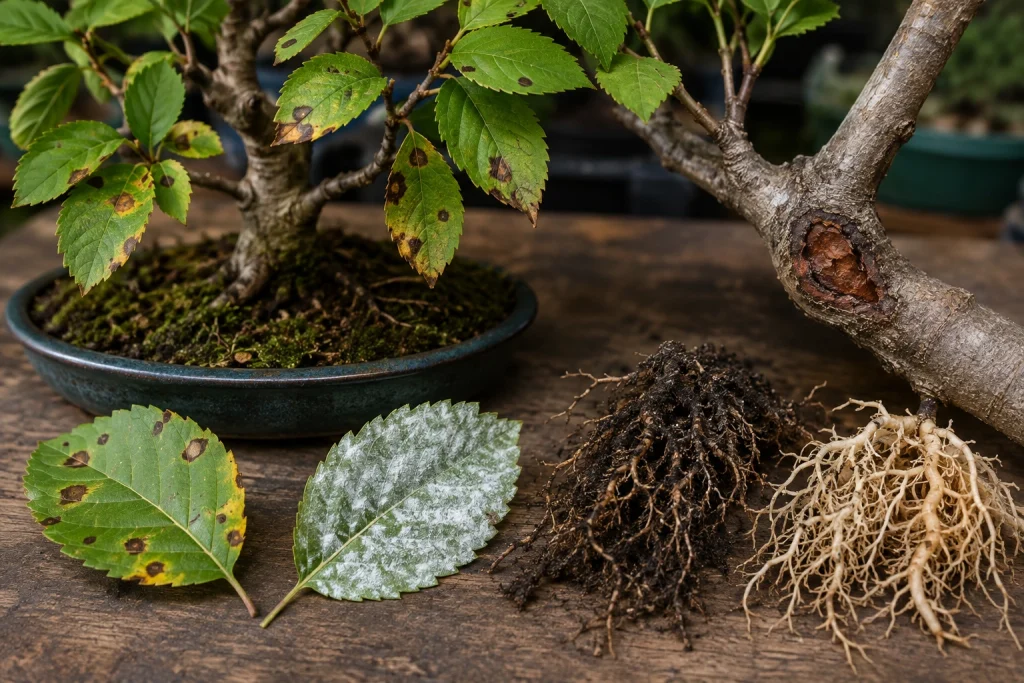
“Root rot” is a broad term rather than one single disease. Several fungi and fungus-like organisms, including Phytophthora species, can damage roots. Constantly saturated, poorly aerated soil can also kill roots and create conditions favorable to disease.
Common Warning Signs
Watch for:
- Persistent wilting even though the soil is wet
- Yellow or dull foliage
- Reduced new growth
- Unexplained leaf drop
- Branch dieback
- Dark brown or black roots
- Soft or decaying fine roots
- A tree that becomes loose in its pot because roots have deteriorated
Healthy fine roots are normally firm rather than mushy.
Moisture-related Phytophthora problems can produce yellowing, wilting, root decay, and dieback, and wet growing conditions are an important risk factor. (University of Minnesota Extension)
What to Do
First, stop treating watering as a fixed daily schedule. Check the soil and water according to the needs of the species, season, pot, and growing conditions.
Make sure drainage holes are open.
If severe root decay is suspected, the tree may eventually need examination outside the pot and removal of dead root tissue. However, do not automatically perform aggressive root pruning on a severely stressed bonsai. Removing too much functioning root tissue can make recovery less likely.
Repotting into a clean, free-draining bonsai substrate may help when degraded or waterlogged soil is contributing to the problem, but repotting does not guarantee that a true root pathogen has been eliminated.
2. Powdery Mildew
Powdery mildew is one of the easiest foliar diseases to recognize.
It usually looks like white or gray flour-like patches on the leaves. Young foliage may also become curled or distorted.
The University of Minnesota Extension’s powdery mildew guidance notes that powdery mildew on trees and shrubs is often more of an appearance problem than a serious health threat, although susceptibility varies among plants. (University of Minnesota Extension)
For a bonsai, repeated or heavy infections still deserve attention because preserving healthy foliage is important to maintaining tree vigor.
Practical Management
- Improve airflow around the canopy.
- Avoid crowding many bonsai tightly together.
- Remove badly affected fallen leaves.
- Keep the tree in the light conditions appropriate for its species.
- Avoid unnecessary heavy feeding that produces excessive weak growth.
- Monitor new leaves for continuing infection.
Do not completely defoliate a weak tree just because several leaves show mildew. Removing too much foliage creates another source of stress.
3. Fungal and Bacterial Leaf Spot Diseases
Leaf spots can appear as tiny brown dots, dark blotches, lesions surrounded by yellow tissue, or areas where dead tissue eventually drops out.
Some are fungal. Others are bacterial.
University of Minnesota Extension describes bacterial leaf spot symptoms on woody plants as dark brown to black spots that may have yellow halos; some can later develop a “shot-hole” appearance when dead centers fall away. (University of Minnesota Extension)
What Bonsai Owners Should Do
Remove fallen diseased leaves from the soil surface. Keeping old infected plant material directly beneath the canopy can allow some pathogens to persist.
Avoid repeatedly splashing water from infected foliage onto healthy leaves.
If you own several bonsai, temporarily giving the affected tree more space can also reduce splash and contact between plants.
Most importantly, do not choose a fungicide simply because the leaves have spots. Fungicides do not treat bacterial diseases, and different fungal pathogens require different management.
4. Anthracnose
Anthracnose is a name used for a group of fungal diseases affecting many woody plants.
Symptoms can include:
- Irregular brown or black leaf lesions
- Damage following leaf veins
- Curled or distorted foliage
- Dead young shoots
- Premature leaf drop
According to the University of Minnesota Extension anthracnose guide, anthracnose on shade trees commonly produces leaf spots, curling, and early leaf drop and can be favored by cool, wet spring conditions. (University of Minnesota Extension)
One episode of leaf damage does not automatically mean the bonsai is dying. A vigorous tree may replace lost foliage.
Repeated disease combined with poor root health, however, is more concerning.
5. Rust Diseases
Rust fungi often create yellow, orange, brown, or rusty-colored spots and spore-producing structures.
Some rust diseases require two different host plants to complete their life cycle. This matters to bonsai growers because junipers, crabapples, hawthorns, and other commonly cultivated woody plants can participate in certain rust disease cycles.
For example, cedar-apple-type rust diseases can involve junipers and plants in the apple family, with orange structures or powdery rust symptoms appearing depending on the host. (CSU Engagement and Extension)
Do not remove an important branch from a carefully styled juniper simply because you see a suspicious swelling.
A mature branch may represent years of development. Confirm whether the swelling is disease, normal bark development, old pruning tissue, or another problem before making an irreversible cut.
6. Canker and Branch Dieback Diseases
A canker is a localized dead or damaged area in the bark and underlying tissue of a stem or branch.
Possible signs include:
- Sunken bark
- Cracked or discolored areas
- Dead branch tips beyond the lesion
- Oozing or abnormal tissue
- A distinct boundary between healthy and dead bark
Cankers frequently become more serious when a tree is already stressed. Colorado State University Extension recommends reducing tree stress, pruning properly, and removing infected limbs as important management measures for Cytospora canker. (CSU Engagement and Extension)
For bonsai, pruning presents an additional challenge. Removing an affected branch could permanently change the design.
Tree health comes before styling. Saving a branch for appearance is rarely worthwhile if confirmed disease is progressing toward the trunk.
Use sharp, clean pruning tools. Higher-quality bonsai shears and branch cutters usually hold an edge longer and make cleaner cuts than very inexpensive tools, but even premium tools require cleaning and maintenance.
7. Verticillium Wilt and Other Vascular Diseases
Vascular diseases interfere with the tissues that move water through the tree.
Verticillium wilt is an important example.
Symptoms can include:
- Sudden wilting
- One branch or one side of the tree declining
- Small yellow leaves
- Branch dieback
- Dark streaking inside affected sapwood on some hosts
Verticillium is difficult to diagnose from external symptoms alone because root damage, drought, and other disorders may look similar. University of Minnesota Extension notes that affected woody plants may develop individual branch death as the pathogen disrupts water and nutrient movement. (University of Minnesota Extension)
There is no simple universal home treatment for a confirmed systemic wilt disease.
If a valuable bonsai develops unexplained one-sided dieback, professional diagnosis is more sensible than repeatedly spraying different products.
8. Sooty Mold: A Disease-Like Symptom That Often Means Pests
A black coating over foliage can look alarming.
Often, it is sooty mold.
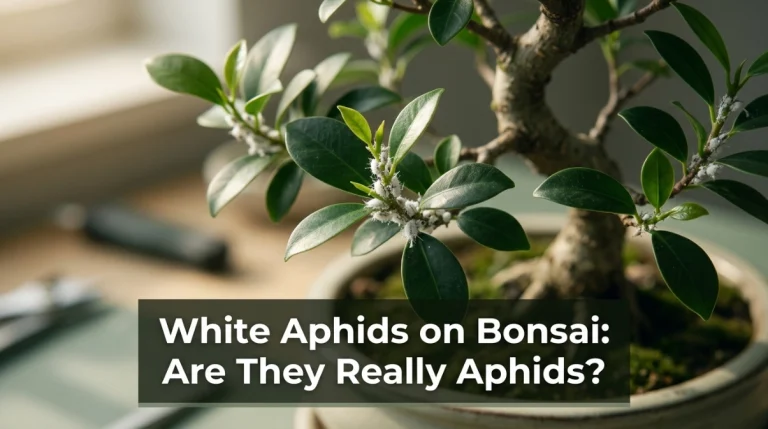
Sooty mold fungi grow on sugary honeydew produced by sap-feeding pests such as aphids and some scale insects. The mold itself generally grows on the honeydew rather than invading healthy leaf tissue. (University of Minnesota Extension)
That means repeatedly washing or spraying the mold without dealing with the insects does not address the main cause.
Check:
- Leaf undersides
- New shoots
- Branch junctions
- Bark crevices
- Sticky foliage
- Small bumps that could be scale insects
This is a good example of why disease and pest diagnosis should be considered together.
How to Respond When You Suspect a Bonsai Disease
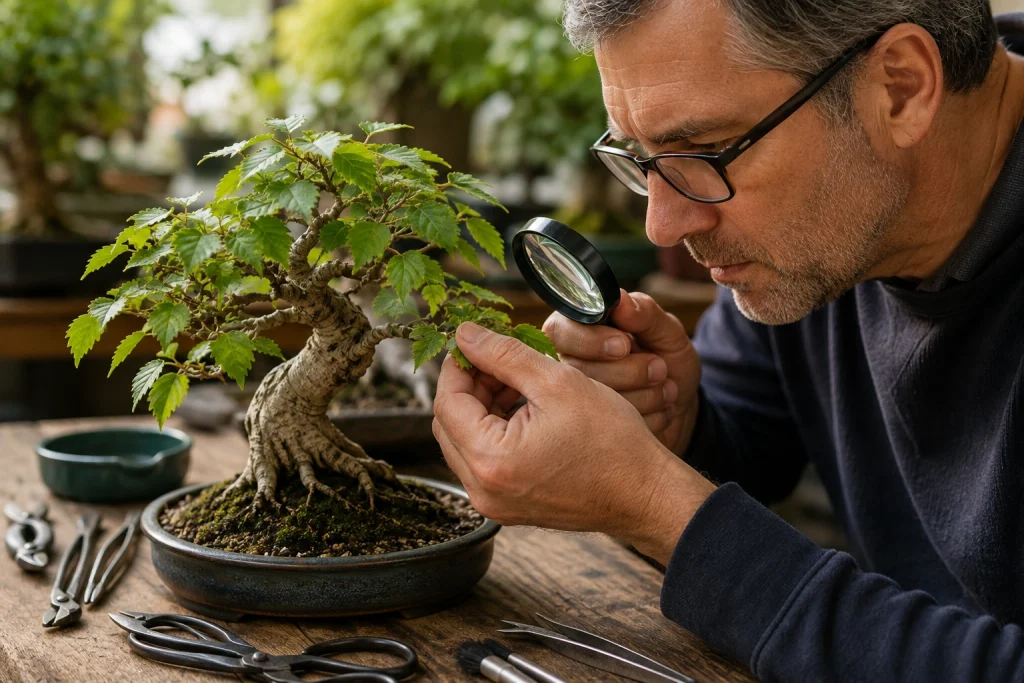
Avoid treating the tree immediately with every product in your cabinet.
Instead, work systematically.
- Separate the affected bonsai when practical. Give it space from healthy trees while you investigate.
- Check soil moisture and drainage. Rule out severe overwatering or underwatering.
- Inspect both sides of the leaves. Look for spores, spots, insects, webbing, scale, or unusual discoloration.
- Examine shoots, branches, and trunk. Look for cankers, wire damage, cracks, or localized dieback.
- Review recent care. Consider repotting, fertilizing, pruning, frost, heat, and pesticide applications.
- Remove obviously dead material when appropriate. Use clean, sharp tools.
- Identify the problem before applying chemicals. Treatment depends on the host species and disease.
- Monitor new growth. New symptoms can reveal whether the problem is still progressing.
Expert Tip
Expert Tip: Take clear photographs when symptoms first appear, then photograph the same leaves and branches several days later. The progression pattern can be much more useful for diagnosis than trying to remember how the bonsai looked a week earlier.
Should You Use a Fungicide on a Bonsai?
Sometimes, but not automatically.
Fungicides work best when the correct product is matched to the correct disease and host plant. Some products are mainly preventive rather than curative, meaning they protect healthy tissue but cannot restore leaves that are already damaged.
A product suitable for one ornamental plant may not necessarily be appropriate for every bonsai species.
If using a fungicide or other pesticide in the United States, follow the product label exactly. The EPA advises pesticide users to use products according to their label directions. (US EPA)
Never increase the concentration because the bonsai is badly affected. A stronger-than-labeled mixture can injure foliage and roots without improving disease control.
Also consider pets, children, nearby edible plants, protective equipment, application location, and required drying or re-entry instructions.
Prevention Is Usually Easier Than Treatment
Good bonsai culture cannot prevent every disease, but it reduces many opportunities for disease to become established.
Focus on These Basics
- Use a substrate appropriate for the species and climate.
- Make sure drainage holes remain functional.
- Water based on actual soil condition rather than the calendar.
- Provide the correct sunlight for the species.
- Allow airflow around foliage.
- Avoid leaving dead leaves piled on the soil.
- Clean tools after working with questionable plant material.
- Inspect newly purchased bonsai before placing them among established trees.
- Avoid major pruning or root work when a tree is already seriously weakened.
- Keep species-specific requirements in mind.
An indoor tropical bonsai and an outdoor temperate juniper should not be treated as though they have identical environmental needs.
Keeping an outdoor species permanently indoors can weaken it, while suddenly putting a shade-adapted tropical bonsai into intense outdoor sun can damage its leaves. Stress does not automatically cause an infectious disease, but a weakened tree may have less ability to recover from problems.
Common Mistakes Bonsai Owners Should Avoid
- Assuming every yellow leaf means root rot. Yellowing has many possible causes.
- Watering on a rigid daily schedule. Soil moisture changes with weather, pot size, species, and season.
- Spraying fungicide before diagnosing the problem. The symptom may be bacterial, pest-related, or environmental.
- Using a stronger chemical mixture than the label permits. More product does not mean better control.
- Repotting a severely stressed bonsai automatically. Major root work can worsen an already serious decline.
- Removing too many leaves at once. A weak tree needs functioning foliage to rebuild energy.
- Ignoring pests while treating sooty mold. The honeydew-producing insect is usually the underlying issue.
- Keeping diseased leaves beneath the tree. Sanitation is an easy preventive step.
- Prioritizing design over health. Sometimes an infected branch must be sacrificed to protect the rest of the tree.
When to Ask an Experienced Bonsai Grower or Arborist
Minor powdery mildew or a few leaf spots can often be managed with better culture and careful monitoring.
Get experienced help when:
- A valuable bonsai is rapidly declining.
- Major branches are dying unexpectedly.
- A suspected canker is approaching the trunk.
- Roots are severely decomposed.
- The tree continues wilting despite appropriate soil moisture.
- Symptoms return repeatedly after reasonable care corrections.
- You suspect Verticillium or another systemic disease.
- Treatment would require removing major roots or structural branches.
- You cannot distinguish disease from pesticide injury or environmental stress.
- Several bonsai begin developing the same symptoms.
For particularly valuable or mature specimens, a plant diagnostic laboratory, experienced bonsai professional, certified arborist, or local university extension service may be able to provide a more reliable diagnosis.
This is especially worthwhile before making irreversible decisions involving major branches, extensive root pruning, or disposal of an old specimen.
FAQs
Can a diseased bonsai tree recover?
Yes. Many bonsai recover from minor leaf diseases and early-stage problems when the underlying cause is corrected. Recovery depends on the disease, species, overall vigor, root health, season, and severity of damage. Systemic diseases and advanced root decay are much more difficult to manage.
How do I know whether my bonsai has root rot?
Possible signs include yellowing, persistent wilting in wet soil, declining growth, and dark or soft roots. These symptoms are not proof by themselves. Check drainage, watering habits, and root condition before assuming root disease.
Why does my bonsai have white powder on its leaves?
A white or gray powdery coating may be powdery mildew. Check multiple leaves and young shoots. Improve airflow and monitor the tree before taking aggressive action.
Should I remove diseased leaves from my bonsai?
Removing badly affected or fallen leaves can help with sanitation, but avoid stripping a weak bonsai of most of its foliage. The tree still needs healthy leaves for photosynthesis and recovery.
Can I use regular garden fungicide on bonsai trees?
Only if the product label allows use on the relevant type of plant and disease. Bonsai are not one plant species, so product suitability depends on what tree you are growing. Always follow label rates and restrictions.
Can overwatering cause bonsai disease?
Excessive moisture can damage roots and create conditions favorable to several root pathogens. However, watering frequency alone is not the whole issue. Soil structure, drainage, temperature, pot depth, species, and root condition also influence how quickly the substrate dries.
Should I repot a sick bonsai immediately?
Not always. Repotting can help when badly degraded or waterlogged soil is part of a root problem, but major root work is stressful. If the tree is extremely weak or you are unsure what caused the decline, seek experienced advice before performing aggressive root pruning.
Conclusion
Learning the common bonsai diseases every grower should know is less about memorizing every fungus and more about recognizing abnormal patterns early.
Root decay, powdery mildew, leaf spots, anthracnose, rust, cankers, vascular wilts, and sooty mold can all provide useful clues about what is happening to a tree. At the same time, overwatering, poor drainage, pests, weather damage, and other care problems can imitate disease.
Start with careful observation. Check the leaves, branches, trunk, roots, soil, and recent care history before choosing a treatment.
Most importantly, diagnose first and treat second. A thoughtful response is far safer for your bonsai than unnecessary spraying, emergency repotting, or aggressive pruning.
Make disease inspection part of your regular bonsai care routine, and investigate unusual changes early while you still have the widest range of options for protecting the tree.