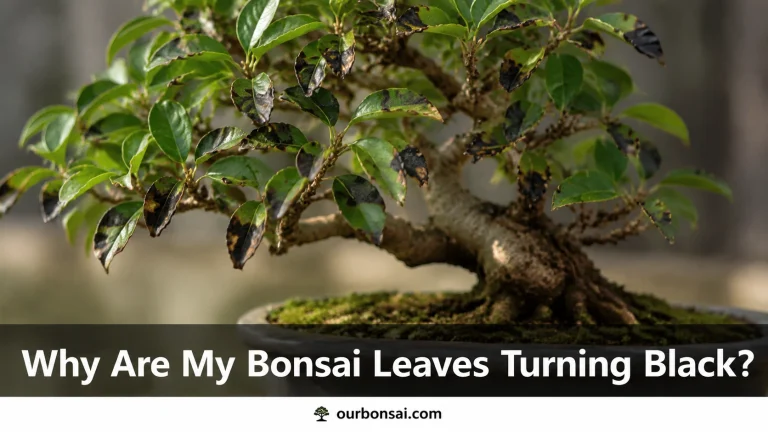
What Does Scale Look Like on Bonsai Trees?
Quick Answer
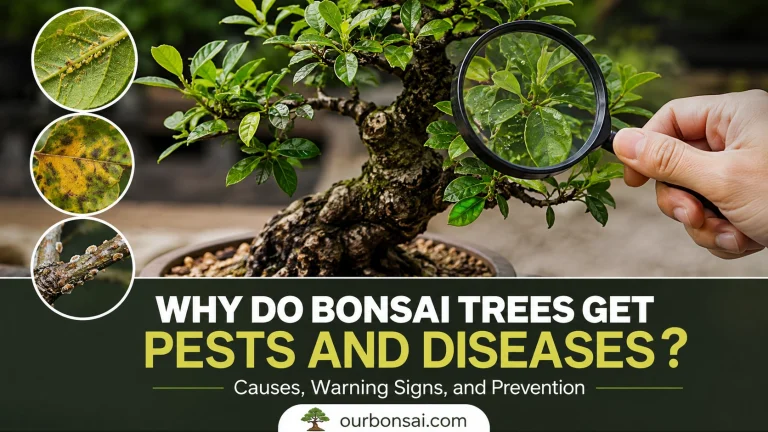
Scale on bonsai trees usually looks like tiny brown, tan, gray, white, or black bumps stuck firmly to leaves, twigs, or branches. Unlike most insects, adult scale may barely move and can resemble bark, scabs, or raised spots rather than bugs. UC IPM’s scale identification guidance notes that common scale coverings range from about 1/25 to 1/4 inch long.
Signs to check first
- Fixed bumps: Look for raised oval, round, or elongated spots that stay attached when the branch moves.
- Sticky leaves: Honeydew often points toward soft scale or another sap-feeding pest.
- Black coating: Sooty mold can grow on honeydew beneath an infestation.
- Yellow foliage: Larger infestations can weaken leaves and cause early leaf drop.
- Tiny crawlers: Newly hatched scale may appear as extremely small yellow or orange moving specks.
How to verify it
- Inspect several leaves and branches with a hand lens before treating the tree, because mealybugs, aphids, bark texture, and dried residue can resemble scale.
If you’ve found strange bumps on a bonsai branch, scale is easy to overlook because it doesn’t look much like an insect. I start by inspecting the bumps themselves, then look for honeydew, discoloration, crawlers, and changes in the tree’s vigor.
This guide explains exactly what scale looks like, where it hides, how armored and soft scale differ, and what to do when you find it. The identification details below reflect established scale-insect guidance available in 2026.
In This Guide
What Does Scale Look Like on a Bonsai Tree?
Scale insects usually look like small stationary bumps attached to the surface of a bonsai. You may find them on bark, twigs, leaf stems, or the leaves themselves.
Many adults lack an obvious insect shape. You usually won’t see clear legs, a head, or the familiar body outline you’d expect from an aphid or beetle.
Definition: Scale insects are sap- or plant-tissue-feeding insects whose settled stages often remain fixed to the plant beneath a waxy, shell-like, or body-derived covering.
Common colors and shapes
Scale varies by species and life stage. Color alone isn’t enough for identification.
- Brown or tan: Common on woody branches, where scale can blend into bark.
- Gray: Some armored scales look like small gray crusts or shells.
- White: Pale armored scales and wax-producing species may appear white or cream.
- Black: Dark soft scales can resemble tiny dark beads or bumps.
- Oval or round: Many mature females have circular, oval, or dome-shaped profiles.
- Elongated: Certain armored species produce narrow, shell-like coverings.
Size also varies. UC IPM reports that common scale coverings can range from roughly 1/25 inch to 1/4 inch long.
Why scale is easy to miss on bonsai
A mature bonsai trunk already contains lenticels, bark flakes, scars, old pruning marks, and natural texture. Scale can disappear visually among those features.
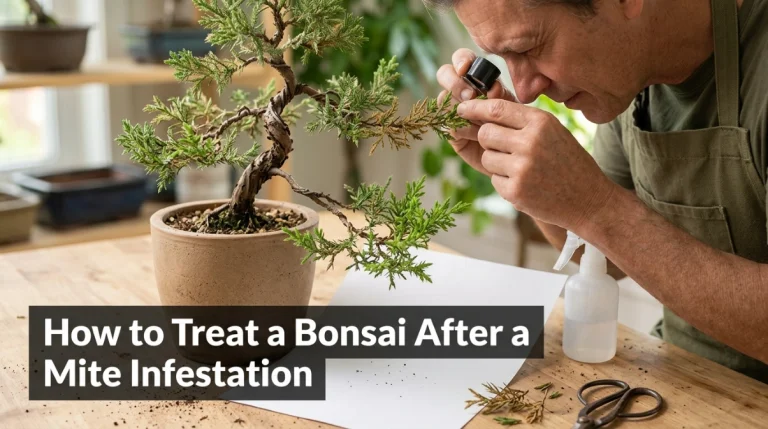
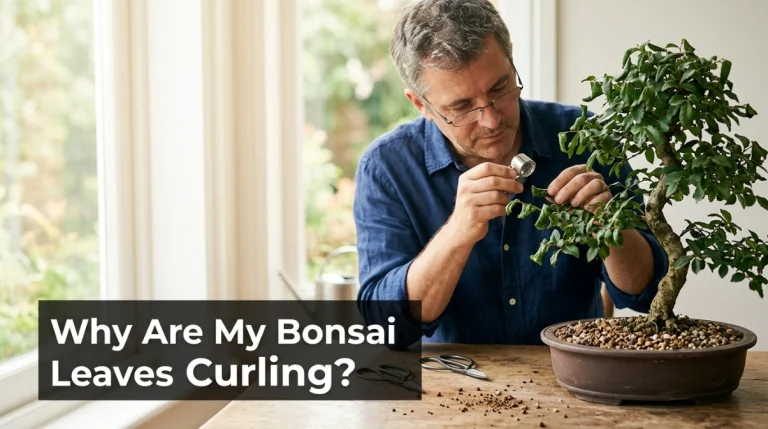
I find inspection easier when I rotate the tree under bright light rather than staring at it from the front. A 10× hand lens is especially useful on rough-barked trees and small-leaved bonsai.
- Compare suspicious bumps with unaffected branches.
- Look for repeated bumps of similar size and shape.
- Inspect around branch junctions and leaf stems.
- Check whether nearby foliage feels sticky.
- Watch for tiny moving crawlers near adult scale.
The Bonsai Empire pest and disease guide also includes scale among the insects commonly encountered on bonsai.
Section Takeaway: Scale usually looks more like a fixed bump than a recognizable insect. Shape, attachment, location, and nearby symptoms tell you more than color alone.
How Can You Tell Armored Scale From Soft Scale?
The two most useful groups for a home bonsai grower to recognize are armored scale and soft scale. Their appearance, honeydew production, and protective coverings differ.
| Feature | Armored Scale | Soft Scale |
|---|---|---|
| Typical profile | Flat to slightly raised | More rounded, convex, or dome-shaped |
| Protective covering | Separate waxy cover over the insect | Outer surface is part of the insect’s body |
| Honeydew | Usually absent | Common |
| Sooty mold | Usually not associated directly | May develop on honeydew |
| Crawler stage | Mobile, tiny, often yellow-orange | Mobile young stages also occur |
What armored scale looks like
Armored scale often resembles a tiny flattened plate stuck onto the tree. Many are less than 1/8 inch across.
With some armored species, the cover can be lifted while the insect’s body remains underneath. Armored scales generally don’t produce honeydew.
What soft scale looks like
Soft scale is often larger and more rounded. Mature females can look like small brown, tan, greenish, or dark domes attached to leaves or branches.
Soft scales feed on phloem sap and commonly excrete sugary honeydew. That makes sticky foliage an important clue.
Section Takeaway: Sticky leaves plus rounded bumps strongly suggest a honeydew-producing pest such as soft scale. Flat bumps without honeydew may point more toward armored scale.
Where Should You Look for Scale on a Bonsai?
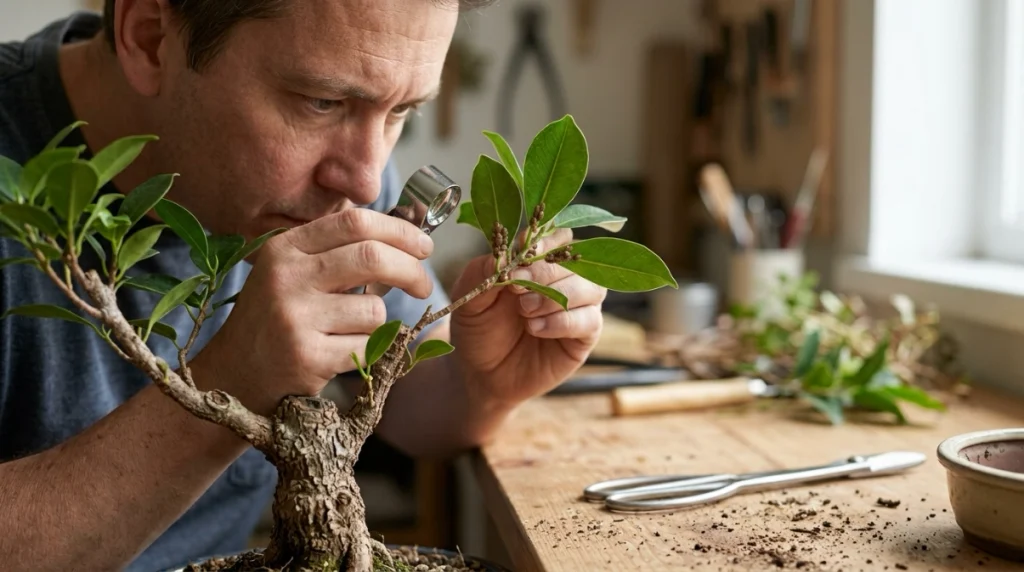
Don’t inspect only the most visible leaves. Scale often establishes itself in protected areas where routine watering and casual observation won’t disturb it.
Check these areas systematically
- Leaf undersides: Inspect along veins and near the leaf stem.
- Leaf axils: Check where leaves meet shoots.
- Young twigs: Smooth bark makes unusual bumps easier to identify.
- Branch crotches: Protected junctions can hide small infestations.
- Trunk crevices: Rough bark can conceal brown or gray scale.
- New growth: Look for weakened shoots and nearby sap-feeding insects.
- Pot rim and debris: Inspect fallen material while checking for pest spread.
New trees deserve especially careful inspection. Scale crawlers are mobile and can be transferred with infested plant material, containers, equipment, hands, and nearby contact.
The American Bonsai Society provides bonsai education and club resources, which can be useful when an unfamiliar pest needs hands-on identification.
How often should you inspect?
During active growth, I prefer a quick visual check whenever I water and a closer inspection about once a week. Newly purchased or previously infested trees deserve more frequent attention.
A good inspection doesn’t require dismantling the tree. Use bright light, rotate the pot, and inspect suspicious areas with magnification.
Section Takeaway: Scale often hides in branch junctions, leaf undersides, bark crevices, and young twigs. A systematic inspection catches far more than a quick glance at the canopy.
What Damage Does Scale Cause to Bonsai Trees?
A few scale insects don’t automatically mean a bonsai will decline. Problems become more serious when populations increase and feeding continues unchecked.
Because scale feeds from plant tissues or sap, a growing infestation can reduce vigor. Symptoms may appear gradually rather than overnight.
Common scale damage signs
- Yellowing leaves
- Premature leaf drop
- Weak or shortened new growth
- Distorted foliage or shoots
- Declining twigs
- Sticky honeydew from soft scale
- Black sooty mold growing on honeydew
- Ant activity around honeydew-producing pests
Armored scales deserve attention even when the foliage isn’t sticky. They don’t normally produce honeydew, so their feeding damage may be your stronger clue.
Soft-scale honeydew creates a different pattern. Leaves, benches, windowsills, or surfaces beneath the bonsai can feel tacky before the scale insects themselves become obvious.
Why ants can be a clue
Ants may visit honeydew-producing insects for the sugary liquid. Heavy ant traffic on a small bonsai is therefore worth investigating.
Don’t assume ants caused the original problem. Instead, inspect for soft scale, aphids, mealybugs, or other honeydew producers.
This identification-first approach follows the broader principles of integrated pest management, which combines monitoring and multiple control strategies rather than automatically reaching for pesticides.
Section Takeaway: Scale damage may show up as yellowing, weak growth, leaf drop, twig decline, or sticky honeydew. Honeydew is useful evidence, but its absence doesn’t rule out armored scale.
Is It Scale, Mealybugs, Aphids, or Something Else?
Correct identification matters because several bonsai problems create spots, bumps, or sticky leaves. Treating the wrong problem wastes time and can stress an already weakened tree.
| What You See | Possible Cause | Best Clue |
|---|---|---|
| Firm brown, gray, or white bumps | Scale | Attached tightly to leaves or woody tissue |
| White cotton-like masses | Mealybugs | Fluffy wax around joints and tender growth |
| Clusters of soft-bodied insects | Aphids | Often gather on soft shoots and buds |
| Tiny pale dots plus fine webbing | Spider mites | Stippling and mites on leaf undersides |
| Flat chalky marks | Mineral or spray residue | Often wipes away without an insect underneath |
Try the magnification test
Use a hand lens to look for body structure, crawlers, wax, eggs, or repeated shell-like coverings. Don’t scrape every mark from the bark until you’re confident it isn’t a normal feature of the tree.
University extension resources also list scale, mites, aphids, mealybugs, thrips, and whiteflies among important houseplant pests. Penn State’s home garden pest resources can help when symptoms overlap.
Section Takeaway: A stationary bump points toward scale, while cottony wax suggests mealybugs and clustered soft insects suggest aphids. Always inspect more than one symptom.
How Should You Deal With Scale on a Bonsai?
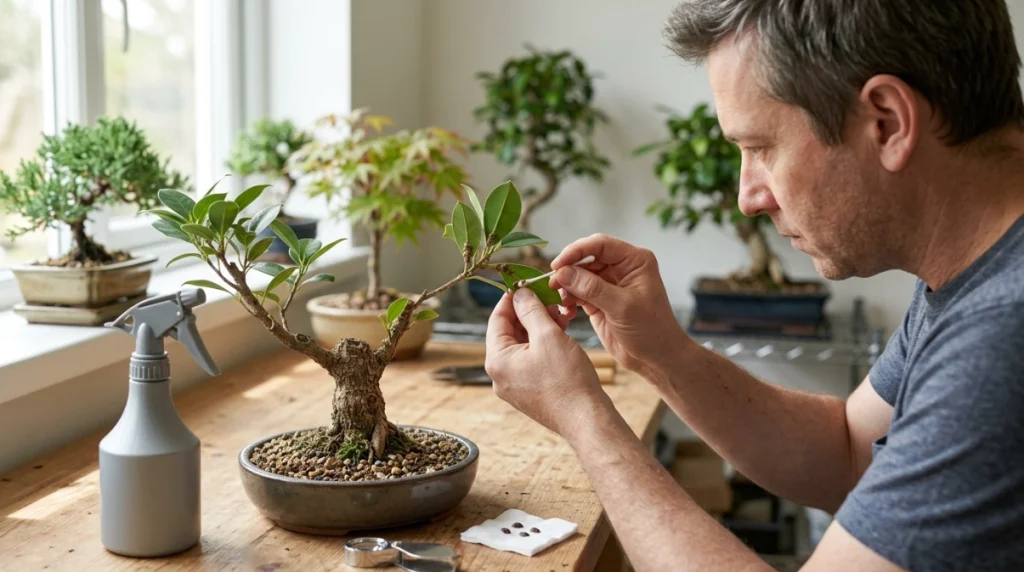
Start with identification and isolation rather than aggressive spraying. A small bonsai lets you inspect and physically remove pests more precisely than you could on a full-sized landscape tree.
1. Isolate the affected bonsai
Move the tree away from other bonsai and houseplants while you identify the infestation. Keep providing the light, temperature, and watering conditions appropriate for that species.
2. Remove manageable scale by hand
Small populations can often be reduced by gently removing individual scales with an appropriate soft tool or swab. Avoid gouging thin bark or damaging buds.
Clean fallen debris and inspect the work surface afterward. Scale crawlers are small enough to move unnoticed.
3. Remove badly infested minor growth only when justified
A heavily covered leaf or expendable twig may sometimes be easier to remove than clean individually. Don’t sacrifice an important branch merely to eliminate several insects.
Pro tip: Pruning live bonsai wood is irreversible, so keep pest-related pruning conservative. Ask an experienced grower or local bonsai club for help before removing an important structural branch.
4. Consider a labeled horticultural treatment
Horticultural oils and insecticidal soaps may be options for certain scale infestations when the product label allows their use on the plant. Thorough coverage and correct timing matter.
Crawlers and young scale stages are generally more vulnerable than mature protected stages. Repeat applications may be needed for some species, but always follow the specific label rather than using a fixed schedule from the internet.
- Confirm the product is labeled for your plant and target pest.
- Follow dilution and temperature restrictions exactly.
- Test sensitive foliage when the label recommends it.
- Avoid treating a severely drought-stressed tree.
- Keep the tree out of harsh conditions when required by the label.
- Monitor for live crawlers and fresh scale after treatment.
Broad-spectrum insecticides can also kill useful predators and parasitoids. The best choice depends on the scale species, host tree, location, and products legally registered where you live.
5. Keep checking after the visible scale disappears
One cleaning session doesn’t prove the infestation has ended. Eggs or immature stages may remain unnoticed.
Inspect the tree repeatedly for new bumps, crawlers, honeydew, ants, and fresh decline. Keep nearby bonsai under observation as well.
Section Takeaway: Isolate first, confirm the pest, physically reduce light infestations, and use labeled treatments only when needed. Continued monitoring is what tells you whether control actually worked.
Frequently Asked Questions About Scale on Bonsai
Can scale insects look like part of the bonsai bark?
Yes. Brown, tan, gray, and dark scale can blend into woody bark so well that it resembles natural texture. Compare suspicious bumps across several branches and use magnification to look for repeated shapes, coverings, crawlers, honeydew, or associated plant damage.
Does sticky foliage always mean scale?
No. Soft scale can produce sticky honeydew, but aphids, mealybugs, and whiteflies can do the same. Armored scale generally doesn’t produce honeydew, so a non-sticky bonsai can still have scale.
What are the tiny moving insects near adult scale?
They may be scale crawlers, the mobile young stage that moves before settling into a feeding location. Crawlers are often extremely small and may look yellow or orange, making a hand lens useful for confirming them.
Can scale kill a bonsai tree?
A severe, persistent infestation can weaken a bonsai enough to cause poor growth, yellowing, premature leaf loss, twig decline, and potentially serious deterioration. Small populations may cause little immediate damage, which is why monitoring pest numbers and tree vigor matters.
Should I scrape every scale insect off?
Physical removal can work well for a light infestation, especially on accessible branches. Work gently because thin bonsai bark, young shoots, buds, and delicate leaves can suffer more damage from aggressive scraping than from a few remaining scale insects.
Why did scale come back after treatment?
Eggs, protected adults, or newly emerging crawlers may survive an initial treatment. Reinfestation can also occur from another plant, which is why isolation, repeat inspections, correct treatment timing, and checking nearby plants are important.
How can I prevent scale from spreading through my bonsai collection?
Inspect new plants before placing them with established trees, quarantine suspicious bonsai, and keep tools and work surfaces clean. Regular inspections also help you catch scale while populations are still small and easier to manage.
Final Takeaway
Scale on bonsai trees usually appears as small stationary bumps in brown, tan, gray, white, or dark colors. The biggest identification clues are firm attachment, unusual repeated bumps, honeydew from soft scale, crawler activity, and gradual weakening of the tree.
Don’t treat based on appearance alone. Inspect closely, determine whether you’re dealing with armored scale, soft scale, or another pest, then choose the least disruptive control that fits your bonsai and the infestation.
Make pest inspection part of your normal watering routine. Catching ten scale insects is far easier than discovering hundreds after the foliage begins to decline.