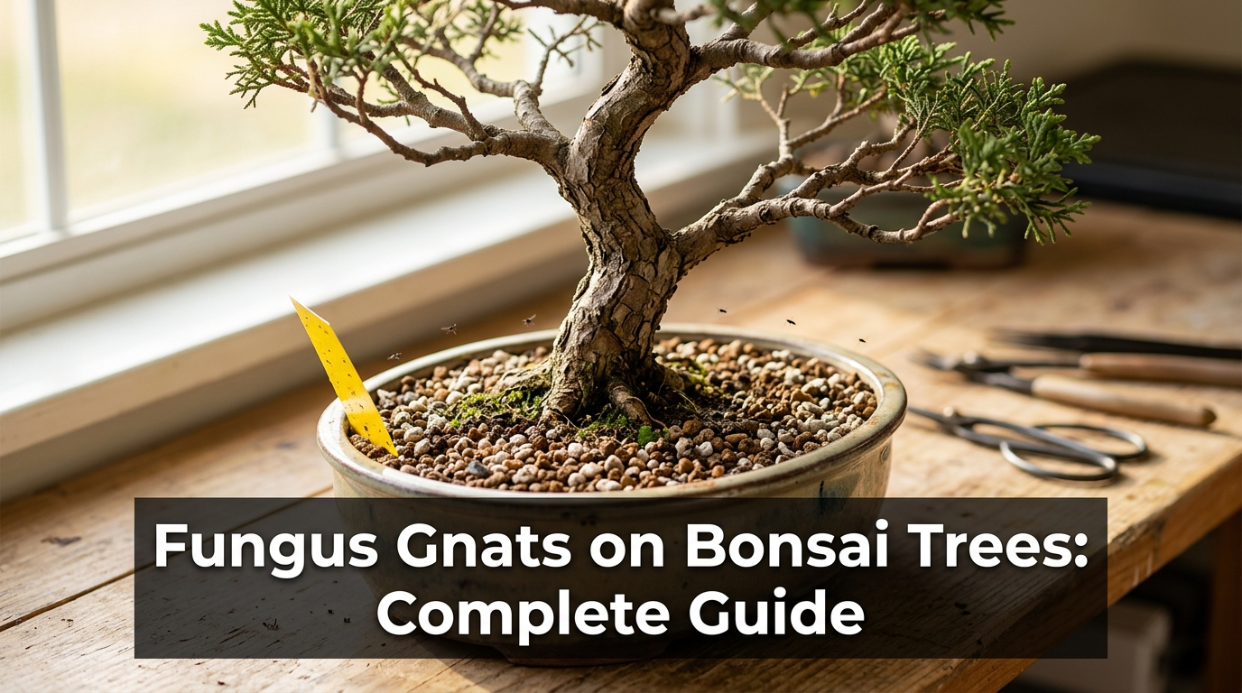
Fungus Gnats on Bonsai Trees: Complete Guide
Quick Answer
Fungus gnats on bonsai trees are tiny dark flies that breed in consistently moist growing media. The adults are mostly a nuisance, but larvae can feed on fungi, decaying material, and fine roots, so control should focus on moisture management and the larval stage rather than simply killing flying adults. The UC Integrated Pest Management fungus gnat guide also emphasizes reducing excess moisture and improving drainage.
What to do first
- Confirm the pest: Look for small mosquito-like flies around the soil and translucent larvae with dark heads.
- Check soil moisture: Constantly damp organic media is one of the strongest fungus gnat warning signs.
- Trap the adults: Yellow sticky cards help monitor and reduce flying gnats but will not eliminate larvae.
- Target the larvae: A properly labeled Bacillus thuringiensis israelensis treatment can interrupt the soil-dwelling stage.
- Improve drainage: Correct compacted soil, blocked drainage holes, standing water, and unnecessary moisture.
- Protect the bonsai: Never let a moisture-sensitive bonsai become dangerously dry just to kill gnats.
The key principle
- Treat the breeding conditions and larvae while continuing species-appropriate bonsai care.
Bonsai fungus gnats can turn watering day into a cloud of tiny flies. More importantly, their presence often tells me the growing medium is staying wetter than it should.
This 2026 guide covers identification, causes, root risks, treatment, watering, repotting, and long-term prevention without putting the bonsai through unnecessary stress.
In This Guide
- How Do I Know If My Bonsai Has Fungus Gnats?
- Why Do Fungus Gnats Keep Appearing in Bonsai Soil?
- Are Fungus Gnats Harmful to Bonsai Trees?
- How Do You Get Rid of Fungus Gnats on a Bonsai?
- How Should You Water a Bonsai With Fungus Gnats?
- Should You Repot or Quarantine an Infested Bonsai?
- How Do You Prevent Fungus Gnats From Coming Back?
- Fungus Gnats on Bonsai Trees FAQ
How Do I Know If My Bonsai Has Fungus Gnats?
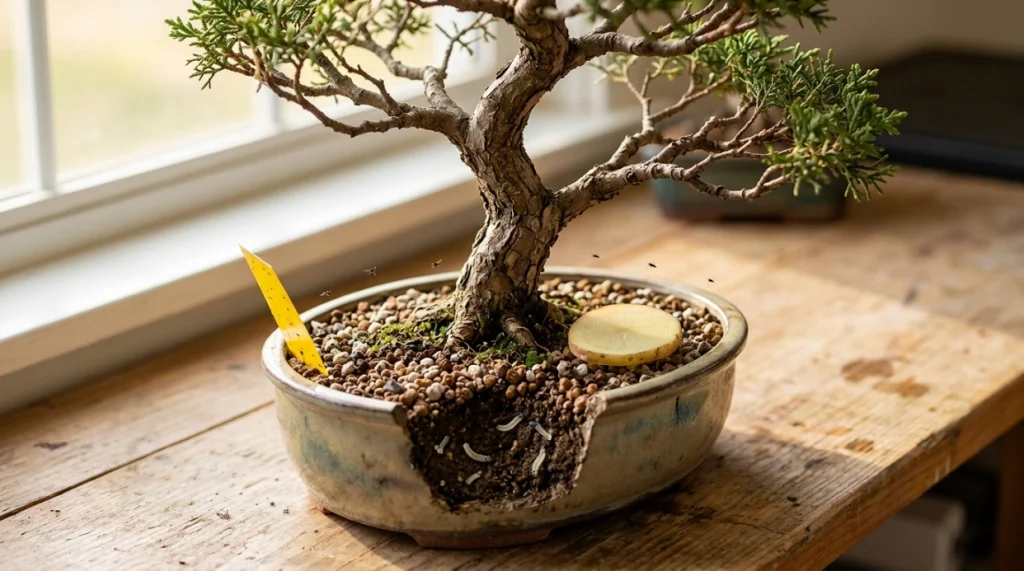
Fungus gnats are small, dark, mosquito-like flies commonly associated with moist container media. Adults usually stay close to the pot, soil surface, nearby shelves, or windows.
Definition: Fungus gnats are small flies, commonly from the family Sciaridae, whose larvae develop in moist organic material and growing media.
What do adult fungus gnats look like?
Common adults measure roughly 1/16 to 1/8 inch long. They have narrow bodies, long legs, long antennae, and clear to grayish wings.
One useful clue is their weak, short-distance flight. They often hop or flutter around the pot instead of flying strongly across the entire room.
- Color: Usually dark gray to black.
- Shape: Slender and mosquito-like.
- Location: Close to soil, pots, windows, and plants.
- Behavior: Short, erratic flights around growing media.
- Size: Commonly around 1/16 to 1/8 inch.
What do fungus gnat larvae look like?
The larvae are much easier to miss. They live inside moist growing media rather than flying above it.
Mature larvae look like tiny translucent or whitish worms with a distinct dark head capsule. Fine organic material around the root zone gives them both shelter and food.
- Check the upper layer of moist media.
- Look near decaying moss or organic top dressing.
- Inspect badly decomposed potting material.
- Check beneath continuously damp surface debris.
How can I confirm fungus gnats?
I start with a yellow sticky card placed just above the pot. A growing number of tiny dark flies over several days strongly supports the diagnosis.
A raw potato slice can also help monitor larvae. Place a small slice cut-side down on the surface and inspect the underside after a few days.
The Colorado State University Extension fungus gnat guidance describes both sticky traps and potato pieces as useful monitoring methods.
Section Takeaway: Confirm the pest before treating it. Adults tell you fungus gnats are present, while larvae and persistently moist media reveal where the population is developing.
Why Do Fungus Gnats Keep Appearing in Bonsai Soil?
Fungus gnats usually persist because the pot gives their larvae a reliable moist habitat. Killing adults without changing that habitat allows another generation to emerge.
Constant moisture is the biggest clue
Females seek damp growing media for egg laying. Moisture also encourages fungi and decomposing organic matter that larvae consume.
This is why a bonsai that never approaches an appropriate drying point can develop recurring gnat populations.
- Frequent watering: Watering again before the tree needs it keeps the surface continuously damp.
- Dense organic soil: Peat-heavy or degraded media can remain wet longer than a coarse bonsai mix.
- Poor drainage: Blocked holes or compacted substrate slow water movement.
- Standing water: A pot left in drainage water stays wetter for longer.
- Dead material: Old leaves, moss, roots, and decomposing debris provide organic matter.
Why bonsai pots can make diagnosis confusing
Bonsai containers are shallow, so moisture can change quickly. A surface that looks dry does not always mean the entire root mass is dry.
The opposite also happens. Fine organic particles may keep the root zone damp even when the top looks acceptable.
I therefore judge moisture by the actual substrate, pot weight, weather, species, and recent watering. A fixed schedule such as “every two days” misses too many variables.
Does fungus cause the gnats?
The name can be misleading. Fungus gnats do not mean your bonsai automatically has a serious fungal disease.
Their larvae naturally consume fungi and decaying organic material. Persistent gnats are often a moisture-management clue rather than proof of an infected tree.
Why do they become worse indoors?
Indoor plants often use water more slowly during cooler or lower-light periods. If watering stays unchanged, the medium may remain wet for much longer.
Indoor tropical bonsai can also share fungus gnats with nearby houseplants. One constantly wet pot may maintain the population for the entire group.
Section Takeaway: Repeated fungus gnats usually point to a repeating environmental condition. Find the moisture source, because trapping adults alone does not remove their breeding habitat.
Are Fungus Gnats Harmful to Bonsai Trees?
Adult fungus gnats are mainly a nuisance and do not bite people. The larvae matter more because they live around the roots.
Larvae mainly feed on fungi, algae, and decaying organic material, but they can also feed on fine roots and root hairs.
Healthy mature bonsai versus weak trees
A vigorous established bonsai may tolerate a small fungus gnat population without obvious injury. Young, weak, recently rooted, or stressed plants have less margin for root damage.
This distinction matters. A few adults do not automatically mean a mature bonsai is dying.
- Lower concern: A vigorous established tree with normal growth and only occasional adults.
- Higher concern: Large numbers of adults emerging after watering.
- Higher concern: Visible larvae throughout wet media.
- Higher concern: Seedlings, cuttings, or newly established bonsai.
- Higher concern: Weak roots, poor drainage, wilting, or persistent yellowing.
Do fungus gnats cause root rot?
Fungus gnats do not automatically cause root rot. However, the same consistently wet conditions that support gnats can also damage roots and favor some root diseases.
That overlap causes many mistaken diagnoses. The gnats may be a symptom of the root-zone environment rather than the main cause of decline.
Warning signs that need more investigation
If the tree looks unhealthy, inspect the entire care routine rather than blaming every symptom on gnats. Bonsai decline can come from watering, light, temperature, disease, fertilizer problems, or damaged roots.
- Persistent wilt while the substrate remains wet.
- Yellowing that continues despite appropriate light.
- Weak or shortened new growth.
- Unexplained leaf drop.
- Dark, soft, or foul-smelling roots during a justified root inspection.
- Water that drains unusually slowly.
The University of Minnesota Extension indoor plant pest guidance notes that fungus gnats are generally more of a nuisance, while overwatering and poor drainage can also contribute to root problems.
That is the pattern I watch most closely. A gnat problem becomes a bonsai-care problem when the environment supporting the gnats is also compromising healthy roots.
How Do You Get Rid of Fungus Gnats on a Bonsai?
The most reliable approach combines adult monitoring, larval control, sanitation, and better moisture management. No single trap addresses the complete life cycle.
At around 75°F, UC IPM reports that development can move from egg to adult in roughly 17 days under favorable conditions. That is why one successful treatment day does not necessarily end the infestation.
Step 1: Isolate the affected pot when practical
Move the bonsai away from other indoor plants if several pots share the same space. This makes monitoring easier and reduces movement between containers.
Keep the tree in conditions appropriate for its species. Do not move a sun-loving outdoor bonsai into a dark room merely for quarantine.
Step 2: Put yellow sticky traps near the soil
Sticky cards capture adults and show whether the population is rising or falling. Place them close enough to the pot to catch low-flying gnats.
Replace heavily covered traps when needed. Continue monitoring even after the number of adults falls.
Step 3: Correct unnecessary moisture
Allow the surface to approach an appropriate drying point before watering again. The goal is not to dehydrate the tree.
Species, pot size, soil composition, temperature, wind, light, and season still determine when a bonsai needs water.
Step 4: Remove breeding material
- Pick out fallen leaves.
- Remove decaying flowers or fruit.
- Clean decomposing organic debris.
- Remove standing drainage water.
- Check whether surface moss is remaining constantly saturated.
- Make sure drainage holes are functioning.
Step 5: Target larvae when needed
Bacillus thuringiensis subspecies israelensis, commonly shortened to Bti, is a biological control used against certain fly and mosquito larvae. Products must be labeled for the intended use and applied exactly according to their directions.
Bti targets larvae rather than solving adult activity instantly. Keep sticky traps in place while the existing adults finish their short life cycle.
Step 6: Consider beneficial nematodes for persistent infestations
The beneficial nematode Steinernema feltiae is used commercially against fungus gnat larvae. It can be useful where environmental conditions and product instructions suit the treatment.
Storage, water temperature, application method, and soil conditions affect living biological controls. Follow supplier instructions carefully.
| Control Method | Main Target | Best Use | Bonsai Consideration |
|---|---|---|---|
| Yellow sticky traps | Adults | Monitoring and reducing egg-laying adults | Low plant risk, but not a larval treatment |
| Moisture correction | Breeding conditions | Foundation of long-term control | Never dry the root ball beyond species tolerance |
| Bti treatment | Larvae | Active infestations in growing media | Use only a correctly labeled product |
| Steinernema feltiae | Larvae | Biological control programs | Living organisms require correct handling |
| Repotting | Infested or degraded media | When soil or root condition already justifies repotting | Root disturbance can seriously stress a bonsai |
What about neem oil, hydrogen peroxide, or cinnamon?
I do not make these my first response to a bonsai fungus gnat problem. Concentrations, formulations, phytotoxicity, and root sensitivity can vary too much for casual experimentation.
Some pesticide products containing neem-derived ingredients may be labeled for fungus gnat management. That is different from mixing an unverified homemade soil drench.
Likewise, hydrogen peroxide can injure living tissues at unsuitable concentrations. A bonsai’s compact root system is not the place where I want to guess.
Section Takeaway: Break the life cycle instead of chasing individual flies. Combine monitoring, correct watering, sanitation, and a properly labeled larval treatment when the infestation requires it.
How Should You Water a Bonsai With Fungus Gnats?
Water according to the tree’s needs while avoiding unnecessary continuous moisture. Do not use fungus gnats as a reason to let the entire root system become dangerously dry.
Why common houseplant advice needs adjusting for bonsai
Some fungus gnat guidance recommends drying the top 1 to 2 inches of potting mix. Many bonsai pots are only a few inches deep, so that instruction cannot be copied literally.
A shallow pot can move from safely moist to dangerously dry quickly. Fine feeder roots near the surface may also dry first.
Use the substrate, not the calendar
I prefer a moisture check before every watering. The exact interval changes throughout the season.
- Look: Observe surface color and dampness.
- Touch: Check accessible substrate where appropriate.
- Lift: Learn how the pot feels when wet versus approaching watering time.
- Watch drainage: Slow drainage can indicate compaction or deterioration.
- Consider weather: Heat and wind can shorten drying time dramatically.
Water thoroughly when the tree needs water
Reducing watering frequency does not mean giving tiny sips. When the bonsai needs water, wet the root mass properly and let excess water drain freely.
Repeated shallow sips can leave parts of the root system dry while keeping the surface attractive to gnats.
Choose a better-draining substrate when appropriate
A good bonsai substrate balances drainage, oxygen, moisture retention, and structural stability. Common components include akadama, pumice, lava rock, calcined clay, and bark in species-appropriate combinations.
No universal ratio fits every bonsai. A juniper outdoors in a wet climate may need a different balance from a tropical ficus growing indoors.
The general principles taught by Bonsai Empire also emphasize species-specific care and careful watering because bonsai grow in small containers with limited water reserves.
Should I remove moss?
Healthy moss is not automatically a fungus gnat problem. However, thick constantly wet moss can make it harder to judge surface moisture and may keep organic material damp.
For an active infestation, temporarily reducing heavy top dressing can improve inspection. Preserve valuable presentation moss separately if needed.
Section Takeaway: The goal is a healthy wet-to-dry rhythm, not drought. Water thoroughly when needed, then let the substrate move toward an appropriate drying point before watering again.
Should You Repot or Quarantine an Infested Bonsai?
Quarantine is often useful, but emergency repotting is not automatically necessary. Repot because the soil or roots justify it, not simply because a few gnats are flying.
When quarantine makes sense
Separate an actively infested indoor bonsai from nearby houseplants and other bonsai when practical. Fungus gnats can move between suitable moist containers.
- Keep the tree in appropriate light.
- Maintain suitable temperature and airflow.
- Use a dedicated sticky trap.
- Inspect neighboring pots.
- Clean standing water and organic debris from the area.
When repotting may be justified
Repotting becomes more reasonable when the growing medium itself is failing. Old compacted media can remain wet, lose structure, and make both root health and fungus gnat management harder.
- The soil drains abnormally slowly.
- The substrate has broken down into fine material.
- The pot remains wet much longer than expected.
- Root disease is reasonably suspected.
- The tree is already due for seasonal repotting.
- The infestation remains severe despite correcting its breeding conditions.
Repotting still has to match the species and season. Temperate bonsai, tropical trees, conifers, and deciduous species tolerate root disturbance differently.
Pro tip: Root pruning is irreversible. If a valuable, weak, old, or unfamiliar bonsai needs major root work, consult an experienced grower or local bonsai club before cutting healthy roots.
When not to repot
Do not automatically bare-root a healthy bonsai because three gnats landed on a sticky card. The treatment can become more stressful than the pest.
A poorly timed repot can reduce water uptake and weaken recovery. Start with identification, monitoring, drainage, sanitation, and larval management unless root conditions require more.
What if the roots already look unhealthy?
Persistent wilt in wet soil, poor drainage, sour-smelling media, and progressive decline deserve closer investigation. Fungus gnats may be present alongside a separate root problem.
Do not assume every dark root is diseased without understanding the species and substrate. If extensive root removal appears necessary, get experienced help.
Section Takeaway: Quarantine is low-risk and useful for monitoring. Repotting should remain a horticultural decision based on roots, soil condition, species, and season.
How Do You Prevent Fungus Gnats From Coming Back?
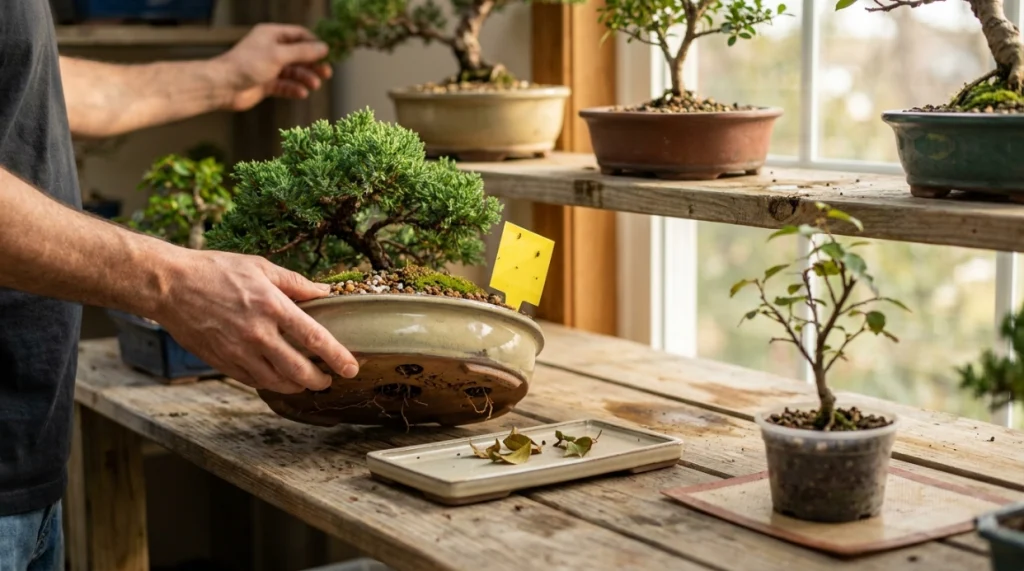
Long-term prevention comes from making the root zone less suitable for uncontrolled fungus gnat reproduction. Healthy bonsai culture does most of the work.
Build a simple prevention routine
- Inspect while watering: Watch for tiny flies moving from the soil.
- Water by need: Stop following a rigid calendar.
- Keep drainage open: Check holes, screens, and compacted substrate.
- Remove debris: Do not leave decaying foliage on wet soil.
- Monitor new plants: Separate new acquisitions before placing them beside a collection.
- Check neighboring pots: Houseplants can maintain the same infestation.
- Replace degraded soil: Repot at the correct seasonal time when structural breakdown becomes a problem.
Do not rely permanently on sticky traps
A sticky card is an excellent early-warning system. It is a poor substitute for correcting the breeding environment.
If traps fill again every week, find the wet container sustaining the population. That may not even be the bonsai where you first noticed the adults.
Check new trees before they join the collection
New bonsai, nursery plants, and houseplants can bring pests into an indoor growing area. Give new plants a separate observation period whenever space allows.
Inspect the foliage, trunk, pot rim, drainage holes, and soil surface. A sticky card can reveal flying insects that were easy to miss during purchase.
Match care to the species
Good pest prevention starts with growing the tree correctly. An outdoor juniper, indoor-suitable tropical ficus, deciduous maple, and pine do not share identical moisture or environmental needs.
For broader bonsai education and access to clubs and experienced growers, the American Bonsai Society is also a useful starting point.
My practical rule
When I see fungus gnats, I treat them as information first. They tell me to inspect moisture, drainage, organic debris, neighboring plants, and the condition of the substrate.
That mindset prevents overreaction. It also solves the environmental problem that allowed the gnats to multiply.
Section Takeaway: Prevention is mostly good bonsai culture. Keep roots appropriately aerated, avoid continuous unnecessary moisture, remove decaying material, and inspect the collection regularly.
Fungus Gnats on Bonsai Trees FAQ
Will fungus gnats kill a bonsai tree?
A small population usually will not kill a healthy established bonsai. Heavy larval populations can feed on fine roots, while the persistently wet conditions supporting the gnats may create a larger root-health problem.
Can fungus gnats live in inorganic bonsai soil?
They can still appear if moisture and organic food sources are available. However, a coarse, free-draining substrate with little decomposing organic material is generally less favorable than constantly wet peat-rich media.
Do yellow sticky traps get rid of fungus gnats completely?
No. Sticky traps capture adult fungus gnats and help track population changes, but eggs, larvae, and pupae remain in the growing medium.
Use traps as part of a broader control program rather than the only treatment.
How long does it take to get rid of fungus gnats?
Expect control to take more than a few days because several life stages may already be present. Under favorable warm conditions, fungus gnats can complete a generation in roughly two to four weeks, depending on temperature and species.
Can I let my bonsai dry out completely to kill fungus gnats?
No. Severe drying can damage a bonsai’s fine root system before it solves the infestation.
Let the growing medium approach the appropriate watering point for that species, then water thoroughly and allow free drainage.
Are fungus gnats a sign of overwatering?
They are strongly associated with persistently moist growing media, so they are a useful warning sign. Their presence does not prove that every bonsai is being overwatered, because substrate composition, temperature, drainage, and neighboring pots also matter.
Should I use insecticide immediately?
Not necessarily. Start by confirming the pest and correcting moisture or sanitation problems.
If larval treatment is needed, choose a product specifically labeled for the intended plant, pest, and application method, then follow the label exactly.
Final Takeaway
Fungus gnats on bonsai trees are manageable once you stop treating them as only a flying-insect problem. The adults are the visible stage, but moisture and larvae in the growing medium keep the cycle going.
Confirm the pest, monitor adults, improve drainage, remove decaying material, and target larvae when necessary. Most importantly, protect the bonsai’s roots while you do it.
If gnats keep returning, recheck the whole growing area. The wettest pot on the shelf is often where the real problem is hiding.