How Often Water Bonsai Trees Need: A Simple Frequency Guide

How often water bonsai trees need is the question every beginner asks, and the honest answer is: as often as the soil starts to dry, which for most trees means daily outdoors in summer and every two to seven days the rest of the time. Indoor trees usually need water every two to four days. Those are only averages. The real frequency for your tree depends on six things: pot size, soil, species, season, sun and wind, and indoor heating. Once you understand them, you can predict your tree’s needs and confirm them with a quick finger test.
In this guide
- The quick answer by tree type
- The 6 factors that decide how often to water
- How to check if your bonsai needs water
- Signs you are watering too often or too rarely
- Does the amount matter as much as the frequency?
- What if you cannot check every day?
- Example: one tree, four different answers
- Common mistakes
- FAQ: how often water bonsai
- Final thoughts
The quick answer by tree type
| Tree | Indoors | Outdoors in summer | Outdoors in winter |
|---|---|---|---|
| Ficus | Every 2 to 4 days | Daily | Bring inside |
| Jade | Every 5 to 10 days | Every 2 to 3 days | Bring inside |
| Chinese elm | Every 2 to 3 days | Daily | Every 5 to 7 days |
| Juniper | Not recommended indoors | Daily | Every 5 to 10 days |
| Japanese maple | Not recommended indoors | Daily, often twice | Every 5 to 10 days |
| Azalea | Not recommended indoors | Daily, often twice | Every 3 to 7 days |
| Schefflera | Every 3 to 5 days | Daily | Bring inside |
| Serissa | Every 2 to 3 days | Daily | Bring inside |
Use these as starting points. Then adjust using the six factors below.
The 6 factors that decide how often to water
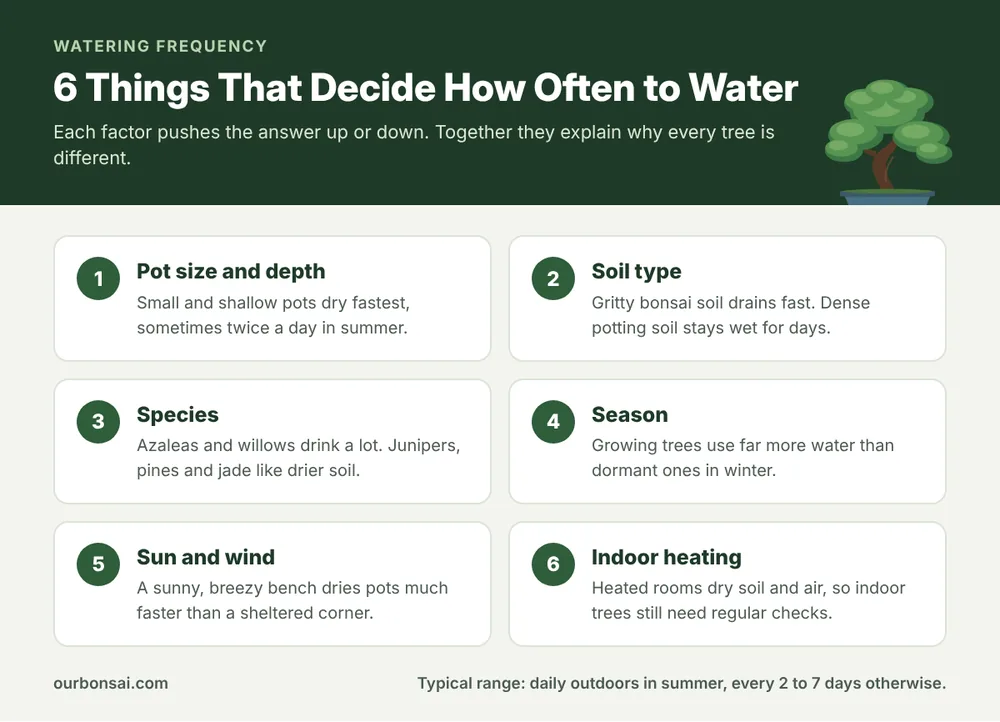
1. Pot size and depth
A tree in a shallow 10 cm pot has very little soil to hold water and can dry out in hours on a hot day. The same tree in a deep training pot might go two or three days. Small “mame” and shohin bonsai are the most demanding to keep watered.
2. Soil type
Gritty bonsai soil made of akadama, pumice and lava drains in seconds and dries out in a day or two in warm weather. That sounds like more work, but it is much safer, because you can water generously without drowning the roots. Dense, peat-based potting soil holds water for days, which makes underwatering less likely and root rot much more likely. Our guide to bonsai soil vs regular soil explains the trade-off.
3. Species
Some trees are naturally thirsty: azaleas, willows, bald cypress, hornbeam. Others prefer to dry a little between waterings: junipers, pines, olives and succulents like jade. Knowing your species saves you a lot of guesswork. See our bonsai species overview if you are not sure what you have.
4. Season
Trees use most water when they are growing and in leaf, from spring through summer. In autumn, growth slows. In winter, deciduous trees drop their leaves and evergreens rest, so water use falls sharply. A deciduous tree that needed water daily in July may only need it once a week in January.
5. Sun, wind and temperature
Plants lose water through their leaves in a process called transpiration, which speeds up with heat, sun, wind and dry air. A pot on a sunny, windy balcony can need twice as much water as one in a sheltered corner. Our guide on watering bonsai in summer covers how to manage heat waves.
6. Indoor heating and air conditioning
Indoor trees live in a gentler climate, so they usually need water less often than outdoor ones. But heating in winter and air conditioning in summer dry both the soil and the air. A tree near a radiator can dry out almost as fast as an outdoor one. Our guide to watering indoor bonsai in winter explains how to adapt.
How to check if your bonsai needs water
The factors tell you roughly when to look. These checks tell you whether to water.
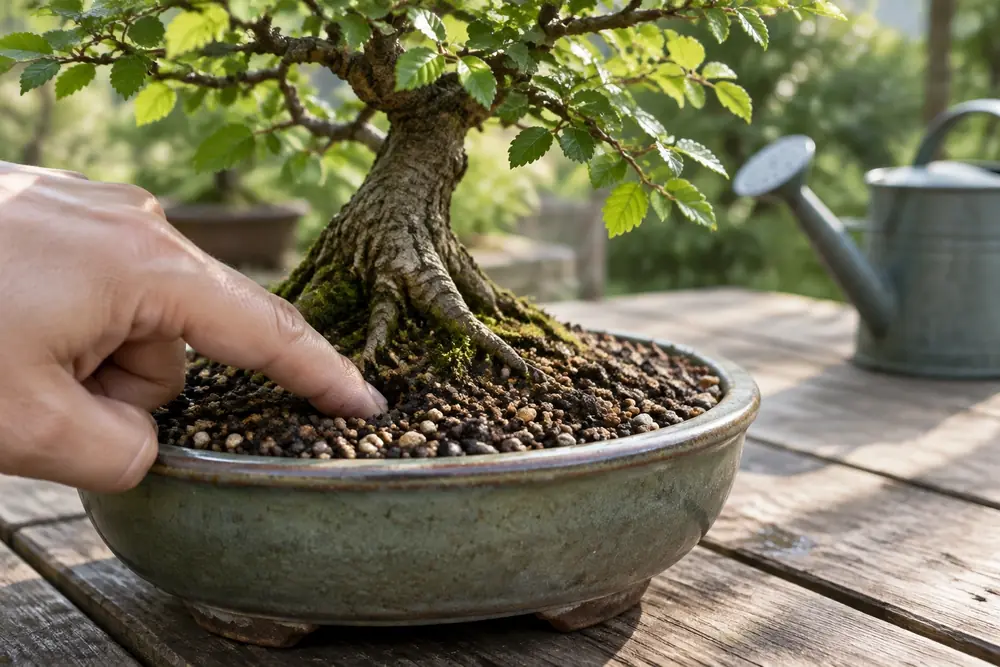
- Finger test: Push a finger about 1 cm into the soil. Dry at that depth means water now.
- Color: Most bonsai soils turn lighter as they dry.
- Weight: A dry pot feels noticeably lighter than a freshly watered one.
- Chopstick: Push a wooden chopstick into the soil for 10 minutes. Dark and damp means wait.
- Moisture meter: A cheap soil moisture meter is handy for indoor trees.
Check every day. It only takes a few seconds per tree, and it is the habit that keeps bonsai alive.
Signs you are watering too often or too rarely
| Watering too often | Watering too rarely |
|---|---|
| Soil always dark and wet | Soil pulling away from the pot edge |
| Yellow leaves, starting low on the tree | Drooping, then crispy leaves |
| Green algae or moss spreading fast | Water running straight off the surface |
| Sour smell, soft roots | Leaf tips browning, sudden leaf drop |
If you see the left column, read our guide to root rot in bonsai. If you see the right column, soak the pot in a basin of water for 10 minutes, then check more often.
Does the amount matter as much as the frequency?
Yes. Whenever you water, water thoroughly, until water runs out of the drainage holes. Wait a minute and water again. Small sips every day keep the top wet and the bottom dry, which leads to weak, shallow roots. Deep, complete watering, followed by letting the top dry slightly, is what healthy roots need. A fine-rose can like those in our best Japanese watering can for bonsai guide helps you water slowly without washing soil out.
What if you cannot check every day?
For a busy week, move outdoor trees into light shade, group them together and water well in the morning before you leave. For longer absences, an automatic system or a helper is the safer option. Our guide to the best automatic watering system for bonsai compares choices.
Example: one tree, four different answers
Take a single Chinese elm in a 20 cm pot of gritty soil. In July on a sunny bench it needs water every day. Moved into the shade during a heat wave, it might go a day and a half. In October it drops to every two or three days. In January, in a sheltered spot outdoors, it might go a week. Same tree, same pot, same soil: four completely different answers. That is exactly why checking beats counting.
Common mistakes
- Following one fixed number. “Every three days” will be wrong half the time.
- Treating all trees the same. Group trees by thirst and check each one.
- Watering wet soil because it is “watering day”. Always check first.
- Forgetting dormant trees in winter. They need less water, not none.
FAQ: how often water bonsai
How often should I water a bonsai tree indoors?
Usually every two to four days, but check the soil daily. Trees near heaters may need water more often.
Should I water my bonsai every day?
Outdoors in summer, most bonsai do need water every day. Indoors and in cooler seasons, usually not. Check before watering.
How do I know if I am overwatering my bonsai?
The soil stays wet for days, leaves yellow and drop, and the roots may smell sour. Let the soil dry slightly between waterings.
Is it better to water bonsai in the morning or evening?
Morning is best. The tree has water for the warm part of the day and the leaves dry before night.
Final thoughts
So, how often water bonsai trees need comes down to six factors: pot, soil, species, season, sun and heating. Use the table above as a starting point, check the soil every day, and water thoroughly whenever it starts to dry. After a few weeks you will know each of your trees’ rhythms by heart. For a complete overview of daily care, see our main bonsai care guide.